

Berlin’s legendary queer nightclub SchwuZ has announced that it will close its doors for good on November 1, marking the end of an era for Germany’s oldest LGBTQ+ venue and a new chapter in Berlin’s ongoing “Clubsterben” — the so-called death of clubs.
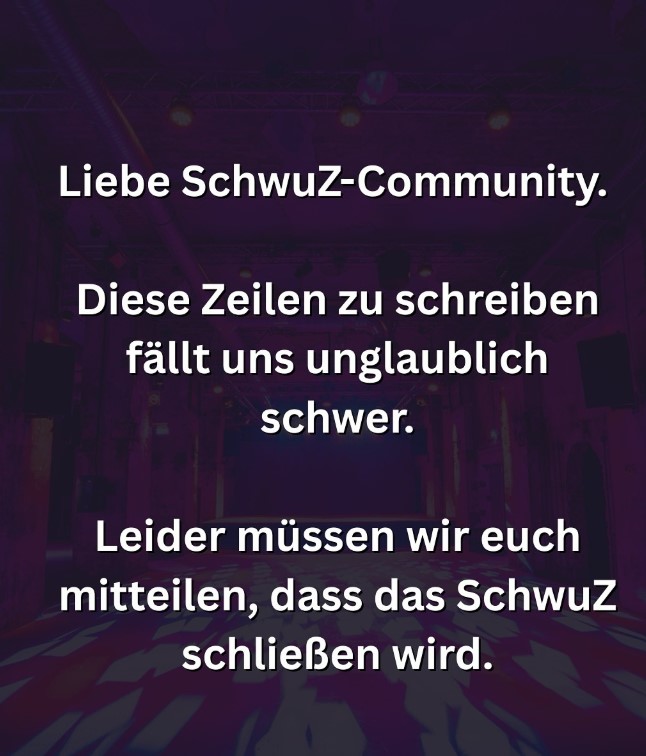
“Unfortunately, we must inform you that SchwuZ will be closing its doors,” the Neukölln-based club wrote on Instagram. Founded in 1977, SchwuZ has long held a central place in Berlin’s queer and nightlife scenes, known for its inclusive ethos and sprawling 1,600-square-meter industrial venue.
The closure comes after months of financial struggle. Earlier this year, management filed for bankruptcy protection as costs soared. In September, general manager Katja Jäger told AFP that inflation, high rent, and reduced customer spending had left the cooperative-run club facing monthly losses of about €50,000.
A Failed Rescue Effort
Sur July, SchwuZ announced layoffs affecting about a third of its 100 staff members and launched a crowdfunding campaign to raise €300,000 to avoid insolvency. Despite a rallying cry — “We stay if you stay” — the campaign gathered just over €52,000 in pledges. Efforts to attract investors also failed, the club said in its statement: “After intensive discussions, no party could be found willing or able to take over the club.”
Economic Pressures on Berlin’s Nightlife
SchwuZ’s closure underscores a wider crisis for Berlin’s world-famous nightlife. Since the COVID-19 pandemic, dozens of clubs — including Griessmühle, Remiseet Watergate — have shuttered or downsized due to rising rents, tightened zoning rules, and changing nightlife habits.
According to the Berlin Clubkommission, which represents over 200 venues, as many as 40 clubs have closed in the last five years. Industry groups blame inflation and gentrification, as well as reduced disposable income among younger patrons.
“Before, regulars would come every weekend, sometimes twice,” Jäger explained. “Now they might come once a month — and drink less.”
Berlin’s government has pledged to support nightlife spaces as cultural institutions through targeted subsidies and zoning protections, yet for some clubs, including venues central to queer community life, that assistance is coming too late.

A Symbolic Loss for Queer Berlin
SchwuZ’s influence extends beyond nightlife. Over nearly five decades, it became a refuge for queer expression, drag, activism, and art — a place where generations of Berliners came to celebrate diversity. Its closure resonates like a cultural loss as much as an economic one.
As one longtime visitor wrote on social media: “SchwuZ wasn’t just a club. It was home.”
Vous aimerez aussi
-

Queens of the South: When Nice Turns Carnival into Queer Celebration
On 27 February 2026, Place Masséna in Nice will shimmer a little brighter. Lou Queernaval,
-

Cœur de pirate at AB: the runaway pop of a queer icon lands in Brussels
A major figure in Francophone pop and an outspoken voice in the queer community, Cœur de pirate
-

When the Unseen History: [IN]VISIBLE Festival Turns KBR into an Augmented Reality Lab
From 25 to 27 March 2026, the Royal Library of Belgium (KBR) hosts [IN]VISIBLE Festival:
-

Safer on Paper, Not in Reality”: ILGA Warns of Rising Anti-LGBTQIA+ Violence in Belgium
Belgium still ranks among Europe’s most protective countries for LGBTQIA+ people on paper – yet
-

“March Is for the Queers”: Why You Should Put Queer March Ghent 2026 on Your Radar
Every March, Queer March turns Ghent into a month-long celebration of queer life, resistance, and
 Français de Belgique
  English
  Nederlands (België)