
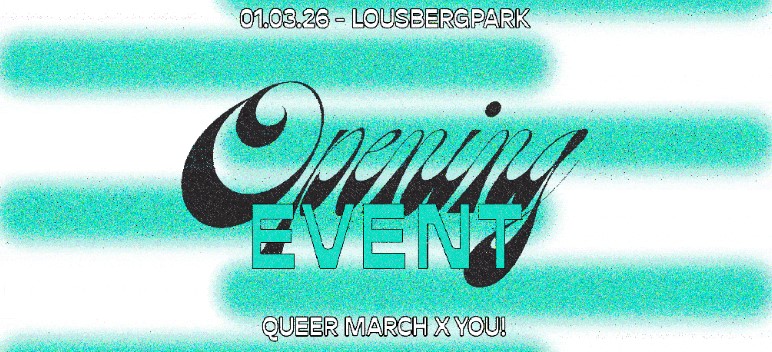
Every March, Queer March turns Ghent into a month-long celebration of queer life, resistance, and community care. With talks, workshops, art, parties, and strong political messaging against rising anti-queer and anti-trans sentiment, it’s becoming one of Belgium’s most important grassroots queer events. Here’s why Brussels queers should care – and how to plug in.
Queer March has a simple but powerful slogan: “March is for the queers.” Each year, the initiative transforms the month of March into a sprawling, city-wide queer festival in Ghent, built around community, solidarity, and political awareness. Instead of just one parade day, Queer March creates a full ecosystem of events where people can meet, organise, learn, and party – and it’s designed with accessibility and grassroots empowerment at its core.
What is Queer March?
Queer March is a Ghent-based initiative that aims to unite the city’s queer community around a wide range of activities spread across the month of March. It’s not just a march: it’s a programme of talks, workshops, art, fairs, and nightlife, all explicitly framed as a response to the growing wave of anti-queer and anti-trans discourse in Flanders and beyond.
Their mission is fourfold:
- Connect queer people and organisations
- Empower the queer community
- Educate and foster open dialogue
- Celebrate queer pride and diversity
In their own words, “Together, we stand stronger in facing the rising tide of anti-queer and anti-trans sentiment. While extreme right-wing voices grow louder, unison matters more than ever.”
More info:
👉 About Queer March: https://queermarch.be/over/
How Queer March supports the community
Queer March isn’t just an events brand; it’s a resource engine for Ghent’s queer community.
They:
- Collect funds and redistribute them to queer organisations and initiatives, thanks in part to subsidies from the City of Ghent. This financial support helps keep events affordable or even free.
- Foresee spaces – mainly queer-owned – and make them available for community events, offering infrastructure to smaller collectives who might not have access to venues.
- Organise their own activities, such as panel talks, art exhibitions, and parties, often in partnership with local queer spaces.
Some of their partner spaces for 2025 include Chopin Chopin, Vol Pension et Geheel De Uwe, highlighting a strong link to Ghent’s independent queer and queer-friendly venues.
A taste of what to expect: past editions
Looking at Queer March 2024 gives a good idea of the vibe and scope. On 30 March 2024, they took over De Vooruit (now VIERNULVIER) in Ghent for a packed day of activities:
- Panel talks such as “Pride in crisis?” et “Queer belonging”, questioning the future of Pride and exploring what it means to build queer home and community.
- Workshops including “Feminizing techniques” et “Coffee & Families”, mixing practical tools with space for intergenerational and family-focused conversations.
- A fair featuring queer organisations and queer-owned businesses, giving visibility to grassroots initiatives and local entrepreneurs.
- Plenty of time to connect, reflect and have a good time, with social spaces to meet new people or catch up with old friends.
Expect Queer March 2026 to build on this model: political, practical, joyful, and community-centred – with a programme that stretches far beyond a single day.
Stay tuned via:
👉 Website: https://queermarch.be/
👉 About page: https://queermarch.be/over/
Read also : 2026 Global & European Pride Calendar: Dates & Destinations
Why this matters for Brussels queers
For LGBTQIA+ people in Brussels, it’s easy to focus on Brussels Pride and local parties, but Queer March offers something complementary: a month-long, explicitly political and community-powered project just a short train ride away. In a context where far-right and anti-trans narratives are gaining traction across Belgium, Ghent’s Queer March is a living example of how cities can resource their communities – not just symbolically, but materially.
It’s also a great opportunity for cross-city alliances: Brussels-based collectives, artists, performers, activists and community groups can bring their work to Ghent, collaborate with local organisers, or simply show up and lend support. Think of it as a queer bridge between Ghent and Brussels – a chance to build networks that we’ll need as the political climate toughens.
If you’re planning your 2026 queer calendar, don’t just block the date for Brussels Pride. Save March as well – and make room for at least one weekend (or more) in Ghent.
KET Magazine is a community‑driven, non‑profit magazine run by volunteers based in Brussels. Get in touch to share your thoughts or tell us about your activities. You can also promote your events on our website or support our work with a donation. Contact us at Info@ket.brussels.
You may also like
-

Queer feet, green beats: Paradise City gets your summer moving (softly)
From 26 to 28 June, Paradise City returns to Kasteel de Ribaucourt in Perk with
-

Queer Paris in Your Pocket: A New Guide to the City’s LGBTQIA+ Memory and Momentum
Released on 4 June by First, Queer Paris is a new pocket guide that maps out the French capital through
-

Let Your Heart Be Heard: The Queer Finale Brussels Has Been Warming Up For
After months of rehearsals, teasers and city‑wide build‑up, Various Voices Brussels 2026 is heading towards its big
-

One Last Warm-Up: Brussels Still Has Time to Join the Biggest LGBTQI+ Choir at ING Arena
Brussels has already been singing queer for weeks, and now one of the most open
-

Dress to Bury the Old World: A Queer Funeral for Dictators at AB
On Friday 5 June, Ancienne Belgique turns into a political dancefloor with “DICTATOR’S FUNERAL”, a
 Français de Belgique
  English
  Nederlands (België)