
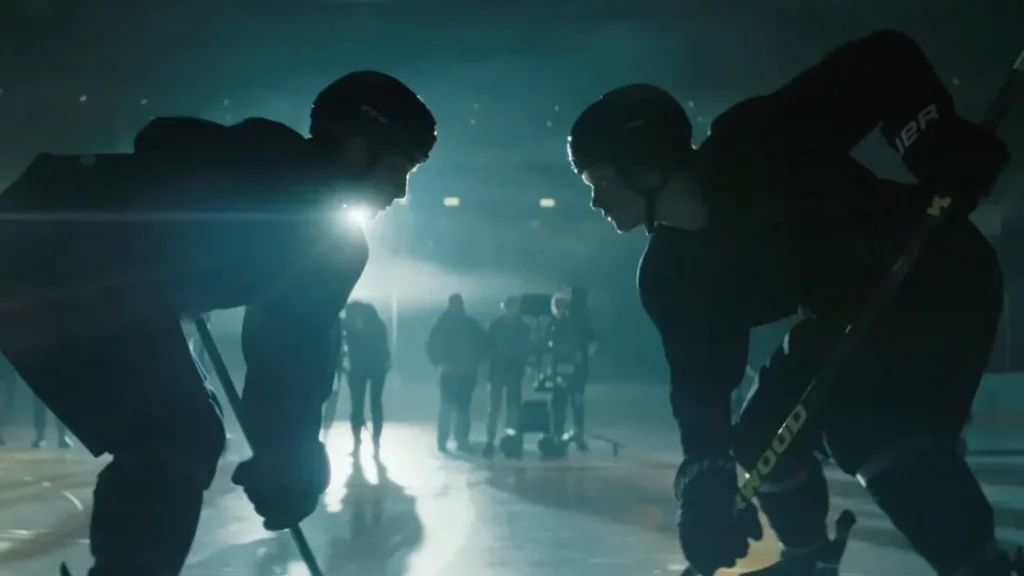
At first glance, Heated Rivalry looks like a provocation. Two professional hockey players. Rivals. Lovers. A lot of sex. Too much, some say. But what really unsettles isn’t the explicitness, it’s the fact that gay desire is allowed to sit at the centre of the story without apology, tragedy, or lesson attached. For once, queerness isn’t a metaphor. It’s the plot.
Set in the hyper-coded world of men’s professional sport, the series follows Ilya and Shane as they navigate competition, secrecy, and an on-again, off-again relationship shaped by the pressure to stay closeted. This isn’t new territory for queer storytelling. What is new is how insistently Heated Rivalry lingers on pleasure. Sex isn’t a side note or a reward for suffering. It’s repetitive, intense, sometimes messy because it matters. Because for people who live under constant constraint, desire often becomes a lifeline.
That choice has sparked debate inside queer communities. The show’s massive success is driven largely by a female fan base familiar with the romance novels it’s adapted from. This raises uncomfortable but necessary questions: who is looking, and why? When gay intimacy becomes a mainstream spectacle, does it risk being softened, stylised, or consumed without context? Or does visibility, even imperfect, still expand the space we have to exist?
What Heated Rivalry gets right is the emotional undercurrent beneath the bodies. These sex scenes aren’t about performance; they’re about urgency. The sense that what’s happening might be taken away at any moment. For anyone who has loved in secret, who has counted hotel rooms and stolen hours, that feeling is painfully familiar. The tenderness is real, even when the framing isn’t always ours.

The series won’t speak for every queer experience, and it shouldn’t have to. But its presence matters. In a media landscape that often desexualises gay men to make them palatable, Heated Rivalry insists on desire as something visible, complex, and worth defending. Currently available on Max (formerly HBO Max) in Europe, including Belgium, the conversation it sparks isn’t happening somewhere else – it’s happening here, too. And that, in itself, feels like a shift worth paying attention to.
You may also like
-

BRDCST 2026: Brussels’ most genre‑fluid festival turns listening into a political act
From 3 to 6 April, BRDCST 2026 takes over Ancienne Belgique and spills into Cinema
-

Every-Body-Knows: dancing with queer memory in Brussels
With Every-Body-Knows-What-Tomorrow-Brings-And-We-All-Know-What-Happened-Yesterday, choreographer Mohamed Toukabri offers an intimate and political solo where every movement asks what
-

Ixelles Museum is back: a new chapter for Brussels art lovers
After years wrapped in scaffolding and anticipation, the Musée d’Ixelles / Ixelles Museum is finally reopening its
-

Killion Huang at EDJI: when Tarot becomes a queer language of intimacy
In Ixelles, EDJI Gallery opens a new chapter with Chinese artist Killion Huang, born in 1999 and
-

Horst Arts & Music: where club culture, architecture and queer futures meet
Just outside Brussels, Horst Arts & Music Festival turns Asiat Park in Vilvoorde into a
