
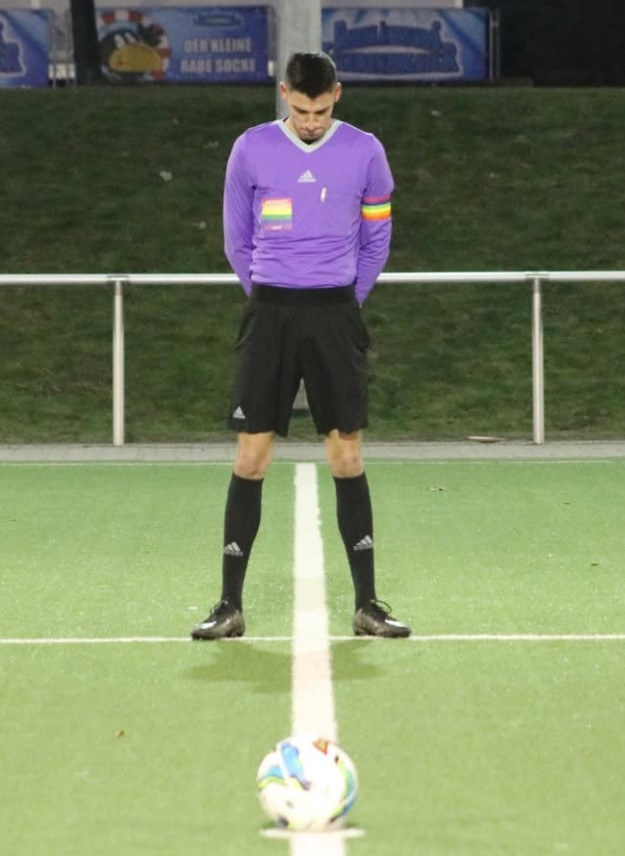
When German referee Pascal Kaiser walked onto the pitch in Cologne, he thought the most terrifying part of his day would be asking his boyfriend to marry him in front of tens of thousands of people. Instead, the real horror waited for him days later, outside his own home.
Before a recent FC Köln match at the RheinEnergieStadion, Kaiser turned a routine game into a moment of unapologetic queer joy. During a break, he stepped onto the touchline, took the stadium microphone, and dropped to one knee in front of his partner, Moritz. With around 50,000 fans watching, he asked the question many queer couples still don’t dare to pose in public: Will you marry me?
Moritz said yes. The crowd erupted in cheers. For a few radiant minutes, a football stadium – so often associated with macho culture and homophobic chants – became a stage for queer love, vulnerability, and courage. Kaiser, an amateur referee and vocal advocate against homophobia in sport, later admitted he had been terrified of being booed. Instead, he walked off the pitch with what looked like a victory for visibility: a viral video of pure romance and a powerful message that queerness belongs everywhere, including the heart of the football world.
But visibility, for queer people, is never just about celebration. It is also about risk.
In the days that followed, as the proposal spread widely online, the tone shifted. Alongside the messages of support came a flood of homophobic insults and threats. Some of the hate fixated not just on his sexuality, but on the audacity of displaying it so publicly in a traditionally “straight” space like a football stadium. The same act that made him a symbol of progress also made him a target.
One night, after receiving explicit threats, Kaiser contacted the police to report what was happening and to ask whether he was in immediate danger. He was reportedly reassured that he had nothing to fear at home. Around twenty minutes later, he stepped outside into his garden for a cigarette – and found out how wrong that was.
Three men were waiting for him.
They attacked him violently on his own property, leaving him with visible injuries, including a badly bruised eye. Photos he later shared showed the damage on his face, a stark contrast to the smiling, tearful images from the stadium days earlier. Authorities are now treating the assault as a potential homophobic attack, directly connected to his public proposal and the intense media attention around it.
For many LGBTQ+ people, Kaiser’s story hits painfully close to home. It encapsulates a reality we know too well: the same moments of joy and pride that affirm our existence can provoke dangerous backlash. The stadium proposal was a declaration that queer love can take up space in one of Europe’s most hyper-masculine environments. The assault at his doorstep was a brutal reminder that homophobia doesn’t disappear just because we cheer for a romantic video on social media.
Yet there is another part to this story: solidarity.
After news of the attack broke, waves of support poured in from fans, queer groups, players, and allies. People rallied around Kaiser and Moritz, condemning the violence and reaffirming the importance of fighting homophobia in football and beyond. In turning his pain and injuries into something visible, Kaiser refused to let the attackers erase his joy or drive his love back into the shadows.
His journey from a public proposal to a hate-fueled assault forces us to confront a hard truth: representation alone is not enough. Stadiums lit up in rainbow colors and viral proposal clips are powerful, but they must be backed by real protection, serious legal consequences for hate crimes, and tangible cultural change in sport and society.
UPDATE 21/02 – German authorities are now investigating the account given by Pascal Kaiser, the amateur referee who claimed he was assaulted outside his home after proposing to his partner in public. According to the Cologne public prosecutor’s office, he is suspected of having staged the attack and of having written some of the threatening messages himself, which casts serious doubt on his initial story. The investigation is ongoing and no final conclusions have been reached at this stage.
KET Magazine is a community‑driven, non‑profit magazine run by volunteers based in Brussels. Get in touch to share your thoughts or tell us about your activities. You can also promote your events on our website or support our work with a donation. Contact us at Info@ket.brussels.
You may also like
-

Sing It Queer: open your home (and your city) to 4,000 LGBTQI+ voices
From 24 to 28 June 2026, Various Voices Brussels 2026 will turn the capital into
-

Poland’s Supreme Administrative Court Recognises Same-Sex Marriages from Other EU Countries
A major step for LGBTQ+ rights in Eastern Europe: on Friday, Poland’s Supreme Administrative Court (NSA)
-

The Cruise 2027: Ready to Sail into Queer Paradise?
From July 15th to 24th, 2027, The Cruise is back on board the spectacular Celebrity Equinox for
-

Ten Years After the Brussels Attacks, a City – and Its Queer Community – Still Carry the Shock
Ten years after the 22 March 2016 bombings at Brussels Airport and Maelbeek metro station,
-

Brussels Pride: from Gay Pride to Belgian Pride to a city that owns its colors
In 30 years, Brussels has gone from a small “Gay Pride” marched by a few
