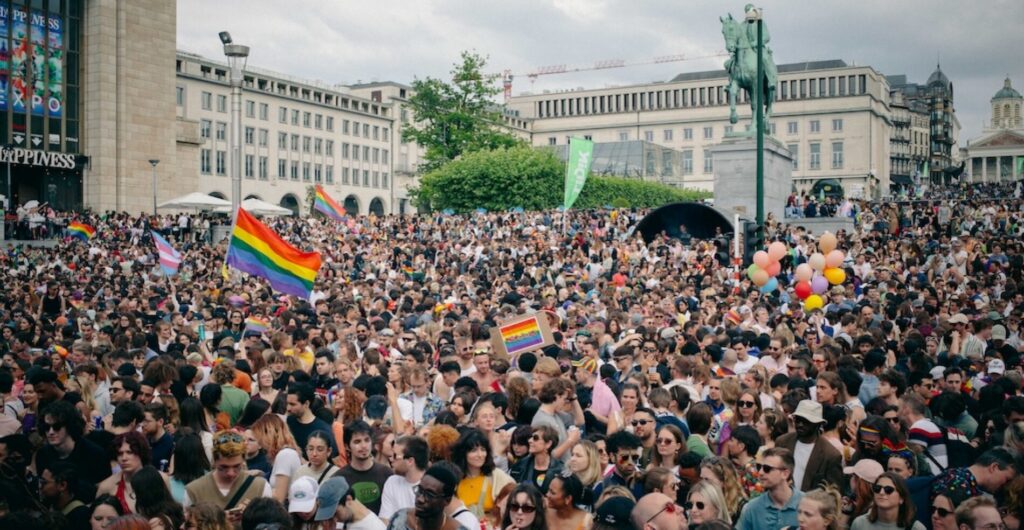
Pride is more than a party. It’s more than glitter, floats and a yearly Instagram post. Pride is a political space, a collective moment where our communities say clearly: we are here, we are many, and we have demands – not just slogans.
On 28 February 2026, RainbowHouse Brussels is inviting the community to do exactly that: sit down together, talk, disagree, dream and decide what Brussels Pride 2026 should stand for. Not in a backroom, not in a press release written far away from the streets, but in a participatory workshop open to the people Pride is supposed to represent.
What’s happening on 28 February?
On Saturday 28 February, RainbowHouse Brussels hosts a co-creation workshop to shape the political themes and key demands of Brussels Pride 2026.
- Doors open at 12:00, the workshop starts at 13:00.
- The session will be facilitated by community organiser Michiko Lii, who will guide discussions, make sure as many voices as possible are heard and help turn ideas into clear priorities for Pride.
- The goal is simple and ambitious at the same time: by the end of the day, a shared set of themes and demands for Brussels Pride 2026 will be defined together with the people in the room.
Attendance is free, but RainbowHouse asks you to confirm by email:
brusselspride2026@rainbowhouse.be
You can also keep an eye on RainbowHouse’s channels here:
- RainbowHouse Brussels: https://rainbowhouse.be
- Instagram: @rainbowhouse_brussels
Why this matters for queer Brussels
Brussels has no single “gay neighbourhood” anymore – queer life is spread across bars, night clubs, community spaces, art venues and activist collectives. Pride needs to reflect that diversity. A participatory workshop is one concrete way to:
- Bring together people who don’t always meet: nightlife crowd, grassroots activists, migrants, elders, trans and intersex people, sex workers, students, parents, people living outside the city centre.
- Put topics on the table that don’t always get a mic on the main stage: housing, safety in public space, racism in the scene, access to health care, the situation of undocumented queers, disability, mental health, chosen families and more.
- Connect Pride’s political demands with the realities of those who live, work, cruise, love and survive in Brussels all year long.
If you want to see what kind of services and support already exist in the region, you can also check the Brussels-Capital Region LGBTQIA+ page:
https://be.brussels/en/assistance-social-health/lgbtqia
Pride as process, not just an event
For many of us, Pride shows up once a year as a parade and a busy weekend. But Pride is also a process: months of meetings, negotiations, compromises and sometimes tensions. Opening that process to community input is a way to:
- Make sure Pride doesn’t become a purely corporate or institutional product.
- Anchor the march and the village in real local struggles and victories.
- Hold organisers and institutions accountable to the communities they claim to represent.
If you care about police presence at Pride, accessibility, safer spaces, the balance between party and politics, representation of bi, trans, intersex, asexual and aromantic people, or visibility for racialised and migrant queers, this is the moment to say it – not just after the march.
Practical info
- Date: Saturday 28 February 2026
- Place: RainbowHouse Brussels (city centre) – more info: https://rainbowhouse.be
- Welcome: from 12:00
- Start of workshop: 13:00
- Facilitator: Michiko Lii
- Registration / confirmation: brusselspride2026@rainbowhouse.be
Hashtags you can follow or use to spread the word:
#BrusselsPride · #Pride2026 · #LGBTQIA · #CommunityVoices · #RainbowHouseBrussels
If you’re reading this on ket.brussels, you already know Brussels Pride doesn’t happen in a vacuum. Showing up on 28 February is one way to make sure that, this year, Pride speaks with your voice too.

KET Magazine is a community‑driven, non‑profit magazine run by volunteers based in Brussels. Get in touch to share your thoughts or tell us about your activities. You can also promote your events on our website or support our work with a donation. Contact us at Info@ket.brussels.
You may also like
-

Portugal set to roll back trans self-determination law: what’s at stake?
Portugal, long seen as a frontrunner on trans rights in Europe, is on the verge
-
Ten Years After the Brussels Attacks, a City – and Its Queer Community – Still Carry the Shock
Ten years after the 22 March 2016 bombings at Brussels Airport and Maelbeek metro station,
-

Brussels Pride: from Gay Pride to Belgian Pride to a city that owns its colors
In 30 years, Brussels has gone from a small “Gay Pride” marched by a few
-

“Out of step, outlawed”: être homosexuel·le au Sénégal en 2026
While Brussels is gearing up for another Pride season, LGBTQI+ people in Senegal are facing
-

Brussels Pride 2026: registrations for Pride Village are open – be part of it!
Brussels Pride is turning 30, the far right is on the rise across Europe, and
