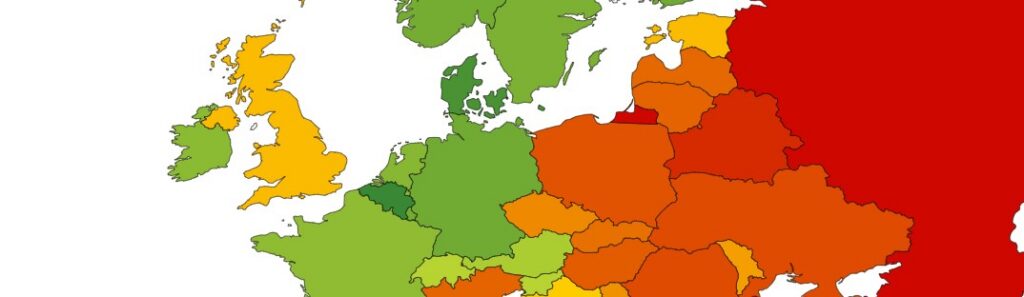
Belgium still ranks among Europe’s most protective countries for LGBTQIA+ people on paper – yet homophobic and transphobic violence is rising, youth acceptance is slipping, and most victims never file a complaint. ILGA-Europe’s latest Annual Review shows a country caught between strong laws and a harsher everyday reality, forcing Belgian civil society to raise the alarm and call for urgent action from policymakers, schools and digital platforms.
A “safe” country where violence is getting worse
In its latest Annual Review of the human rights situation for LGBTQIA+ people in Europe, ILGA-Europe highlights a worrying trend: Belgian civil society reports more incidents of violence motivated by homophobia and transphobia than in previous years. Local organisations point to several patterns: an increase in ambushes set up via dating apps, attacks on LGBTQIA+ venues, and a rise in harassment at work and on social media. Yet despite this escalation, only around 14% of victims report these incidents to the police, suggesting that the official statistics drastically underestimate the scale of the problem.
Belgian equality bodies such as Unia and the Institute for the Equality of Women and Men have also documented more cases marked by hate crimes, including physical assaults and serious intimidation, particularly targeting gay and trans people. One recurring pattern involves “dating app traps”, where perpetrators create fake profiles to lure victims and then insult, threaten, beat or blackmail them, sometimes in organised groups. For many in the community, the message is clear: Belgium may look safe in international rankings, but everyday life tells a different story.
Useful links:
- ILGA-Europe Annual Review (overview): https://www.ilga-europe.org/report/annual-review-2026/
- ILGA-Europe website: https://www.ilga-europe.org/
- Unia (Equal Opportunities Centre): https://www.unia.be/
- Institute for the Equality of Women and Men: https://igvm-iefh.belgium.be/
Young people: less acceptance, more “acceptable” violence
This rise in violence goes hand in hand with a decline in acceptance among young people. A recent “Facts & Figures” report from the Youth Research Platform (Jeugdonderzoeksplatform, JOP) – coordinated by VUB researcher Fien Pauwels – compares homophobic attitudes among 14‑ to 18‑year‑olds in Flanders between 2018 and 2023. The findings are sobering: homophobia has increased across all youth groups, with average scores on a homophobia scale rising significantly over time.
Even more alarming, nearly one in five students now believes that violence against gay people can be acceptable, compared to less than one in ten in 2018. Support for same-sex marriage is falling, and fewer young people think schools should teach respect for LGBTQIA+ people – just over half agree, down from around three-quarters in 2018. Researchers point to toxic online environments, anti‑“woke” influencers and polarising public debates as key drivers of this shift, with boys and students in vocational education showing the sharpest increases in homophobic attitudes.
Useful links:
- JOP / VUB “Facts & Figures” on homophobia among youth: https://brispo.research.vub.be/en/nieuwe-facts-figures-over-de-houding-van-jongeren-ten-opzichte-van-homoseksualiteit
- Youth Research Platform (Jeugdonderzoeksplatform): https://www.vlaanderen.be/cjm/nl/jeugd/onderzoek-jeugd/jeugdonderzoeksplatform-jop
- Ket.brussels analysis of the JOP study: https://ket.brussels/2025/04/03/less-tolerance-among-youth-a-wake-up-call-not-a-reason-to-give-up/
Digital spaces: from harassment to organised ambushes
Online spaces that many queer people use for connection and community have also become key arenas of violence. A report by RTBF underlines how young people and LGBTQIA+ individuals are particularly exposed to digital violence, including harassment, surveillance and threats on social media and messaging platforms. European research on cyber‑victimisation shows that LGBTQIA+ people face disproportionate levels of online abuse, from insults and hate speech to outing, threats and scams.
The same digital tools that help people meet – especially dating apps – are being weaponised. ILGA-Europe and Belgian actors report a growing number of “guet‑apens” (ambushes) set up via dating platforms, where queer people are lured to meetings and then attacked or blackmailed. For trans and non‑binary people, this digital violence often intersects with discrimination in employment, healthcare and insurance, creating a climate where simply being visible online or offline can feel risky.
Useful links:
- RTBF: “Harcèlement, surveillance, menaces…” (in French): https://www.rtbf.be/article/harcelement-surveillance-menaces-les-jeunes-et-les-personnes-lgbtqia-particulierement-exposes-aux-violences-numeriques-11666206
- ILGA-Europe resources on hate crime and hate speech: https://www.ilga-europe.org/resources/news/latest-news/
- Safer dating tips (English, ILGA affiliates and NGOs): search via https://www.ilga-europe.org/resources
Healthcare: more trans-related services, but long waits
It’s not all bad news. ILGA-Europe notes some positive developments in Belgium, particularly in access to gender-affirming healthcare. The number of specialised centres providing transition-related care has increased from two to six in recent years, expanding the geographical spread of expertise and offering more options for trans and non‑binary people seeking support.
However, waiting times remain extremely long – often between one and four years before patients can access certain treatments or consultations. These delays have serious mental health consequences and can push some people towards unsafe self-medication or unregulated treatments. Civil society organisations are calling for more investment in staff, decentralised services and informed consent models to reduce bottlenecks and ensure that trans healthcare is accessible in practice, not just in theory.
Useful links:
- ILGA-Europe country information on Belgium: https://www.ilga-europe.org/
- Trans-specific support in Belgium (selection, FR/NL):
- Genres Pluriels: https://www.genrespluriels.be/
- Çavaria: https://www.cavaria.be/
- RainbowHouse Brussels: https://rainbowhouse.be/
Strong laws, fragile realities: Belgium’s place in Europe
Despite these worrying trends, ILGA-Europe still considers Belgium one of the European countries with a relatively strong legal framework protecting LGBTQIA+ people. Anti‑discrimination legislation, marriage equality, recognition of diverse family forms and legal gender recognition reforms place Belgium among the higher-ranking states in ILGA-Europe’s Rainbow Map and Annual Review.
Yet Belgium is not immune to the broader polarisation sweeping across Europe. ILGA-Europe warns of increasingly organised anti‑gender and anti‑LGBTQIA+ movements, growing hate speech in politics and media, and the normalisation of narratives that depict LGBTQIA+ rights as “ideology” or a threat to children. For activists, this contradiction is crucial: good laws do not automatically guarantee safety, especially when social attitudes, policing practices and online platforms fail to keep up. Turning legal progress into lived equality will require sustained pressure from civil society, better data collection on hate crimes, investment in education and youth work, and stronger accountability for digital companies.
Useful links:
Ket.brussels on ILGA-Europe 2025 alarm: https://ket.brussels/2025/02/28/lgbtqia-rights-under-attack-ilga-europe-sounds-the-alarm/
ILGA-Europe Rainbow Map & Annual Review hub: https://www.ilga-europe.org/rainbow-europe/
KET Magazine is a community‑driven, non‑profit magazine run by volunteers based in Brussels. Get in touch to share your thoughts or tell us about your activities. You can also promote your events on our website or support our work with a donation. Contact us at Info@ket.brussels.
You may also like
-

“March Is for the Queers”: Why You Should Put Queer March Ghent 2026 on Your Radar
Every March, Queer March turns Ghent into a month-long celebration of queer life, resistance, and
-

Six Charming Princes for Three Castles: LGBT Couples Rebuilding France’s Fairy‑Tale Landscape
First, there were princesses in towers waiting for some vaguely straight prince on a horse.
-

Why You Absolutely Must Watch This Documentary “Mister Nobody Against Putin” on ARTE
In ARTE’s documentary Mister Nobody Against Putin, a school worker in a polluted Russian town turns
-

The First Homosexuals: Queer Origins on View at Kunstmuseum Basel
For anyone interested in LGBTQIA+ history, queer art and how our identities were first imagined, “The
-

LAST DAYS OF: Borders — A Night of Sound, Vision, and Resistance Electrosexual (DE) feat. Nicky Miller live — In support of Abolish Frontex
On March 14, La Garçonnière Prod. revives its iconic LAST DAYS OF series at Brasserie Illegaal. The night promises a
 English
  Français de Belgique
  Nederlands (België)