
Croatia, once hailed as a post-war success story of European integration, is facing a new surge of nationalist discourse and historical revisionism that many fear could reopen the region’s deepest wounds. Observers warn that the trend, accelerated throughout 2025, is not only rewriting the past but also endangering minorities, including the Serb and LGBT communities.
A Concert Turned Political Rally
The turning point came in July, when Marko Perković, better known as Thompson—a rock star celebrated for his patriotic songs and infamous for his pro-Ustaša sympathies—drew a staggering 450,000-strong crowd in Zagreb. He opened the concert with the phrase “Za dom spremni” (“For the homeland—ready!”), the slogan once used by Croatia’s wartime fascist regime, which collaborated with Nazi Germany.
“The concert gave far-right sympathizers a sense of validation,” explains Florian Bieber, professor at the University of Graz and expert on Balkan politics. “The roots were already there, but this showed them how mainstream their numbers have become.”
Even Prime Minister Andrej Plenković, leader of the ruling HDZ party, attended the rehearsals and posted a selfie with Thompson. Since forming a coalition with the ultraconservative Homeland Movement in 2024, Plenković’s government has faced mounting criticism for tolerating nationalist, anti-immigration, and anti-LGBT rhetoric.
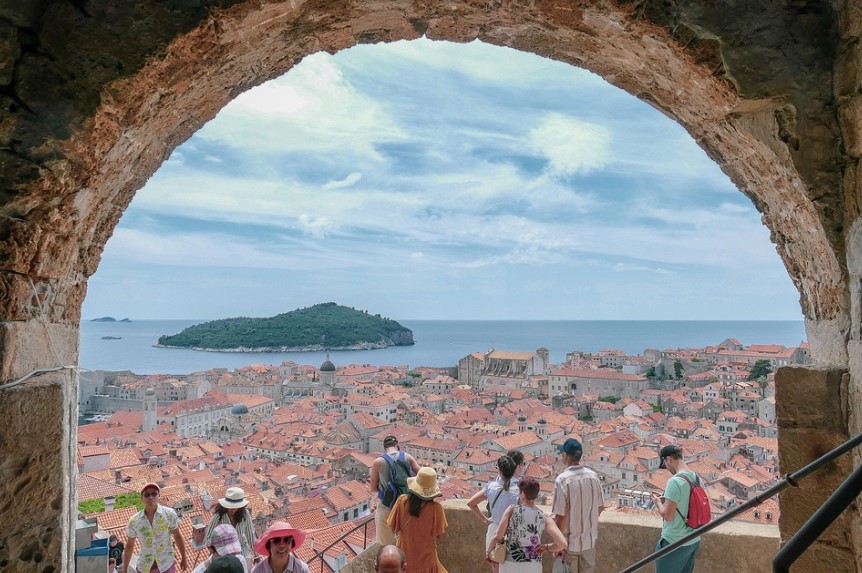
@Pixabay
“Faith, Family, Homeland”
Thompson, whose stage name references a machine gun, rose to fame during the Yugoslav wars of the 1990s. He presents his concerts as celebrations of “faith, family, and homeland” while denying any link to fascist ideology. Yet his defense rings hollow as audiences wave flags bearing banned symbols and shout slogans honoring the Ustaša regime.
The issue goes beyond music. In October, a group of MPs organized a parliamentary roundtable questioning the number of victims at the Jasenovac concentration camp—where at least 100,000 Serbs, Jews, Roma, and anti-fascists were murdered, according to the U.S. Holocaust Memorial Museum. The event was denounced by Croatia’s Jewish community as a “scandalous moral disgrace.”
Growing Intolerance and Minority Fear
Far-right violence escalated this autumn. In early November, masked hooligans attacked a Serbian cultural event, chanting fascist slogans and prompting the cancellation of several multicultural gatherings for safety reasons. Anti-Serb graffiti have since appeared in multiple cities.
“This is something we hadn’t seen before—organized groups of young ultranationalists attacking not only minorities but the idea of cultural freedom itself,” warned Milorad Pupovac, representative of Croatia’s Serb minority.
The pattern has sparked fear among LGBTQ+ activists as well. The Homeland Movement—now part of the ruling coalition—advocates for anti-LGBT policies and restrictions on abortion, aligning with the influential Catholic Church. Such anti-equality rhetoric, observers note, resonates with similar nationalist currents across Europe, from Hungary’s Viktor Orbán to Italy’s far-right movements.
A Struggle for Croatia’s Future
Recent antifascist counter-protests show that many Croatians are pushing back. In late November, about 10,000 demonstrators gathered in Zagreb to denounce extreme-right actions and affirm democratic values. “It’s time for the silent majority to speak out,” said activist Vedrana Bibić in a statement to the AFP.
Analysts like Bieber point out that younger generations—many of whom were born after the 1990s wars—are increasingly exposed to militarized nationalist narratives. “Radical ideas are becoming more socially acceptable in a global context where polarization is rising,” he says.
For now, Croatia stands at a crossroads: between confronting its past honestly or letting revisionism and bigotry shape the next decade.
Useful links and resources:
Human Rights Watch – Croatia Country Report
U.S. Holocaust Memorial Museum – Jasenovac Overview
European Commission: Rule of Law Report on Croatia (2025)
You may also like
-

Queer Paris in Your Pocket: A New Guide to the City’s LGBTQIA+ Memory and Momentum
Released on 4 June by First, Queer Paris is a new pocket guide that maps out the French capital through
-
One Last Warm-Up: Brussels Still Has Time to Join the Biggest LGBTQI+ Choir at ING Arena
Brussels has already been singing queer for weeks, and now one of the most open
-
Lille Pride 2026 is back to claim the city in color
Lille Pride returns on Saturday 30 May 2026 with a full day of community, visibility and celebration,
-
Brussels Is About to Sing Queer: Various Voices 2026 Unfolds Across the City
From 24 to 28 June 2026, Brussels will host Various Voices, Europe’s flagship LGBTQI+ choir festival,
-

Brussels Stands with Senegal’s LGBTQIA+ Community as Repression Gets Worse
Senegal has sharply intensified its anti-LGBTQIA+ repression in 2026, with a new law that increases
 Français de Belgique
  English
  Nederlands (België)