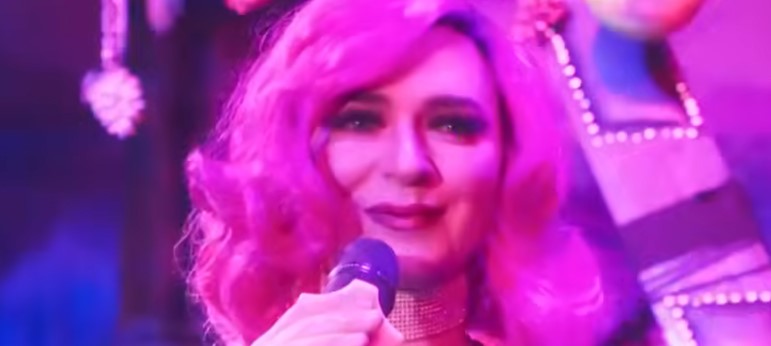
As Russia’s full-scale war against Ukraine drags into another year, Ukrainian drag artists and queer activists are still on the frontline of both survival and visibility. ARTE’s new documentary Queens of Joy – United for Freedom follows three drag queens who choose to stay, fight and care, turning the stage into a battlefield for democracy and LGBTQIA+ rights.
Drag queens who stay, fight and care
Sur Queens of Joy – United for Freedom, Marlen Scandal, Monroe and Aura refuse the script that queerness equals fragility. When Vladimir Putin’s troops invade, they decide not to hide or flee, but to rebuild their lives inside a country at war.
Aura, the drag persona of Artur, joins a Ukrainian army unit that supplies equipment to soldiers at the front. Coming out to his fellow soldiers, he says he no longer fears anything once they have seen him in full glitter as Aura. Monroe, a trans woman and drag diva, has been a visible activist since the Maidan revolution in 2014, when protests toppled pro‑Russian president Viktor Yanukovych and demanded a democratic and European future for Ukraine. Today, she keeps sharing her life on YouTube, from tourism campaigns in Bucovina to her psychology studies, insisting that queer visibility is part of the country’s democratic horizon.
Sasha, who performs as Marlen Scandal, delivers parcels by day in largely Russian‑speaking Kharkiv and becomes a flamboyant queen by night. Between drag shows and everyday hustle, he campaigns for legal recognition of same‑sex couples while being in love with his girlfriend Olja, proving once again that queer lives and relationships do not fit into easy boxes. Together with fellow performer Janna DarkRoom, the trio prepares a charity show in a Kyiv club to raise funds for soldiers, turning nightlife into an infrastructure of care.
Queer Ukraine is not a side story
One of the most powerful lines in the film comes from Sasha: “Sexual orientation does not matter today. If you are a patriot, there is no problem.” It is not that homophobia magically disappears in wartime, but that LGBTQIA+ people are visibly part of the collective fight for survival, from the trenches to mutual aid kitchens.
Estimates suggest tens of thousands of queer soldiers are serving in the Ukrainian armed forces, even if their partnerships are still not fully recognised by law. Activist groups like Ukrainian LGBT+ Military for Equal Rights and international outlets have highlighted how many of these soldiers fear that, if they die, their partners will not be legally recognised – cannot make medical decisions, cannot claim their bodies, cannot access basic rights. The documentary places faces and stories on these statistics: queer Ukrainians are not a “niche” within the war, they are part of the front line defending a plural, inclusive society against an authoritarian project that openly targets LGBTQIA+ people.
Filmmaker Olga Gibelinda follows the three protagonists through food distribution in devastated Kharkiv, shows in Kyiv and Dnipro, and the everyday work of switching fully to the Ukrainian language as a political and cultural choice. Her camera moves between laughter and fear, performance and exhaustion, showing how self‑expression, mutual aid and patriotism weave into the same fabric of resistance.
Why European queer communities must keep supporting Ukraine
For a Brussels‑based queer audience, the stories in Queens of Joy – United for Freedom should feel both distant and very close. Distant, because most of us are not navigating air‑raid sirens on our way to the club; close, because we know nightlife can be a refuge, a political space and a support network when institutions fail.
Russia’s regime has built its power on nationalism, militarism and a reactionary vision of gender and sexuality that treats queer bodies as threats to “traditional values”. Ukraine, despite its contradictions and unfinished legal reforms, is moving in the opposite direction: activists are pushing for same‑sex partnerships, trans rights and anti‑discrimination laws, while queer people serve openly in the army and civil society. Supporting Ukraine, especially from queer communities in cities like Brussels, is not just a geopolitical stance; it is a choice for a Europe where our identities are not negotiable.
Our solidarity can be practical and political at the same time: amplifying Ukrainian queer voices, pressing our governments to maintain support for Ukraine, and donating to organisations that work directly with LGBTQIA+ people on the ground. The film makes it very clear that drag shows, language choices and mutual aid are not “extras” to the war effort, but integral parts of the struggle for a free, plural and queer‑inclusive Ukraine.
Where to watch and how to help
Queens of Joy – United for Freedom (Queens of Joy : unies pour la liberté) is available on ARTE, with streaming access on the ARTE platform until February 2027. You can find it via ARTE’s YouTube channel or directly on arte.tv.
Follow ARTE for updates and context pieces:
- Instagram : @artefr
- Facebook : facebook.com/artetv
- X/Twitter: @artefr
If you want to support LGBTQIA+ people in Ukraine or learn more about their work, you can check:
- OutRight International – Support for LGBTQ+ Ukrainians
- KyivPride, organising Pride and advocacy during the war
- Insight NGO, a feminist LGBTQ organisation providing services and advocacy
- Ukrainian LGBT+ Military for Equal Rights, representing queer soldiers and pushing for legal recognition
From Brussels to Kyiv, queer communities are connected by the same fights for safety, joy and self‑determination. Watching Queens of Joy, talking about it in our venues and online, and refusing “war fatigue” when it comes to Ukraine is one concrete way to keep that connection alive – and to say clearly whose side we are on.
KET Magazine is a community‑driven, non‑profit magazine run by volunteers based in Brussels. Get in touch to share your thoughts or tell us about your activities. You can also promote your events on our website or support our work with a donation. Contact us at Info@ket.brussels.
Vous aimerez aussi
-

Ocean Vuong at Bozar: When the Luminous and the Broken Meet
On 14 March 2026, Vietnamese American writer and poet Ocean Vuong comes to Bozar for
-

Decolonising the Dancefloor: When the Party Becomes Political
With “Décoloniser le dancefloor”, performer, activist and voguer Habibitch turns the club and the stage
-

Discover the Art and Aesthetics of BDSM at an Exclusive Event near Brussels
Far from stereotypes, BDSM is revealing its elegant, artistic, and deeply human side. An upcoming
-

Pillion: A Dark Ride Through Desire and Self-Discovery
In Pillion, a lonely traffic warden’s mundane life takes a thrilling turn when he meets a
-

Queer Voices, One City: Meet the Choirs of Various Voices Brussels 2026
This June, Brussels turns into a queer soundscape: 120 LGBTQI+ choirs from 18 countries are
 Français de Belgique
  English
  Nederlands (België)