

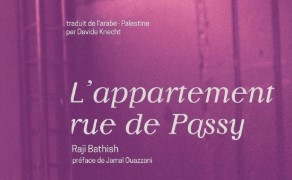
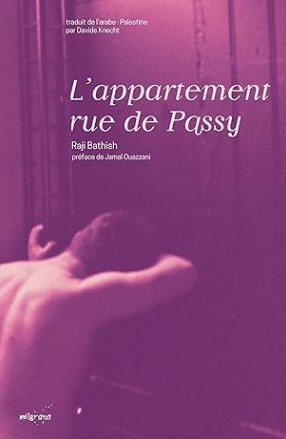
Avec L’appartement rue de Passy, Palestinian writer Raji Bathish takes readers from Haifa to Paris to follow Jamil and Amir, two friends caught between desire, class, exile and disillusion. Paris appears both as a promised land of freedoms and a black hole where hopes are slowly crushed. Through a fragmented, poetic writing style, Bathish signs a deeply queer, brutally lucid novel on what it means to move, to love and to lose oneself between worlds.
A queer pioneer from Nazareth
Born in Nazareth, Raji Bathish is a writer, translator and cultural researcher who has become a key figure in the new generation of Arab authors. He has published several novels – including Vola et ses soeurs et L’appartement rue de Passy – as well as the novella La dame du container and short story collections like Une chambre à Tel‑Aviv.
Beyond fiction, he teaches at the Open University, where he works on Palestinian and Israeli cinema history, art history and narrative writing workshops. He is widely considered one of the pioneers of queer and homosexual literature in the contemporary Arab world, and a major voice in experimental writing. His work is marked by fragmentation, cross‑pollination between literature, art and cinema, and a constant play with gender identities, timelines, places and styles within the same text.
Paris as promise and trap
Sur L’appartement rue de Passy, the starting “curse” sets the tone: “Tu te contentes de trop peu.” Jamil throws this line at Amir during their stay in France, like a mix of accusation and sorrow. Together, these two Palestinian friends dream of a better life and try to give meaning to their existence, oscillating between Haifa and Paris.
But Paris is not just an idealised “Ville lumière”. It is both a capital of freedoms and a dark vortex where dreams and lives disintegrate. The 16th arrondissement and its balconies with dull gilding, gay saunas where orgies are woven from solitude, and art galleries filled with a French bourgeoisie that treats the “other” as a piece to hang on cold walls: all these settings become the stage for a human tragedy that Bathish unfolds with sharp satire and poetic language.
Queer desire, class and the violence of looking
The novel dives head‑on into queer desire, but refuses to make it glamorous or purely tragic. Instead, it situates queer lives in the middle of intersecting forces: social mobility, racialisation, exoticisation, and the violence of being constantly looked at as an object. The gay saunas become less a space of liberation than a mirror of loneliness; the galleries show how bodies and stories can be turned into decorative “diversity” for a bored elite.
For Jamil and Amir, intimacy is never separate from these structures. Their friendship, desires and frustrations unfold while negotiating visas, precarious jobs, class codes and the weight of being Palestinian abroad. Between Haifa and Paris, every move – towards love, a different life, another city – carries both the hope of breathing and the risk of burning out.
Movement as vital and fatal
One of the core statements of the book is brutally simple: “entre amour, mobilité sociale et déracinement, tout mouvement est à la fois vital et fatal.” Movement is necessary – to escape, to survive, to become – but each displacement also opens new wounds. Bathish’s writing does not try to resolve this tension. Instead, it lets readers sit inside it: migration as both lifeline and fracture; queer love as both horizon and hazard; Paris as both refuge and illusion.
The fragmented, intermedial style – closer at times to a film montage than a linear narrative – reinforces this feeling. Scenes follow one another like shots: apartments, balconies, bodies, streets, interiors, phone calls, memories of Haifa, ghosts from Tel‑Aviv, all stitched together in a language that shifts between tenderness and biting irony.
Why it matters for KET readers
For readers in Brussels and Belgium, L’appartement rue de Passy resonates on several levels. It is a queer novel anchored in the realities of Arab diasporas, migration and class, offering a perspective still under‑represented in Francophone publishing. It also speaks to anyone who has projected their fantasies onto a “big Western city” – Paris, Brussels, Berlin – only to discover the cracks: racism, precarity, loneliness, or the way “freedom” is unevenly distributed.
Bathish’s book invites us to look at these cities not just as queer havens or villains, but as complex spaces where power, desire and violence intersect. It reminds us that for many queer migrants, every step forward is double‑edged: vital, and potentially fatal.
KET Magazine is a community‑driven, non‑profit magazine run by volunteers based in Brussels. Get in touch to share your thoughts or tell us about your activities. You can also promote your events on our website or support our work with a donation. Contact us at Info@ket.brussels.
You may also like
-

The curtain falls: Cabaret Mademoiselle prepares its last bow
On 20 July 2026, the curtain of Cabaret Mademoiselle on rue du Marché au Charbon will fall
-

I Love Dancefloor: Brussels Turns Up the Volume on Summer Nights
As part of the city’s Summer Wonders programme, I Love Dancefloor invites everyone to step out of
-

Jim Queen: a queer Western hits Brussels before everyone else
On Tuesday June 17, UGC De Brouckère hosts a special avant‑première of Jim Queen, in the
-

Born to Draw, Born to Be Other: Emil Ferris Brings Her Monsters to Ixelles
From 13 June to 25 July, Galerie Martel in Ixelles hosts Born to Draw: My Favorite
-

Queer feet, green beats: Paradise City gets your summer moving (softly)
From 26 to 28 June, Paradise City returns to Kasteel de Ribaucourt in Perk with
 Français de Belgique
  English
  Nederlands (België)