

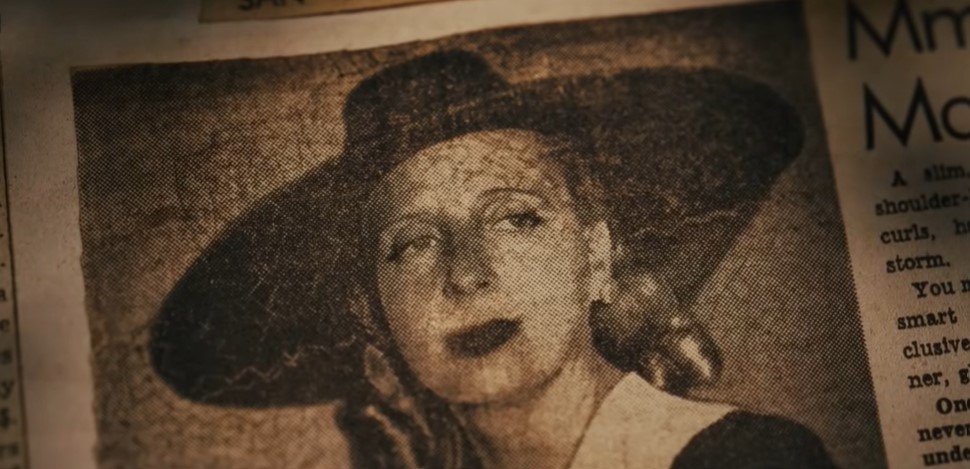
First hero of our series “Artists Who Changed How the World Sees Homosexuality”, Tamara de Lempicka painted desiring, androgynous, powerful women. In the Paris of the Roaring Twenties, this bisexual artist imposed a queer aesthetic ahead of her time, moving between scandal and fascination.
In the popular imagination, Art Deco often wears the cold, sleek face of Tamara de Lempicka’s heroines: geometric women with perfect red lips, wrapped in shiny fabrics that look like car bodies. Behind these “glamorous” images, however, is a bisexual, worldly, unapologetically free artist who openly blurred the lines of gender and desire. For a queer audience, her paintings are far more than a style exercise: they tell a different story of modernity.
Born in 1898 in Warsaw, Tamara Górska grew up in a wealthy family, between Poland and Russia, before ending up in Paris after the Russian Revolution. She arrived there as an exile but turned this displacement into an aesthetic manifesto. In the French capital of the 1920s, she reinvented herself as Tamara de Lempicka: a woman who chose to live from her painting, to move in elite artistic and high‑society circles, and to construct her own myth. Her personal image – short hair, garçonne allure, meticulously controlled elegance – was already a queer performance in itself.
Her canvases are populated by female bodies that overflow the moral frame of the time. Far from docile madonnas, Lempicka paints muscular, angular, sensual women, often depicted alone, heads thrown back, eyes closed, lips slightly parted. Female desire is no longer hinted at; it is frontal. Her female nudes – from androgynous models to lovers stretched out on crumpled sheets – become a possible space of lesbian projection at a time when homosexuality is mostly lived in the margins and between the lines.
Tamara de Lempicka did not hide her attraction to women. She moved in the lesbian and bisexual salons of 1920s and 1930s Paris, had numerous affairs and relationships, all while being married to men and surrounded by aristocrats and patrons. This fluid love life, far from heterosexual norms, directly fed her work. In her portraits of women, we can sense both the painter’s gaze and the lover’s gaze: she does not simply represent bodies, she desires them. For an LGBT+ readership, this reversal of perspective is crucial: it is no longer the male gaze that dominates, but that of a queer woman.
Her Art Deco aesthetic – smoothed volumes, metallic light, highly constructed compositions – becomes the vehicle for deeply subversive content. Wrapped in a veneer of high society glamour, lesbian eroticism slips into bourgeois interiors. Lempicka smuggles queerness into respectable living rooms in the form of “decorative” paintings that nonetheless radiate sexual tension and multiple identities. She shows that transgression can also operate through style, surface, and the careful construction of an image.
With the rise of fascism and the Second World War, Tamara de Lempicka left Europe for the United States and later Mexico. For a time, her painting fell into relative oblivion before being rediscovered in the 1970s and 1980s, notably by queer icons such as Madonna, who collected her work. Today, her images are everywhere: posters, book covers, murals. This resurgence has also allowed her work to be reread through an LGBT+ lens, bringing to light the bisexual and lesbian dimension of her models and of her own life.
For many queer people, Tamara de Lempicka embodies a form of retroactive pride. Before Stonewall, before Pride marches, before we had words for many of our identities, she painted women who love women, bodies that refuse the softness expected of them, faces that openly assume desire. Her Art Deco style is not just a vintage Instagram aesthetic: it carries the trace of a silent struggle, the struggle to live outside norms while conquering the international art scene.
By opening this series “Artists Who Changed How the World Sees Homosexuality” with Tamara de Lempicka, we pay tribute to a queer pioneer whose brush sketched out another possible world: one in which lesbian and bisexual desire is no longer confined to the shadows, but placed at the centre of the canvas, in the raw, dazzling light of modernity.
KET Magazine is a community‑driven, non‑profit magazine run by volunteers based in Brussels. Get in touch to share your thoughts or tell us about your activities. You can also promote your events on our website or support our work with a donation. Contact us at Info@ket.brussels.
You may also like
-

Frida Kahlo: the bisexual Mexican icon who turned her life into radical queer art
Second chapter in our series “Artists Who Changed How the World Sees Homosexuality”, Frida Kahlo
 Français de Belgique
  English
  Nederlands (België)