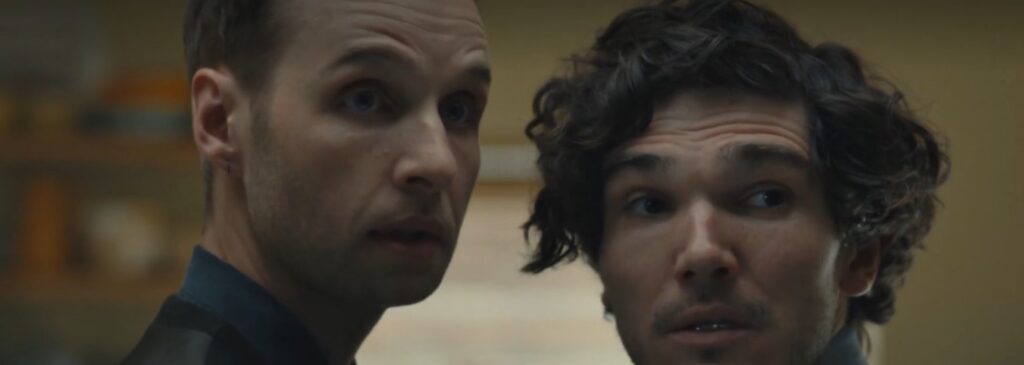
The three-part British mini-series “Lost Boys & Fairies” follows a gay couple in Cardiff navigating an adoption process that is as bureaucratic as it is intimate, moving between social worker assessments, family trauma and glittering drag nights. Led by a breathtaking performance from Siôn Daniel Young, this bilingual Welsh/English queer drama is available in the original version with subtitles on RTBF’s Auvio platform.
In “Lost Boys & Fairies”, we follow Gabriel, a singer and drag queen in a Cardiff queer cabaret, and his partner Andy, who have been together for eight years and decide to adopt a child. What starts as a fairly standard adoption journey – meetings with a social worker, forms to fill in, home visits – quickly turns into a deep dive into Gabriel’s wounds: a childhood shattered by his mother’s death, a brutal homophobic father, past addictions and a persistent sense of shame.
During an event organised to introduce prospective parents to “hard to place” children, the couple meets Jake, a 7‑year‑old boy scarred by paternal violence and repeated foster placements. He does not match their original “ideal brief”, but gradually becomes the emotional core of the series: a kid who is, in his own way, queer‑coded and who has to relearn trust, tenderness and safety. The story is as much about queer parenthood as it is about healing: how do you become a parent when you never had a proper role model, and how do you love a child without making them carry your own ghosts?
What sets “Lost Boys & Fairies” apart from many LGBT dramas is the way it alternates social realism with musical flights of fancy. The scenes at the Neverland club – feathers, sequins, lipsyncs and original songs – are far more than a colourful queer backdrop: they mirror Gabriel’s inner world, his fears, desires, rage and bursts of hope, as if the stage were the only space where he can tell the whole truth. This performative dimension, deeply rooted in drag culture, gives the series a very specific intensity: one moment we’re in a cold, bureaucratic meeting with social services, the next we’re thrown into a flamboyant number about abandonment and chosen family.
Siôn Daniel Young’s performance as Gabriel is at the heart of the show’s impact: he plays a man who is both flamboyant and broken, funny and deeply vulnerable, constantly walking the line between self‑destruction and the desire to pass something on. Around him, Fra Fee’s Andy is more grounded and quietly supportive, embodying a gentler form of queerness, while Elizabeth Berrington, Sharon D. Clarke and Maria Doyle Kennedy round out a rich gallery of characters: a relentless social worker, alternative mother figures and the Neverland community, which functions as an extended chosen family.
Created by queer Welsh playwright Daf James, who drew on his own experience of adoption, the series has been praised at festivals and by critics, and has already picked up international awards. It tackles head‑on themes that are rarely handled with such nuance in mainstream TV drama: internalised homophobia, HIV, consent, depression, but also the very concrete question of what a “settled” gay couple’s family life can look like outside heteronormative scripts.
For an LGBT audience, “Lost Boys & Fairies” feels like a love letter to our chosen families, to the queer parents who already exist and to those who don’t yet dare imagine themselves as parents. It’s a short series (3 episodes) but dense, sometimes brutal, often tender, and it leaves behind striking images: a drag‑queen dad singing for his future son, a child slowly learning he deserves more than violence, a couple wondering whether love is enough but choosing to keep trying.
The series is available in English with subtitles on RTBF’s Auvio platform, so you can fully enjoy its Welsh/English bilingual dialogue and Siôn Daniel Young’s vocal performance. For more on the show’s universe, you can check its detailed pages (cast, synopsis, awards) on the BBC or Wikipedia, watch the trailer on Arte, or read critical takes from queer and mainstream outlets.
Misschien wilt u ook
-
Niall Horan, Soft-Spoken Pop Star – And Loud LGBTQ+ Ally
From Pride tweets to rainbow flags in the crowd, Irish singer Niall Horan has quietly
-

Angèle x Justice’s “What You Want”: A Queer Night Out We’ve All Dreamed Of
Projected onto the façade of La Monnaie in Brussels and shot at night in Marseille
-
Ten Years of Balkan LGBTQIA: A Decade of Fighting Borders, Discrimination and Silence
Created in Brussels by volunteers from across the Balkans, Balkan LGBTQIA has spent ten years
-
Cœur de pirate at AB: the runaway pop of a queer icon lands in Brussels
A major figure in Francophone pop and an outspoken voice in the queer community, Cœur de pirate
-
When the Unseen History: [IN]VISIBLE Festival Turns KBR into an Augmented Reality Lab
From 25 to 27 March 2026, the Royal Library of Belgium (KBR) hosts [IN]VISIBLE Festival:
 Nederlands (België)
  English
  Français de Belgique