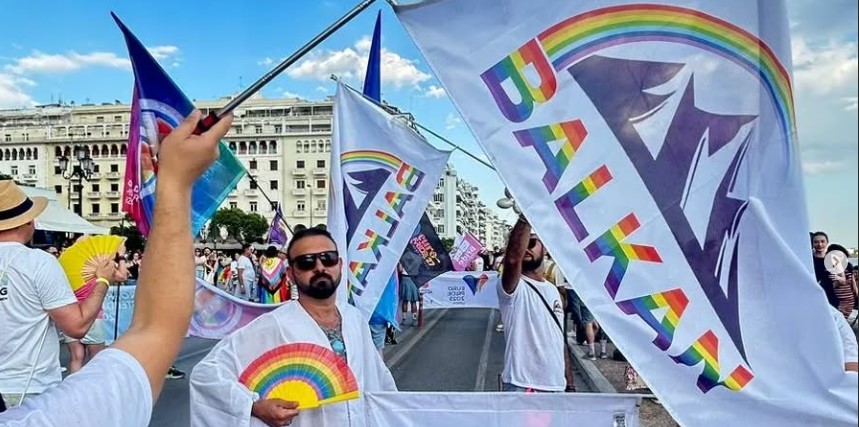
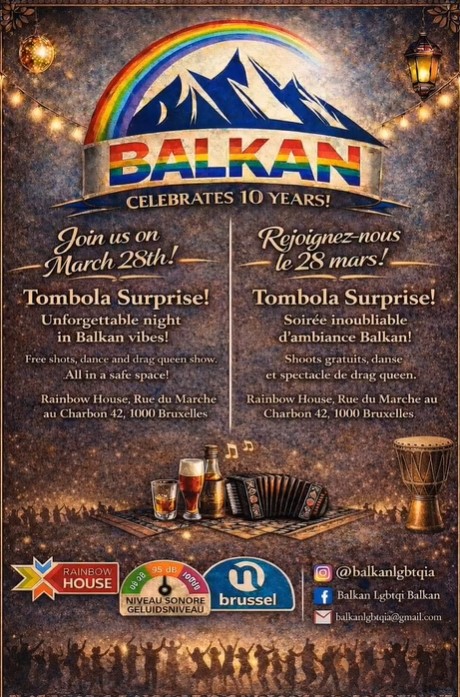
Created in Brussels by volunteers from across the Balkans, Balkan LGBTQIA has spent ten years defending queer people with Balkan roots – and anyone facing discrimination – through legal support, translation, and unapologetically political parties. As they celebrate a decade of community work, their message is clear: music, mutual aid and rights defence all belong in the same struggle.
Ten years ago, a small group of volunteers from different Balkan countries came together in Brussels with a simple observation: queer people with Balkan backgrounds were falling through the cracks. Between homophobia and transphobia “back home”, racism and xenophobia in Belgium, language barriers and complex procedures, many were left to navigate everything alone. Out of that reality, Balkan LGBTQIA was born – an association based at RainbowHouse Brussels that has spent a decade helping, supporting and defending LGBTQIA+ people from the Balkan region and beyond.
From grassroots volunteers to a community anchor
Balkan LGBTQIA was founded by volunteers coming from various Balkan countries, bringing their own migration stories, languages and activist experiences. From the start, the association defined its mission broadly:
- naar help, accompany and defend the interests of LGBTQIA+ people originating from the Balkans;
- naar fight any form of discrimination, including racism, xenophobia, queerphobia and transphobia;
- to act as a bridge between communities who are too often kept apart by prejudice and political tensions.
Based in Brussels and part of the RainbowHouse association network, Balkan LGBTQIA quickly became a reference for people dealing with double and triple marginalisation: queer, migrant, racialised, sometimes Roma, sometimes undocumented.
More info:
👉 RainbowHouse profile (EN): http://rainbowhouse.be/en/association/balkan-lgbtqia-2/
👉 RainbowHouse profile (FR): http://rainbowhouse.be/fr/association/balkan-lgbtqia/
Legal help, translation and everyday survival
One of the least visible but most crucial parts of Balkan LGBTQIA’s work is practical support. The team offers:
- legal consultations or referrals when people face discrimination, violence, housing or migration issues;
- translation and interpretation, to help community members communicate better with institutions, lawyers, doctors or social services;
- listening and orientation, so that no one has to take on bureaucracies and hostile environments alone.
For many, especially those who are newly arrived or still insecure in their status, having someone who speaks their language and understands both Balkan contexts and Belgian systems can be the difference between isolation and empowerment.
Balkan Party: the musical fight against borders
If you’ve heard of Balkan LGBTQIA, it’s probably through their most famous and authentic action: the musical battle known as BALKAN PARTY.
These nights are much more than a party. They are designed to:
- break down discriminatory barriers faced by LGBTQIA+ people from the Balkans;
- challenge conflicts and divisions between different Balkan communities, often imported from nationalist politics or historical tensions;
- create a space where everyone can dance together as humans first, regardless of origin, religion, passport or language.
On the dancefloor, turbofolk meets pop, Roma music meets electro, diaspora kids meet newcomers. The politics is in the mix: Balkan Party insists that joy, music and cultural pride are valid forms of resistance, especially for communities that are often only seen through the lens of “problem” or “victim”.
Why this 10-year milestone matters
Ten years on, Balkan LGBTQIA has helped countless people navigate discrimination, build friendships and reclaim joy in a context of rising racism, anti-migrant rhetoric and anti-queer backlash across Europe and the Balkans. Their work shows why intersectional organising is not a buzzword but a necessity: you cannot address queerphobia in the Balkans without talking about nationalism, you cannot support Balkan queers in Brussels without talking about migration, class and language.
For Brussels’ LGBTQIA+ scene, the association has also been a reminder that Pride is multilingual and diasporic. Balkan LGBTQIA brings stories, music and political realities that complicate the often West-centric narrative of queer rights. Celebrating their 10th anniversary is a way to honour the labour of volunteers who have translated forms, sat in waiting rooms, mediated conflicts and turned parties into safer spaces.
Useful links
Facebook page (events, Balkan Party, updates): https://www.facebook.com/Balkanlgbtqia
Balkan LGBTQIA via RainbowHouse (EN): http://rainbowhouse.be/en/association/balkan-lgbtqia-2/
Balkan LGBTQIA via RainbowHouse (FR): http://rainbowhouse.be/fr/association/balkan-lgbtqia/
Balkan LGBTQIA info (EN – Arc-en-Ciel International): https://www.arcenciel-international.be/resources-in-belgium/balkan-lgbtqia
Misschien wilt u ook
-
Queens of the South: When Nice Turns Carnival into Queer Celebration
On 27 February 2026, Place Masséna in Nice will shimmer a little brighter. Lou Queernaval,
-

Cœur de pirate at AB: the runaway pop of a queer icon lands in Brussels
A major figure in Francophone pop and an outspoken voice in the queer community, Cœur de pirate
-

When the Unseen History: [IN]VISIBLE Festival Turns KBR into an Augmented Reality Lab
From 25 to 27 March 2026, the Royal Library of Belgium (KBR) hosts [IN]VISIBLE Festival:
-
Safer on Paper, Not in Reality”: ILGA Warns of Rising Anti-LGBTQIA+ Violence in Belgium
Belgium still ranks among Europe’s most protective countries for LGBTQIA+ people on paper – yet
-
“March Is for the Queers”: Why You Should Put Queer March Ghent 2026 on Your Radar
Every March, Queer March turns Ghent into a month-long celebration of queer life, resistance, and
 Nederlands (België)
  English
  Français de Belgique