
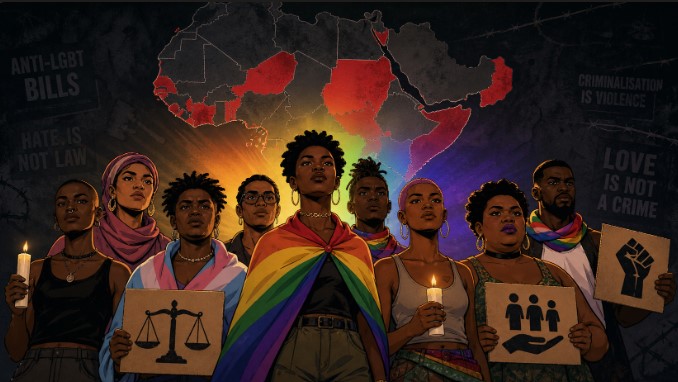
Niger has just promulgated a new penal code that, for the first time, explicitly criminalises homosexuality, with penalties reportedly reaching up to 20 years in prison. In a country where same-sex relations were already heavily stigmatised but not clearly targeted by the law, this marks a brutal shift from social taboo to state repression. This move comes as several African states adopt harsher laws against LGBTQ+ people, deepening what human rights organisations describe as a broader regression on the continent.
From silence to criminalisation
Until now, Niger’s legal system did not explicitly criminalise homosexuality, even if social attitudes remained largely hostile in a society that is predominantly Muslim and conservative. That ambiguity offered fragile room for some LGBTQ+ people to exist “between the lines”, even under constant threat of family rejection, police harassment or public humiliation.
With the adoption of this new penal code, that grey zone disappears. According to information relayed by the presidential communication office and human rights observers, consensual same-sex acts are now punishable under criminal law, with sentences that can go as far as 20 years in prison. In practical terms, this means that what used to be framed as “moral” or “religious” condemnation is now backed by the full force of the state.
Part of a wider wave of anti-LGBT laws
Niger is not an isolated case. Over the past few years, several African countries have tightened or introduced anti-LGBT legislation, often in the name of “family values”, “public morality” or resistance to supposed “Western influence”.
- In Uganda, a 2023 law introduced some of the harshest penalties in the world, including the death penalty for so‑called “aggravated homosexuality” and life sentences for same-sex relationships.
- In Burkina Faso en Mali, new penal codes adopted in 2025 and 2024 criminalise consensual same-sex relations with prison terms and fines.
- In Senegal, a recent bill seeks to double prison terms for “acts against nature”, targeting LGBTQ+ people even more aggressively than before.
Human Rights Watch and other organisations have warned that at least six African states – including Niger – have taken concrete steps to tighten anti-homosexuality laws, contributing to what the Institute for Security Studies calls a “human rights regression” on the continent.
Daily life under an atmosphere of fear
For LGBTQ+ people in Niger, this legal shift amplifies an already existing atmosphere of fear. Activists and networks, often operating underground or in exile, describe a context where arrests, blackmail, extortion and violence can all escalate once the law formally labels their identities and relationships as criminal.
Criminalisation also has ripple effects beyond the courtroom. It can:
- Force people deeper into hiding, cutting them off from health services, housing and support networks
- Make it harder for NGOs and community organisations to operate without being accused of “promoting homosexuality”
- Fuel moral panics and witch-hunts, where anyone perceived as “too different” can become a target
For trans and gender-non-conforming people, whose existence is often policed even more harshly, the combination of legal repression and social violence can quickly become unbearable.
Why this matters in Brussels and Belgium
From Brussels, it might be tempting to see these developments as “far away”. But for a city that hosts diasporas from across West and Central Africa – including Niger, Mali, Burkina Faso, Senegal and more – these laws are not abstract. They affect families, friends, lovers and communities who move between here and there. They also shape asylum claims, migration stories and the safety of LGBTQ+ people travelling back and forth.
For KET’s readers, this is a reminder that queer and trans liberation is deeply uneven across the world – and that victories in one place do not automatically protect those elsewhere. It also underlines the importance of fighting for strong asylum procedures, supporting diaspora-led organisations and keeping international pressure on governments that turn human beings into crimes.
What solidarity can look like from here
There is no easy answer to how people in Brussels can “fix” what is happening in Niger or elsewhere. But there are concrete steps that can be taken:
- Supporting human rights organisations and local networks documenting abuses and offering legal or material support
- Amplifying the voices of Nigerien and African LGBTQ+ activists who are already articulating what they need from allies
- Pressuring Belgian and European institutions to consider anti-LGBT laws when assessing diplomatic, development and asylum policies
Above all, it means remembering that when a state decides that loving or existing a certain way is a crime, it is not just a “cultural difference”. It is a human rights issue.
KET Magazine is a community‑driven, non‑profit magazine run by volunteers based in Brussels. Get in touch to share your thoughts or tell us about your activities. You can also promote your events on our website or support our work with a donation. Contact us at Info@ket.brussels.
You may also like
-

One Last Warm-Up: Brussels Still Has Time to Join the Biggest LGBTQI+ Choir at ING Arena
Brussels has already been singing queer for weeks, and now one of the most open
-

Lille Pride 2026 is back to claim the city in color
Lille Pride returns on Saturday 30 May 2026 with a full day of community, visibility and celebration,
-

Brussels Is About to Sing Queer: Various Voices 2026 Unfolds Across the City
From 24 to 28 June 2026, Brussels will host Various Voices, Europe’s flagship LGBTQI+ choir festival,
-

Brussels Stands with Senegal’s LGBTQIA+ Community as Repression Gets Worse
Senegal has sharply intensified its anti-LGBTQIA+ repression in 2026, with a new law that increases
-

Various Voices 2026: Brussels becomes a queer choir city
In just a few weeks, Various Voices 2026 will finally land in Brussels. After years of preparation,
 Nederlands (België)
  English
  Français de Belgique