
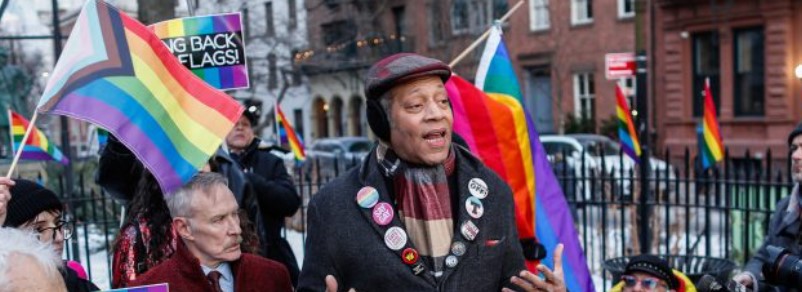
The Pride flag has been pulled down from the Stonewall National Monument in New York — not by accident, not by storm damage, but because of rules imposed under the Trump administration that now ban any flag other than the U.S. banner and a handful of official emblems. The removal, enforced by the National Park Service memo dated January 21, has sparked outrage from New York’s Democratic mayor, LGBT+ organizations and a crowd of protesters who gathered in front of the Stonewall Inn to say: you don’t get to erase us.
The flag that says “we were here”
Stonewall isn’t just another historic site. It marks the 1969 riots that broke out after a police raid on the Stonewall Inn in Greenwich Village — six days of confrontation that became a turning point for the modern LGBT+ rights movement in the United States. The area was designated a national monument in 2016, specifically to honor that history: the bar, the park and the surrounding streets are a living memorial to queer resistance. Removing the rainbow flag from that space hits like a deliberate act of symbolic cleansing.
New York’s Democratic mayor Zohran Mamdani called the move “outrageous”, reminding the world that “New York is the birthplace of the modern LGBT+ rights movement, and no act of erasure will ever change, or silence, that history.” For many in the community, the flag at Stonewall isn’t décor. It is a declaration: we were here, we are here, and we’re not leaving.
“A slap in the face”
On Tuesday night, around a hundred protesters gathered in the park facing the Stonewall Inn, many wrapped in rainbow flags, to denounce the decision. For Jade Runk, a 37‑year‑old trans woman, the message is brutal: taking down the flag “in front of a historic site like this is simply a slap in the face,” she said. “It’s a message that says, ‘we don’t want you to exist’.”
Another protester, 29‑year‑old Aleksander Douglas, described the move as “unacceptable behavior from an autocratic government erasing a minority,” waving a Pride flag in open defiance. Their anger isn’t just about fabric on a pole. It’s about who gets to be visible, who gets to be honored, and who is being pushed back into the shadows.
GLAAD, one of the major LGBT+ advocacy groups in the U.S., stressed that “the values of inclusion and freedom embodied by the Pride flag cannot be erased.” Brandon Wolf of the Human Rights Campaign went further, condemning the Trump administration’s obsession with trying to “stamp out the joy and pride Americans feel for their communities.” The National Park Service, for its part, has declined to comment. Silence speaks loudly.
A broader rollback on LGBT+ rights
This is not an isolated bureaucratic quirk. Since returning to the White House a year ago, Donald Trump has aggressively hit the brakes on LGBT+ progress, and especially on trans rights. On day one of his new term, he declared there were only “two sexes, male and female” and invoked a single “biological truth,” signalling a hardline agenda against gender diversity.
Since then, his administration has moved to limit access to gender‑affirming care, attempted to restrict trans healthcare and social recognition, and pushed narratives that deny the legitimacy of trans lives under the guise of “protecting” children or defending “biology.” In that context, ripping the Pride flag from Stonewall looks less like a neutral rule about flag protocols and more like part of a wider campaign to shrink queer visibility in public space.
Why this matters for our community
For many LGBT+ people, Stonewall isn’t just American history; it’s shared queer history. The Pride marches we attend, the slogans we chant, the rights we’ve won and are still fighting for all trace a line back to that bar and those six nights where queer and trans people refused to be pushed around by police any longer.
When a government enforces rules that strip away the symbol of that struggle from the very site where it began, it’s not “just a flag”. It’s an attempt to reframe whose story gets told on “official” ground. It says: your struggle is tolerated in the margins, but not sanctioned, not honored, not flown.
And yet, the response at Stonewall also reminds us of something else: our history has never depended on permission. Protesters showed up. Flags reappeared in people’s hands, on their backs, in their chants. The act of erasure is real, but so est la réponse : noisy, visible, stubborn.
Want to follow and support?
Here are some useful starting points to stay informed and get involved (or to share with friends who are asking what they can do):
Legal and policy tracking on anti‑LGBT+ and anti‑trans measures in the U.S. (maps and overviews):
– ACLU LGBT & HIV Project: https://www.aclu.org/issues/lgbtq-rights
– Local/state queer organizations that document attacks on trans healthcare and rights.
GLAAD – U.S. media‑watch and LGBT+ advocacy:
https://www.glaad.org
Human Rights Campaign (HRC) – national advocacy org on LGBT+ rights and legislation:
https://www.hrc.org
Stonewall Inn & Stonewall National Monument (history and context):
– National Park Service info on Stonewall National Monument
– Stonewall Inn official site / community updates
You may also like
-

One Last Warm-Up: Brussels Still Has Time to Join the Biggest LGBTQI+ Choir at ING Arena
Brussels has already been singing queer for weeks, and now one of the most open
-

Lille Pride 2026 is back to claim the city in color
Lille Pride returns on Saturday 30 May 2026 with a full day of community, visibility and celebration,
-

Brussels Is About to Sing Queer: Various Voices 2026 Unfolds Across the City
From 24 to 28 June 2026, Brussels will host Various Voices, Europe’s flagship LGBTQI+ choir festival,
-

Brussels Stands with Senegal’s LGBTQIA+ Community as Repression Gets Worse
Senegal has sharply intensified its anti-LGBTQIA+ repression in 2026, with a new law that increases
-
Queer Mess Open Air: 16 Hours of Queer Joy at Circle Park
On 30 May 2026, Queer Mess Open Air takes over Circle Park in Anderlecht for
 Nederlands (België)
  English
  Français de Belgique