
Alfred Kinsey didn’t set out to become a queer icon, but his work quietly cracked open the rigid categories that still shape how people think about sexuality. For many LGBTQ+ people, his most enduring legacy is not a book or an institute, but a simple, radical idea: sexuality exists on a spectrum, not in fixed boxes.
Who was Alfred Kinsey?
Alfred Kinsey was an American scientist born in 1894 who started his career studying insects, not humans. Later, at Indiana University, he turned his research skills toward one of society’s biggest taboos: sex.
In the late 1940s and early 1950s, he and his team collected thousands of detailed, anonymous sexual histories from people across the United States. The results were published in two landmark volumes, “Sexual Behavior in the Human Male” (1948) and “Sexual Behavior in the Human Female” (1953). These books revealed a huge gap between what people said they believed about sex and what they actually did.
The Kinsey Scale, in plain language
Out of this massive research came what is now known as the Kinsey Scale, a 7‑point scale running from 0 to 6.
- 0 means exclusively heterosexual.
- 6 means exclusively homosexual
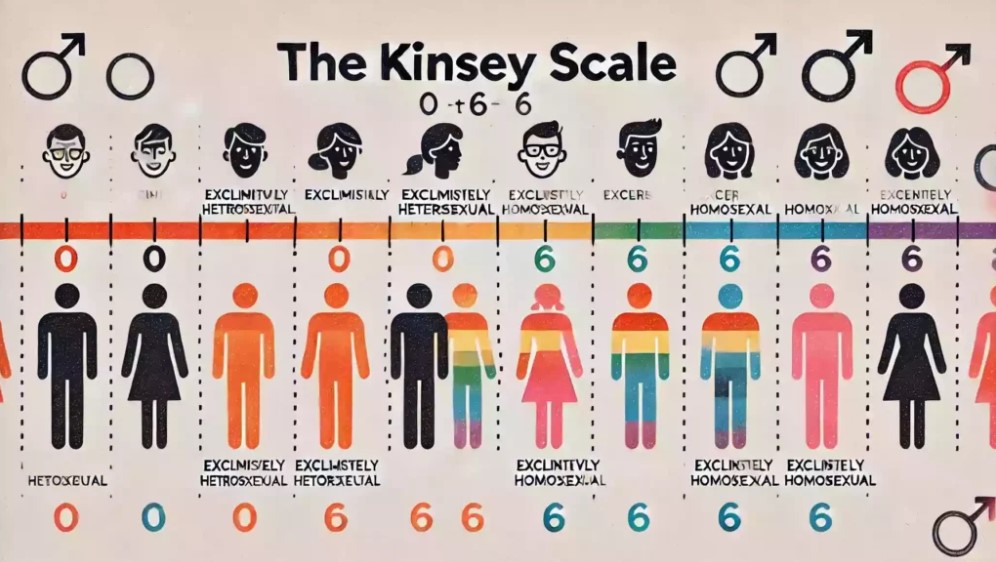
Everything in between marks different degrees of attraction to more than one gender. What really matters is the logic behind the scale: instead of asking “Are you gay or straight?”, Kinsey asked “How much, and in what ways, are you attracted to different genders?”
That shift might sound simple, but it was revolutionary. It acknowledged that many people’s experiences and desires don’t fit neatly into either “straight” or “gay,” and that sexual orientation is not always a fixed, either/or identity.
Why this spectrum matters for LGBTQ+ people
For queer and questioning people, the Kinsey Scale offers language for the messy middle that is so often erased. It gives conceptual room for:
- People who mostly date one gender but occasionally feel attraction to another.
- Bi, pan, and queer folks who experience their sexuality as fluid over time.
- Anyone who never felt that “100% straight” or “100% gay” fit their lived reality.
In a world that still pushes binary thinking, the idea of a continuum can be deeply validating. It says: you are not confused, broken, or “not queer enough” just because your desires don’t line up with rigid labels. Your place on the spectrum is allowed to be complex, shifting, or hard to name.
Beyond labels: embracing fluidity
The Kinsey Scale is not perfect or complete. Modern research uses more nuanced models that consider identity, behavior, romantic attraction, gender experience, and more. But the core message still resonates strongly in LGBTQ+ communities: sexuality is diverse and often fluid.
For someone coming out later in life, or moving from identifying as straight to bi to queer, the scale can offer a sense of continuity rather than contradiction. It frames change not as “lying about who you were before” but as learning more about where you sit on a spectrum that was always there.
Making space for the in‑between
Queer spaces often celebrate labels as tools of visibility and community, but those same labels can become gatekeeping devices. The Kinsey perspective invites a different approach: instead of asking whether someone is “really” straight, bi, or gay, it asks how their experiences and attractions show up along a continuum.
For LGBTQ+ people, that can mean:
- Accepting that sexuality can be situational, contextual, or evolving.
- Honoring identities that sit between or beyond familiar categories.
- Reducing shame around “not fitting” a label perfectly.
In that sense, the most queer thing about Kinsey’s work is not the numbers 0 to 6 themselves, but the permission they represent. They tell a story that many LGBTQ+ people know intimately: desire rarely fits into tidy boxes, and there is nothing wrong with living in the space between.
You may also like
-
One Last Warm-Up: Brussels Still Has Time to Join the Biggest LGBTQI+ Choir at ING Arena
Brussels has already been singing queer for weeks, and now one of the most open
-
Lille Pride 2026 is back to claim the city in color
Lille Pride returns on Saturday 30 May 2026 with a full day of community, visibility and celebration,
-
Brussels Is About to Sing Queer: Various Voices 2026 Unfolds Across the City
From 24 to 28 June 2026, Brussels will host Various Voices, Europe’s flagship LGBTQI+ choir festival,
-

Brussels Stands with Senegal’s LGBTQIA+ Community as Repression Gets Worse
Senegal has sharply intensified its anti-LGBTQIA+ repression in 2026, with a new law that increases
-
Queer Mess Open Air: 16 Hours of Queer Joy at Circle Park
On 30 May 2026, Queer Mess Open Air takes over Circle Park in Anderlecht for
 English
  Français de Belgique
  Nederlands (België)