
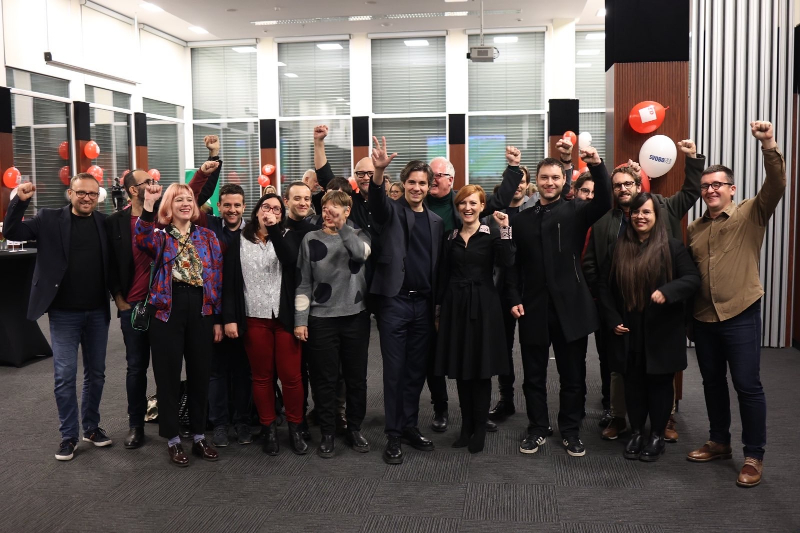
Slovenia’s Parliament has enacted changes to the country’s Family Code that have now delivered Marriage Equality for same-sex couples.
The legislative change follows a recent court decision that found that not allowing same-sex couples to marry was a violation of the anti-discrimination provisions of Slovenia’s constitution.
Speaking about the changes to the Family Code, the President of Slovenia – Nataša Pirc Musar – said: “Human rights are neither left nor right. They are universal and we all have them. Above all, they are never taken for granted, you have to fight for them every day. As societies develop, so does human rights law, which breaks down prejudices and applies to everyone. That is why I am happy and proud that today in Slovenia we are on the path of fully equalising the rights of same-sex partners with the rights of heterosexual couples in terms of the possibility of entering into marriage and jointly adopting a child.”
What’s life like for LGBTQ people in Slovenia?
What’s life like for LGBTQ people in Slovenia? Let’s take a look at some of the key equality indicators.
Is homosexuality legal in Slovenia?
Yes. Same-sex sexual activity was decriminalised in 1977.
The age of consent is 15, regardless of sexuality.
Are there anti-discrimination protections in place for LGBTQ people in Slovenia?
Yes. A court decision in 2009 confirmed that the country’s constitution bans discrimination on the basis of sexuality.
Is there Marriage Equality in Slovenia?
Yes. Legal recognition of same-sex relationships was introduced in 2006. Following a subsequent court ruling, legislation was enacted in 2023 that delivered Marriage Equality for same-sex couples.
What’s life like for LGBTQ people in Slovenia?
Slovenia is a socially conservative country, but things do seem to be slowly improving.
There is a visible and vibrant LGBTQ community in Ljubljana.
You may also like
-

At Liège’s Queer Families Festival, Every Family Has a Story
The third edition of the Queer Families Festival takes place on 11 October at the
-

“After”: Listening to LGBTQIA+ Survivors Speak About Intimate Partner Violence
On 8 October, Tels Quels invites people to Les Grands Carmes in central Brussels for
-
Liège’s Maison Arc-en-Ciel Needs Support to Keep Its Doors Open
Maison Arc-en-Ciel de Liège, a vital LGBTQIA+ community hub in Wallonia, is facing growing financial
-
Garden Party de la Maison Arc-en-Ciel de Liège
Liège’s Maison Arc-en-Ciel is bringing back its annual Garden Party on Saturday 5 September 2026.
-
IGLYO Wants to Hear From You: Europe’s Biggest LGBTQI School Survey Is Back
IGLYO, the Brussels-based international LGBTQI youth network, has just launched the second edition of its