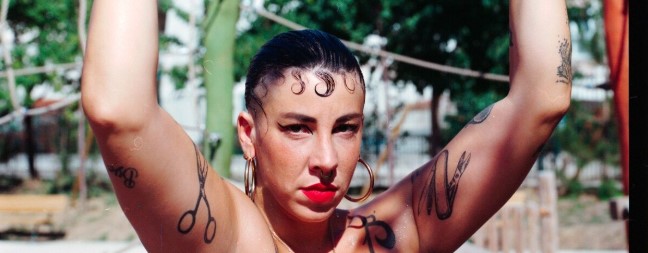
With “Décoloniser le dancefloor”, performer, activist and voguer Habibitch turns the club and the stage into a space of critical reflection. Blending theory, personal testimony and dance, this lecture‑performance reveals how power, privilege and resistance play out on the dancefloor – and invites us to imagine nightlife as a decolonial, feminist and queer space.
In this performance‑talk, Habibitch starts from a simple observation: the dancefloor is never “just a party”. Who gets in, who feels safe enough to take space, whose bodies and dances are celebrated or exoticised – all of this is shaped by histories of racism, colonialism, sexism, queerphobia and class. Drawing on club cultures, ballroom, waacking and feminist of colour theory, she shows how nightlife can both reproduce domination and offer tools to resist it.
The piece questions the myth of the “neutral” or “inclusive” dancefloor. From door policies and “face control” to the way Black and Brown dance styles are appropriated, commodified and stripped of their political roots, “Décoloniser le dancefloor” connects the dots between everyday party practices and broader systems of oppression. At the same time, it highlights the role of queer and racialised communities in inventing spaces of joy, care and collective empowerment on and off the dancefloor.
On stage, theory is never dry. Habibitch uses her body, her dance and her voice to embody the questions she raises: how does a racialised, queer, often hyper‑sexualised body move in spaces not built for it? How do we navigate desire, vulnerability and danger in clubs? How can choreography make visible the invisible boundaries that separate “welcome” bodies from those perceived as “too much”, “out of place” or “undesirable”?
The performance also offers concrete tools for imagining other ways of partying. It invites audiences – club‑goers, organisers, DJs, venue managers and allies – to rethink codes of behaviour, music programming, spatial organisation, access and care. The goal is not to moralise nightlife, but to politicise joy: to see the dancefloor as a potential laboratory for decolonial, anti‑racist, queer and feminist futures, where pleasure, consent and safety are shared responsibilities.
For queer, racialised and marginalised audiences, “Décoloniser le dancefloor” can feel like a moment of recognition: someone is finally naming what many have felt in their bodies for years. For others, it may be an uncomfortable but necessary first step towards understanding that “fun” is not equally accessible to everyone. In both cases, the work insists that there is no such thing as “just a night out” when our bodies carry histories, territories and power relations onto the floor.
Useful links
Context on decolonising public and cultural spaces in Brussels: https://urban.brussels/
Event page on visit.brussels (practical info, date and tickets): https://www.visit.brussels/
Les Halles de Schaerbeek (venue, full programme and accessibility info): https://www.halles.be/
Habibitch – performances, workshops and talks (if available): search “Habibitch decoloniser le dancefloor” via your preferred browser
KET Magazine is a community‑driven, non‑profit magazine run by volunteers based in Brussels. Get in touch to share your thoughts or tell us about your activities. You can also promote your events on our website or support our work with a donation. Contact us at Info@ket.brussels.
You may also like
-

Benefit Party at Les Halles de Schaerbeek puts trans solidarity center stage
On 17 and 18 April, Les Halles de Schaerbeek hosts Benefit Party, a two-day fundraising event
-

Designing Childhood at Design Museum Brussels: how children shaped the future of design
From 1 April to 20 September 2026, Design Museum Brussels presents Designing Childhood. A History of
-
Mothers and Daughters: calling for memories, building a collective queer archive
Mothers and Daughters, Brussels’ beloved lesbian & trans bar and art space, is looking back on
-

Doel Festival: the ghost village that refused to die – and turned itself into a dancefloor
On 25 July, Doel Festival returns for its fifth edition and once again turns Belgium’s
-

Clément Legrand at the Maison Arc-en-Ciel Liège: celebrating the beauty of the male body
Next Friday, April 3, 2026, the Maison Arc-en-Ciel Liège welcomes French artist Clément Legrand for a
