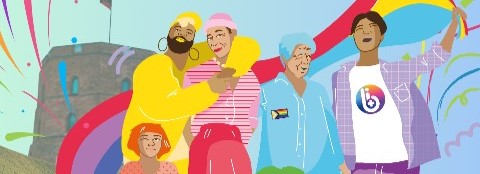
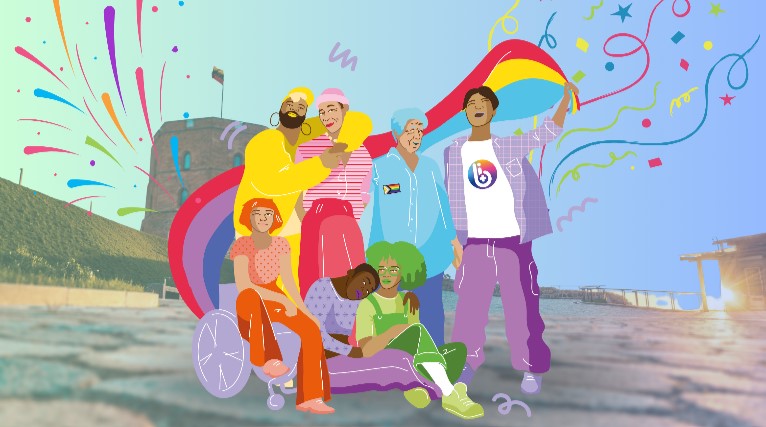
Faced with family rejection, still‑closed closets and precarity, LGBT+ people in Belgium keep building their own families: solidarity house‑shares, mutual aid networks, co‑parenting, rainbow houses and safe spaces. Behind the words “chosen family” are survival strategies – but also a lot of joy.
For many LGBT+ people, family is not about genealogy, blood ties or civil status. It is built with close friends, exes turned allies, flatmates, people met in an association or a queer bar, long‑term confidants. “Chosen family” describes these emotional and practical networks that allow us to stay afloat in a world where the family of origin has not always been a refuge.
In 2026 in Belgium, this notion is anything but abstract. It takes very concrete forms: intergenerational queer house‑shares, WhatsApp mutual aid groups, Sunday dinners in rainbow houses, LGBT+ parents who stitch together support networks for their kids. And in the background, there are stories of rupture: coming‑outs that went badly, heavy silences, conditions attached to being “accepted”.
Rainbow houses, local LGBT+ centres and associations play a key role in this landscape. In Brussels, Antwerpen, Liège, Namur, Mons, Ghent or Charleroi, these spaces become living rooms, kitchens, village squares. Birthdays are celebrated there, break‑ups are cried over, and someone is always around to listen when the closet is still firmly shut at home.
Chosen family does not always replace family of origin: for some, it is an extra layer, an additional safety net, a way to feel less alone even when “blood” parents are still in the picture. For others, it is a full‑on alternative, a way of rebuilding from scratch after a violent rupture or rejection.
In practice, these chosen families tend to organise around three main axes:
- Material support (help with moving, emergency accommodation, lending money, childcare).
- Emotional support (listening, validation, sharing queer experiences, going out together, being present for a coming‑out).
- Political support (marching together at Pride, creating a collective, meeting to write letters or put pressure on decision‑makers).
Academic work on the topic – especially in social work and sociology – underlines that these chosen ties can be just as structuring and protective as “classic” family bonds. In Belgium, recent research shows that chosen families play a key role in preventing distress, suicidal ideation and isolation among LGBT+ youth.
Yet this reality remains largely invisible in public policy. Most schemes (housing, leave, visitation rights, tax rules) are still designed for heterosexual nuclear families. Recognising chosen families would also mean changing these frameworks: allowing a non‑biological queer “aunt” to have a legal role, granting leave to accompany a chosen loved one at the end of life, opening social housing criteria to solidarity house‑shares.
In everyday life, however, chosen families overflow the administrative boxes. They invent their own rituals: “un‑birthday” parties, “family” dinners on 24 December for those who no longer go back to their parents’ home, celebrations of gender transition or new names. They create affective archives: holiday pictures, photo albums, memories that are not “alternative” at all – they are simply family.
Talking about “chosen family” also helps to name racialised and migrant realities. For queer people from diasporas, chosen family can be a space where multiple cultural belongings coexist, where racism within LGBT+ spaces can be discussed, and where transnational solidarities can be built. It is also a way of resisting the idea that family must be heteronormative, white and middle‑class.
In Belgium, several associations explicitly work on these questions. Support groups bring together people rejected by their families of origin, queer house‑share collectives pool rent and energy, and university research projects document these practices of chosen kinship. Rainbow houses, LGBTI+ centres and local antennas become anchor points for these family constellations.
Useful links (Belgium):
Academic study on chosen families in queer communities in Belgium:
http://www.diva-portal.org/smash/get/diva2:1805273/FULLTEXT01.pdf
RainbowHouse Brussels: https://rainbowhouse.be
Çavaria (Flanders): https://www.cavaria.be
Maison Arc‑en‑Ciel de Namur: https://www.macnamur.be
Homoparentalités asbl (LGBTQI+ families): https://www.homoparentalites.be
Arc‑en‑Ciel Wallonie (Francophone LGBTQI+ platform): https://www.arcencielwallonie.be
You may also like
-

Doel Festival: the ghost village that refused to die – and turned itself into a dancefloor
On 25 July, Doel Festival returns for its fifth edition and once again turns Belgium’s
-
Ten Years After the Brussels Attacks, a City – and Its Queer Community – Still Carry the Shock
Ten years after the 22 March 2016 bombings at Brussels Airport and Maelbeek metro station,
-

Ixelles Museum is back: a new chapter for Brussels art lovers
After years wrapped in scaffolding and anticipation, the Musée d’Ixelles / Ixelles Museum is finally reopening its
-

Niall Horan, Soft-Spoken Pop Star – And Loud LGBTQ+ Ally
From Pride tweets to rainbow flags in the crowd, Irish singer Niall Horan has quietly
-

Angèle x Justice’s “What You Want”: A Queer Night Out We’ve All Dreamed Of
Projected onto the façade of La Monnaie in Brussels and shot at night in Marseille
