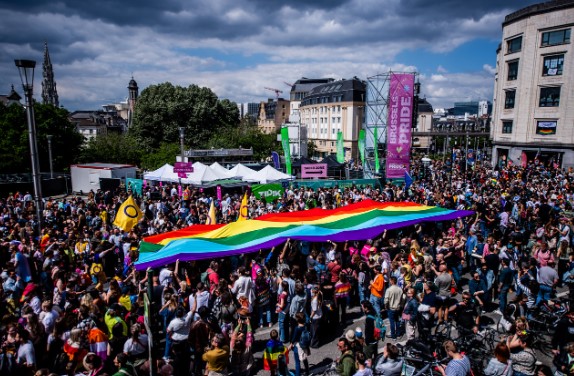
For decades, the “homosexual movement” imagined itself – and was imagined – as a natural extension of left‑wing struggles: anti‑capitalist, feminist, anti‑racist, internationalist. Early post‑Stonewall organisations such as the Gay Liberation Front explicitly aligned with revolutionary liberation fronts, anti‑war campaigns and Black and feminist movements. Yet, half a century later, the landscape is far more complex: some LGBT+ people now see themselves reflected in right‑wing, even far‑right, discourses, without necessarily feeling they are betraying “their side”.
A movement historically rooted in the left
Historians like Jeffrey Weeks and Kenneth Plummer show that homosexual emancipation initially took shape in the wake of socialist and radical left movements, in Europe and North America alike. From Magnus Hirschfeld in Germany to the FHAR in France, and from the British Gay Liberation Front to collectives such as “Gay Left”, the fight against homophobia was inseparable from a broader critique of class, gender and race relations.
In this framework, being gay primarily meant being on the side of the “oppressed”: against the police, against psychiatrisation, against moral order, and therefore instinctively alongside progressive movements. This memory still shapes a large part of queer activist spaces, which continue to see LGBT+ equality as tied to social justice, migrant rights and feminism.
LGBT electorates: still mostly left‑leaning, but less monolithic
Electoral studies show that sexual minorities, on average, remain more likely to vote for left‑wing or centre‑left parties than heterosexuals. Analyses of the “lavender vote” suggest this support stems from parties’ stronger commitment to LGBT+ rights, but also from more progressive values on social issues.
However, this apparent homogeneity is eroding: some gay voters – especially white, male and more affluent – are turning away from left‑wing parties, which they see as overly focused on other groups (migrants, religious minorities, precarious youth, etc.). In several European countries, surveys indicate that mainstream right‑wing parties and, to a lesser extent, parts of the radical right are attracting a small but growing share of LGBT voters.
When the right discovers it can be “gay‑friendly”
To understand this partial shift, we also need to look at how segments of the right have appropriated LGBT‑rights rhetoric. Political scientists and analyses published in the Journal of Democracy describe how some European conservative parties foreground their “tolerance” toward gays to distance themselves from religious hardliners and the most reactionary currents.
In Western Europe, several right‑wing and even radical right parties now deploy an ambivalent discourse: they claim to protect gays and women… against a designated enemy, often Muslims or migrants. This national “pinkwashing” presents itself as a defence of sexual minorities, but in practice it legitimises securitarian, xenophobic or Islamophobic policies.
Homonationalism: when the rainbow flag serves the nation
It is in this context that theorist Jasbir K. Puar coined the concept of “homonationalism” in Terrorist Assemblages: Homonationalism in Queer Times (2007). Puar shows how Western states mobilise the figure of the “good homosexual” – white, cis, integrated, consumerist – as proof of their modernity, in order to oppose a supposedly tolerant “Us” to a backward “Them”, often Muslim or non‑Western.
Homonationalism does not mean that gays are “racist by nature”; it names a political arrangement: the conditional inclusion of certain LGBT+ subjects in the national narrative, at the price of excluding or stigmatising other minorities. Within this logic, defending equal marriage can coexist with support for anti‑migrant laws, securitarian policies or military interventions, all in the name of a supposedly “gay‑friendly” civilisation.
Gay votes for the far right: numbers and fault lines
Recent online surveys suggest that far‑right parties now enjoy non‑negligible support among some queer voters, especially in Europe. An article on GAY45, based on polling among users of the dating app Romeo and on recent European election results, highlights for instance:
- In France, around 17% of queer voters choosing the Rassemblement national in one election, with even higher support among married gay men.
- In Austria, over 30% of queer respondents saying they vote for the FPÖ, a far‑right party with an openly xenophobic track record.
These figures must be handled cautiously (online sampling, selection biases), but they confirm a trend: the radical right is no longer a universal red line for all LGBT voters. Motivations often cited include Islamophobia, fear of immigration, rejection of “political correctness”, or the perception that the left no longer truly cares about cis gay men.
Social and identity shifts behind the politics
Sociological work also points to the effects of the “normalisation” of gay lives: access to marriage, parenthood, and an overall improvement in the socio‑economic status of some LGBT groups, particularly white gay men in big cities. This relative integration can foster more individualist political trajectories, where priorities shift toward taxation, security or asset protection rather than solidarity with other minorities.
In that context, some gay men feel represented by right‑wing discourses promising to safeguard their living standards, neighbourhoods or borders, while assuring them that their formal rights (union, visibility) will remain untouched. Where the left is perceived as pushing broader agendas – anti‑racist, feminist, environmental – some experience a disconnect from their own priorities, or even feel criticised as “privileged” within activist circles.
Nuancing without excusing
Acknowledging that some LGBT people vote for the right or the far right does not mean essentialising them or endorsing that choice. It does, however, force the LGBT+ movement to confront its own blind spots: its whiteness, class biases, the centrality of cis men, and its sometimes ambiguous relationship to the state and the police.
Concepts such as homonationalism invite us to shift the focus: the question is not about sorting “good” from “bad” gays, but about understanding how our identities can be instrumentalised by political projects that ultimately endanger other members of our communities, especially trans, racialised, migrant or precarious people. For an LGBT audience, the challenge is twofold: refusing to be cast as a “model minority” in service of an exclusionary national story, and continuing to build solidarities that reach beyond our own bubbles.
Further reading (with links)
Research on the “lavender vote” and sexual minorities’ voting behaviour (example on ScienceDirect):
https://www.sciencedirect.com/science/article/abs/pii/S0261379422000993
Jasbir K. Puar, Terrorist Assemblages: Homonationalism in Queer Times and the article “Rethinking Homonationalism” (PDF, University of Bristol):
https://www.bristol.ac.uk/media-library/sites/law/documents/Puar%20-%20Rethinking-Homonationalism.pdf
“Left-Wing Homosexuality: Emancipation, Sexual Liberation, and Identity Politics”, New Politics:
https://newpol.org/issue_post/left-wing-homosexuality-emancipation-sexual-liberation-and-identity-politics/
“Leftist sexual politics and homosexuality: a historical overview” (article indexed on PubMed):
https://pubmed.ncbi.nlm.nih.gov/8666751/
“Why Europe’s Right Embraces Gay Rights”, Journal of Democracy:
https://www.journalofdemocracy.org/articles/why-europes-right-embraces-gay-rights/
GAY45 feature, “Extreme Far-Right Queer Movement in Europe Confirmed by Austrian and German Elections”:
https://gay45.eu/elections/
You may also like
-

Mothers and Daughters: calling for memories, building a collective queer archive
Mothers and Daughters, Brussels’ beloved lesbian & trans bar and art space, is looking back on
-

“The LGBT Lobby” Is a Lie: Why This Old Fantasist Myth Still Fuels Real Violence
For decades, anti-LGBT+ voices have recycled the same tired story: that queer people form a
-

Say cheese! Rainbowfriends hosts a cozy Wine & Cheese Night this April
Looking for a chill evening filled with flavour and friendship? On April 26, 2026, the LGBTQ+ community
-

Portugal set to roll back trans self-determination law: what’s at stake?
Portugal, long seen as a frontrunner on trans rights in Europe, is on the verge
-

Sing It Queer: open your home (and your city) to 4,000 LGBTQI+ voices
From 24 to 28 June 2026, Various Voices Brussels 2026 will turn the capital into
