In an influential essay published by Le Grand Continent, Jean-Louis Missika and Henri Verdier describe a “new media regime” dominated by platforms and algorithms that fragment the public sphere into countless parallel realities. For LGBTQ+ people and queer media in Brussels, this diagnosis is not just theory – it helps explain both new opportunities for visibility and the growing risks of polarisation, hate and disinformation.
A short guide to the “new media regime”
In “Le nouveau régime médiatique”, available in French on Le Grand Continent, the authors trace three major media eras: the print-based press, the age of mass broadcast (radio and TV), and the current regime built around the web, platforms and social networks. The first two regimes helped create a shared public space where most people received the same news at the same time, even if many voices – including queer ones – were marginalised or silenced.
The new regime, they argue, works in the opposite way: instead of one common agenda, platforms distribute different messages to different people at different moments, guided by opaque algorithms that optimise attention and engagement. The result is an “atomised” public sphere where smaller, more homogeneous groups interact mostly with content that confirms their views, while rarely crossing paths with others.
You can read the full article (in French) here: https://legrandcontinent.eu/fr/2023/02/07/le-nouveau-regime-mediatique-i/
Polarisation, bubbles and the cost for democracy
Missika and Verdier describe how this new regime fuels political polarisation by pushing media towards more opinion-driven content and by rewarding emotional, extreme or divisive messages. In their view, platforms have created a permanent “political fog”: topics appear and disappear at high speed, there is no longer a clear table where society negotiates priorities, and the old organisers of public debate – traditional media, parties, institutions – struggle to keep up.
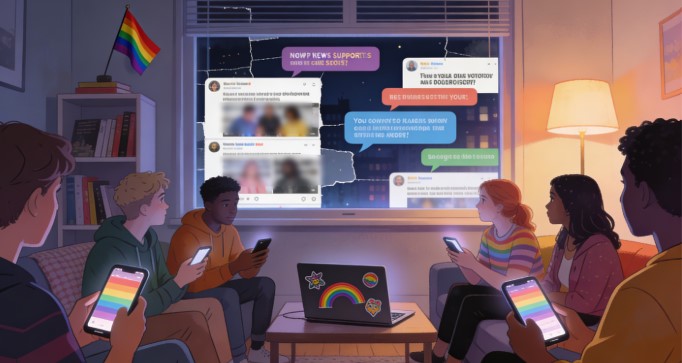
For LGBTQ+ communities, this environment is double-edged. On the one hand, queer people can build their own spaces, find information that was never visible in mainstream outlets, and organise transnational solidarity across borders. On the other, the same mechanisms allow anti-LGBTQ+ actors to coordinate harassment campaigns, spread disinformation and normalise hate speech inside closed ecosystems that are hard to monitor or regulate.
Why this matters for queer media like Ket
As a Brussels-based queer magazine, Ket is part of this new media regime: we publish online, share content on Instagram and other platforms, and talk to niche audiences with specific interests, identities and needs. Reading Le Grand Continent’s analysis helps understand both our power and our limits.
On the one hand, queer media can use this fragmented landscape to amplify voices that mainstream outlets still overlook, tell local stories in Brussels that speak to global queer experiences, and connect readers who might feel isolated in their offline environments. On the other, we are also subject to algorithmic visibility, platform policies and the volatility of online attention – factors that can suddenly boost or bury LGBTQ+ content without transparency or accountability.
This article encourages us to think strategically: how do we build bridges between bubbles, reach beyond our comfort zones, and maintain spaces for nuanced, democratic conversation about queer lives in a media environment that often rewards speed and outrage over depth and care?
Reading this as an LGBTQ+ person in Brussels
For queer readers in Brussels and beyond, engaging with “Le nouveau régime médiatique” is a way to put words on a daily feeling: timelines moving too fast, conversations collapsing into conflict, and the sense that we don’t all live in the same information world anymore. It also offers tools to ask better questions: Who curates my feed? Which voices are missing from my media diet? How can I support queer and minority-led outlets that invest in context instead of clicks?
This is not a pessimistic text; it’s an invitation to rethink how we inform, organise and protect ourselves in a time when platforms have quietly reconfigured power over information. For LGBTQ+ communities whose rights and safety are often debated in these fragmented spaces, understanding the rules of this “new regime” is part of staying safe, staying loud and staying connected.
Original article “Le nouveau régime médiatique (I)” (in French) – https://legrandcontinent.eu/fr/2023/02/07/le-nouveau-regime-mediatique-i/
About Le Grand Continent – https://legrandcontinent.eu/fr/a-propos/
KET Magazine is a community‑driven, non‑profit magazine run by volunteers based in Brussels. Get in touch to share your thoughts or tell us about your activities. You can also promote your events on our website or support our work with a donation. Contact us at Info@ket.brussels.
You may also like
-
Exhibition — I Am Here: Self-portraiture, selfies, and the power of visibility
From April 3 to May 31, 2026, the Université libre de Bruxelles (ULB) presents I Am
-
Various Voices 2026: Brussels Prepares for Europe’s Biggest LGBTQI+ Choir Festival
From 24 to 28 June 2026, Brussels will host Various Voices, Europe’s flagship LGBTQI+ choir
-

This Friday at UMI: Baile TRAMA lands in Brussels
This Friday at UMI: Baile TRAMA brings Brazil’s underground to Brussels This Friday, UMI welcomes Baile TRAMA, a
-
Benefit Party at Les Halles de Schaerbeek puts trans solidarity center stage
On 17 and 18 April, Les Halles de Schaerbeek hosts Benefit Party, a two-day fundraising event
-

Designing Childhood at Design Museum Brussels: how children shaped the future of design
From 1 April to 20 September 2026, Design Museum Brussels presents Designing Childhood. A History of
