
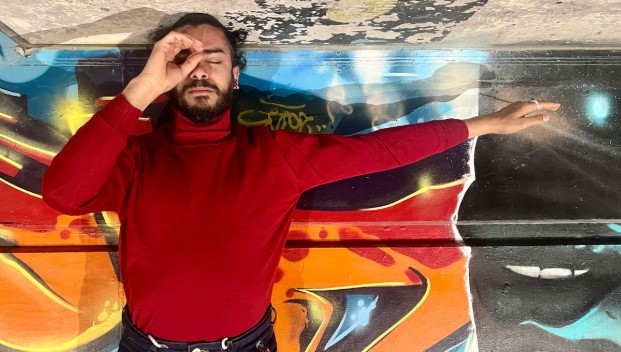
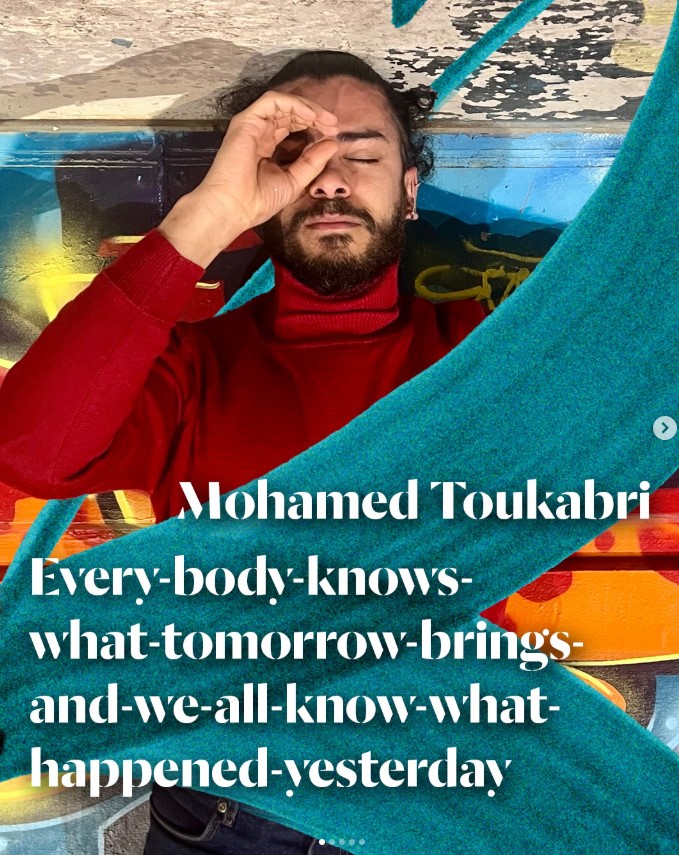
With Every-Body-Knows-What-Tomorrow-Brings-And-We-All-Know-What-Happened-Yesterday, choreographer Mohamed Toukabri offers an intimate and political solo where every movement asks what we choose to pass on, erase, or protect in our personal and collective histories. Set in Brussels, the piece resonates strongly with LGBTQI+ lives shaped by migration, family silences, and bodies that refuse to disappear.
Body
Under its long manifesto-like title, Every-Body-Knows-What-Tomorrow-Brings-And-We-All-Know-What-Happened-Yesterday invites the audience into a space where the body holds both memory and projection. On stage, Toukabri dances with ghosts: family stories, social expectations, the weight of borders and the fantasies placed on racialised and queer bodies. As queer people, it is hard not to recognise ourselves in this tension between what we have lived, what we are allowed to say, and what we are still scared to remember.
The piece is a solo, but it never feels lonely. Toukabri’s presence constantly opens a dialogue with the audience, turning us into witnesses rather than passive consumers. His movement language shifts between vulnerability and control, softness and sharpness, as if the body kept switching modes to survive – a feeling many LGBTQI+ people know well. How do you move when you are watched, exotified, policed, or forced to perform a version of yourself that feels safe for others?
Brussels is not just a backdrop here; it is part of the story. As a city of migration and crossroads, it concentrates lives marked by exile, care networks, chosen families and queer nightlife that often become spaces of survival. Presenting this work in Brussels also means acknowledging the role of local institutions and stages in giving visibility to artists who bring complex, intersectional narratives to the forefront. For racialised and migrant queer communities, seeing these stories centred on stage is not a luxury – it is recognition.
The title itself sounds like a warning and a promise: everybody knows what tomorrow brings, and we all know what happened yesterday. For LGBTQI+ communities, “yesterday” can mean criminalisation, AIDS crises, police violence, conversion practices, families that cut ties. “Tomorrow” can mean backlash against our rights, but also new solidarities, new forms of kinship, new ways of archiving our lives so they cannot be erased again. The solo navigates exactly this fragile line, refusing both nostalgia and naïve optimism.
If you are planning a queer night out in Brussels, this performance offers more than a cultural fix; it opens questions you might want to continue discussing afterwards, in a bar, at a party or during Pride. It echoes the broader political climate in which Brussels Pride takes place, where the slogan “When times get darker, we shine brighter” feels less like marketing and more like a survival strategy. Watching Toukabri move is a reminder that our bodies keep score: of what we have endured, what we dream of, and what we refuse to accept.
To prepare your visit, you can check practical information and tickets directly on the event page:
https://www.visit.brussels/fr/visiteurs/agenda/event-detail.Every-body-knows-what-tomorrow-brings-and-we-all-know-what-happened-yesterday.5700010699
After the show, you might also want to reconnect with the wider LGBTQI+ ecosystem in Brussels – from community centres to mental health resources and nightlife spots – to keep these reflections grounded in real spaces of care and resistance. A performance does not change everything, but it can shift how we inhabit our own bodies, and how we look at those of others.
KET Magazine is a community‑driven, non‑profit magazine run by volunteers based in Brussels. Get in touch to share your thoughts or tell us about your activities. You can also promote your events on our website or support our work with a donation. Contact us at Info@ket.brussels.
You may also like
-
In Mons, Regards pluriels explores a century of Belgian art through the lens of communist utopia
From 11 April to 16 August 2026, Mons’ CAP / Museum of Fine Arts presents Regards pluriels. Belgian art
-

Davi Pontes and Wallace Ferreira bring Repertório N.1 to Brussels
From 8 to 13 May 2026, Théâtre Les Tanneurs in Brussels will host Repertório N.1, the latest work
-
Art Brussels 2026 Reading Between the Lines, Shifting the Gaze
Spring in Brussels recalibrates bodies in space, and Art Brussels 2026 makes that shift tangible.
-
Dykes to the Front: Brussels gears up for a queer community night ahead of Dyke March
On 30 April 2026, Beursschouwburg in Brussels will host Dykes to the Front, a free community night for
-
Bongeziwe Mabandla brings South African soul to Brussels
South African singer-songwriter Bongeziwe Mabandla will perform in Brussels on 25 April 2026, with the concert taking