
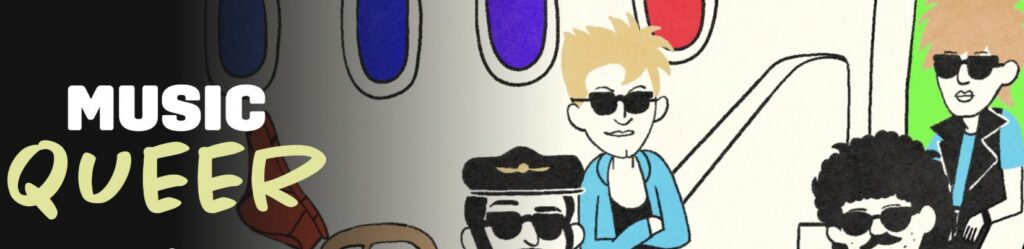
What if every queer anthem you’ve ever screamed in a club came with a mini‑history lesson? With Music Queer, ARTE drops a 20‑episode animated series that turns iconic tracks into bite‑size chapters of LGBTQIA+ social, political and musical history. From Ma Rainey to Lil Nas X, Bronski Beat to Sylvester, Gloria Gaynor to Conchita Wurst, it’s a crash course in how queers have been shaping pop culture for a century — one song at a time.
A queer jukebox on ARTE
Music Queer is a short‑form series created for ARTE.tv by Amandine Fredon and Rebecca Manzoni, with writing by Manzoni and Émilie Valentin and graphics by Leslie Plée. Each episode lasts roughly the length of a song (around three minutes) and focuses on one track that marked queer representation, resistance or joy — think “Smalltown Boy” by Bronski Beat, “I Will Survive” by Gloria Gaynor, “You Make Me Feel (Mighty Real)” by Sylvester, or the queer‑coded explosion of Lil Nas X.
The format is simple and smart: a bit of context about the era, a zoom on the artist, an explanation of what the song meant at the time and how it was received, then a final segment where lyrics appear on screen and the music goes up “karaoke style”. Narrated by Rebecca Manzoni (in French) and voiced by queer and allied artists like Tristan Lopin, Kiddy Smile, Aloïse Sauvage and Shirley Souagnon, the series feels like a friend taking you through their playlist, not a teacher giving a lecture.
Queer music as social history
Together, the 20 episodes map out a century of queer social, political and musical history, showing how LGBTQIA+ themes have always been present in popular music, even when they had to be coded or hidden. Music Queer looks
- early blues and cabaret figures who smuggled queer desire into lyrics and performance
- disco and house tracks that became club‑level survival tools, especially during the AIDS crisis
- French and European artists whose songs carried queer subtexts long before mainstream visibility was thinkable
- contemporary hits that place queer identity front and centre in rap, pop and Eurovision‑adjacent spectacle.
For viewers in Brussels and Belgium, used to juggling French, Dutch, English and more in their daily lives, this multilingual, cross‑border journey feels familiar. It shows how queer culture travels: from US clubs to European radio, from underground scenes to national TV, from whispered verses to loud, unapologetic choruses.
Why it matters for LGBTQIA+ communities
Music Queer matters because it frames queer anthems as history, not just vibes. It reminds us that dancing and singing have often been ways to survive shame, violence and invisibility — and that every banger we love sits in a timeline of struggle and creativity. For younger queers discovering these tracks on streaming platforms, the series offers context: why “Smalltown Boy” still hits so hard, why “I Will Survive” became more than a break‑up song, why Sylvester’s voice mattered in gay clubs in the late 70s.
For older generations, it’s a chance to see their memories honoured in animation, and to connect them to newer voices like Lil Nas X or Eddy de Pretto featured in the line‑up. The tone stays accessible and playful, but the message is clear: queer music is a common good, a shared soundtrack of resistance, joy and everyday resilience.
Practical info
- Title: Music Queer
- Format: Animated mini‑series, 20 episodes of around 3 minutesarte+1
- Where: Streaming on ARTE.tv (full series available online)arte+1
- Creators: Amandine Fredon & Rebecca Manzoni (direction), Rebecca Manzoni & Émilie Valentin (writing) – occitanie-films
- Graphics: Leslie Pléecollectiffamilles+1
- Voices: Tristan Lopin, Kiddy Smile, Aloïse Sauvage, Shirley Souagnon (French version) –occitanie-films
- Broadcast: Online on ARTE.tv, also featured in France Inter’s summer morning showprogrammetv.ouest-france+1
If you’re looking for a way to revisit your favourite queer tracks with fresh ears — or to discover where today’s anthems come from — Music Queer is a perfect playlist‑plus: watch an episode, learn a story, then turn the volume up.
KET Magazine is a community‑driven, non‑profit magazine run by volunteers and based in Brussels. You can find our other music and nightlife stories on ket.brussels, and you can always write to us to share your projects or pitch a story: info@ket.brussels
You may also like
-
Two nights, different gears: Rave Rebels turns up the volume in Brussels
Rave Rebels returns to Brussels’ ING Arena on 6 and 7 November 2026, bringing Faithless,
-

Adam La Nuit: Making Music Between Worlds
For Adam La Nuit, belonging doesn’t mean choosing one world over another. The Belgian-Congolese artist
-

Tels Quels Talent Show: Brussels’ Queer Voices Take the Mic
On Friday 16 October, the Tels Quels Talent Show brings live queer creativity to Les
-

CLELIA Turns Solitude Into a Shared Pop Therapy
The Brussels-based musician opens up to KET about mental health, queer visibility and her new
-

Eli Is Bringing Her Colourful Pop Universe to Brussels
American singer-songwriter Eli is heading to Brussels this autumn for an intimate show at the