
Benoît Coquil’s Pas perdu takes the Grand Prix in the 2026 Prix International du Roman Gay, whose awards ceremony was scheduled for 19 November at Le Tango in Paris. The organisers’ winners list reaches well beyond the novel, recognising writing on bisexuality, trans experience and queer memory alongside poetry, theatre, fantasy and independently published books. Caroline Lamarche, Camille Teste and Auror.404 are among those honoured. For LGBTQIA+ readers, it is an invitation to explore a literary landscape where no single story has to represent everyone.
The headline prize goes to Benoît Coquil
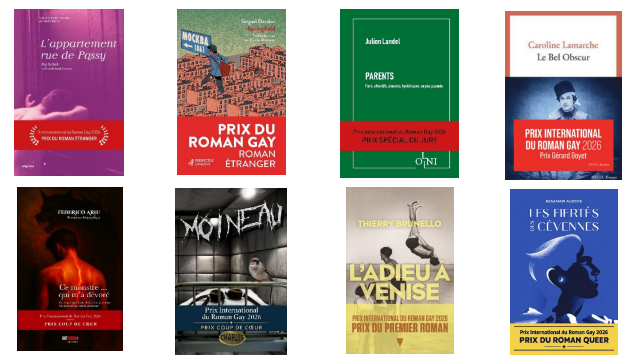
According to the organisers’ press release, the Grand Prix goes to Benoît Coquil for Pas perdu, published by Éditions Rivages. Julien Landel receives the Special Jury Prize for Parents, published by OLNI, while Caroline Lamarche’s Le Bel Obscur, published by Seuil, wins the Prix Gérard Goyet.
The Prix Coup de Cœur is shared by Federico Ariu’s Ce monstre… qui m’a dévoré, published by ArtFusion, and Em Charles’s self-published Moineau. Thierry Brunello receives the First Novel Prize for L’adieu à Venise, published by La Martinière.
These are distinct awards rather than runners-up positions. Together, they offer several possible starting points for readers looking beyond a single headline winner.
The release was issued ahead of a ceremony scheduled for 19 November, hosted by Stéphane Maton-Vann. With that date now past, the list provides a timely reading guide; the details here follow the organisers’ announced results rather than an independently verified account of the evening.
Queer literature travels — and translators make it possible
The Foreign Novel Prize is shared by two books: Raji Batish’s L’appartement rue de Passy, published by Milgrana, and Sergueï Davidov’s Springfield, published by Perspective Cavalière.
The release credits Davide Knecht with translating Batish’s work from Palestinian Arabic, and Nicolas Stuykens with translating Davidov’s from Russian.
Those names belong in the spotlight too. A translated book reaches readers through the work of more than one person, and this part of the list offers a reminder to look beyond the languages we already read.
For French-speaking readers in Brussels, these awards provide two routes into writing that might otherwise remain outside their usual bookshop circuit.
Bisexuality, trans experience and room to define yourself
Despite its name, the Prix International du Roman Gay includes categories that extend across LGBTQIA+ writing and beyond fiction.
Camille Teste’s Embrasser la bisexualité, published by Leduc, receives the Essay Prize. The Transgender Essay award goes to Je suis une femme ! Roxane, by Roxane Godefroid and Nathalie Guinand, published by Le Livre en Papier.
Auror.404 receives the award titled Auteurice Queer for Maison d’enfance, published by Burn-Août. The Queer Novel Prize goes to Benjamin Audoye’s self-published Les fiertés des Cévennes.
The categories do not tell us everything about the books, and they should not stand in for reading them. But they do make space for subjects and forms that a narrower definition of “gay literature” could overlook.
That matters for LGBTQIA+ readers today: visibility is more meaningful when it allows for different experiences, rather than asking one familiar narrative to speak for an entire community.
Independent publishing is part of the story
Self-published books appear in several parts of the list. Alongside Moineau and Les fiertés des Cévennes, Julien Vidal’s D’épreuves et de sentiments receives the Youth award.
Adrien d’Arjanc and Olivier Hancock’s self-published Les Pink Détectives wins the category playfully titled Roman Érotique, mais pas que… — “Erotic Novel, but Not Only…”.
The organisers also recognise a work that has not yet found a publisher: Roman Kissal’s Raba receives the award for a manuscript seeking publication.
Meanwhile, Asmodée Edern, represented in the release by Vincent Engel and Patrick Lowie, is named Best Publishing House.
This is not a list restricted to books already backed by the largest publishers. For readers, that may mean ordering some titles directly from an author or a smaller press rather than expecting every winner to be on the nearest display table.
Beyond the novel: memory, poetry and the stage
Several other categories widen the reading possibilities further.
The Document Prize is shared by David Benyam’s Captif, published by Écrin, and Fabrice Nguena’s Afroqueer, published by Écosociété. In the Memory category, Francis Lamberg’s Yves Navarre et Roger Peyrefitte, published by Asmodée Edern, shares the award with Natalie Adler’s En attendant Marky Moon, published by Phébus.
Guy Bordin and Renaud de Putter receive the Short Story Collection award for Promenade à la rivière, published by Le Livre en Papier. Arnaud Delcorte’s Gandhara, published by Bleu d’Encre, wins for poetry, while Olivier Sylvestre’s Retour à Laval, published by Hamac – Théâtre, receives the Theatre award.
For anyone whose reading habits do not begin and end with novels, these are useful doors into the selection. A poem, a play or a short story can be the right place to start.
More winners for the reading list
The organisers’ announcement also includes:
- Autobiography: Finalement je n’étais pas si bizarre, Didier Lonys — Éditions des 3 Colonnes.
- Romance: D’un cœur à l’autre, Laurent Saint-Gérard — Aloria.
- Current Affairs: Les larmes des oliviers, Romain Le Gloahec — Les Étaques.
- Fantasy: La Mémoire des os, Margot Looten — Plume Blanche.
- Coming In, joint winners: Clandestin familial, Jean Desportes — Éditions du Rocher; and Se rencontrer, Julien Thèves — Abstractions.
- Biography: Daho, une vie en chanson, Sébastien Monod — Hugo Publishing.
- Tribute Novel: Un abandon, Laurent Kiefer — Dunombril.
- Epistolary Novel: Seule, Audrey Cleed — Daronnes.
- Short Novel, joint winners: La fissure de l’âme, Justinien Hautain — Asmodée Edern; and Théâtrocratie, Éric Valentin — Books on Demand.
- Prix Coco Câline: Les nuits félines, Qualipo — Chloé des Lys.
The variety is the point. This is not a prescribed queer bookshelf, but a set of possibilities — including books that may sit well outside your usual tastes.
Practical information
- Award: Prix International du Roman Gay, 2026 selection.
- Ceremony announced for: 19 November 2026, at Le Tango in Paris, presented by Stéphane Maton-Vann.
- Results: The winners above follow the organisers’ supplied press release.
- Book availability: Prices, formats, translations and Belgian stockists are not specified in the release. Check with the relevant publisher, author or bookshop.
- Further information: Capax Infiniti. The website could not be accessed when preparing this article.
- Contact: prixduromangay@gmail.com.
- Support: The announcement credits the Fédération Wallonie-Bruxelles.
Start with a title that catches your attention, a form you rarely read or a writer you have not met on the page yet. There is no need to make the whole list homework.
KET Magazine is a community‑driven, non‑profit magazine run by volunteers and based in Brussels. You can find our other music and nightlife stories on ket.brussels, and you can always write to us to share your projects or pitch a story: info@ket.brussels
You may also like
-
CUDDLES brings bodies, bold performances and a little heat to Brussels
November could use some warmth — but CUDDLES is not promising a gentle embrace. Already
-

Less scrolling, more Brussels: 100 cultural ideas for 2027
Your next Brussels discovery might start on paper. Out on 25 November, Brussels 2027 brings
-

Meet the people behind the headlines: independent media take over La Tricoterie
Less scrolling, more conversation. On Sunday 15 November, the Salon des médias indépendants brings journalists,
-

After the party, parenthood: Jordan Firstman’s Club Kid changes the guest list
One minute you are running the night. The next, a ten-year-old is calling you Dad.
-

Who’s shaping you? Sous Influence takes over a Brussels townhouse
Your family, your feed, your beliefs: how much of who you are did you actually