

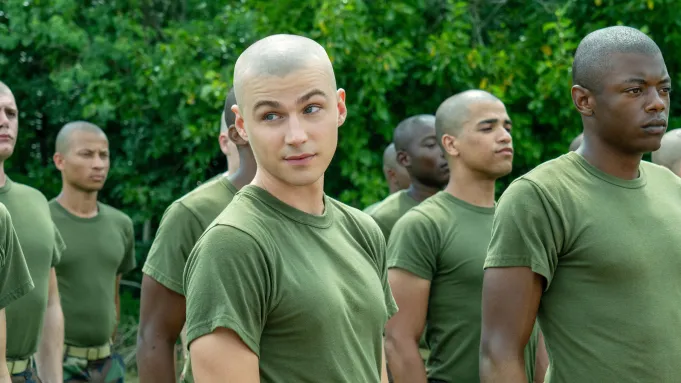
When Netflix confirmed that Boots would not return for a second season, the reaction was swift and heavy. Not only disappointment, but a familiar sinking feeling — the sense that something rare had been cut short just as it began to breathe. For many queer viewers, Boots wasn’t background entertainment. It was a point of recognition.
The series followed Cameron Cope, a closeted young gay man entering the U.S. Marine Corps in 1990, navigating desire, fear, loyalty, and survival inside an institution where queerness was illegal. Inspired by Greg Cope White’s memoir The Pink Marine, Boots carried a quiet confidence: it didn’t overexplain itself or soften its edges. It trusted its audience to sit with discomfort, intimacy, and contradiction.
That trust was reflected behind the scenes too. The show was shaped by out queer writers and featured openly queer actors including Miles Heizer, Max Parker, Sachin Bhatt, Angus O’Brien, and Jack Cameron Kay. Representation here wasn’t decorative — it was structural. The result was a series that allowed tenderness and masculinity to coexist without irony.
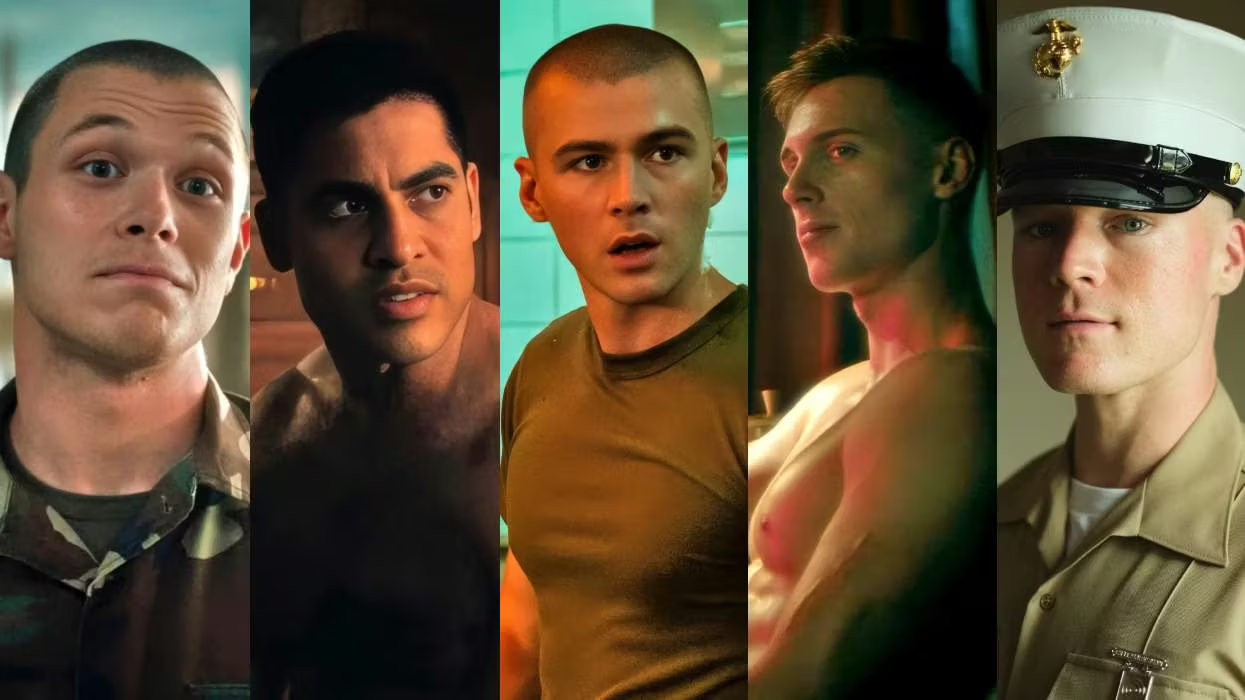
What makes the cancellation harder to accept is that Boots wasn’t struggling. Strong reviews, solid viewership, and weeks in Netflix’s global Top 10 suggested the show was finding its people. Yet, like many LGBTQ+ series before it, it wasn’t given time to grow. The pattern is exhausting, especially for a community that already knows what it means to see its stories paused, delayed, or abandoned.
Still, the impact of Boots doesn’t disappear. Speaking about the cast’s connection, Miles Heizer reflected: “They weren’t familiar with gay culture, hadn’t met a lot of gay people. For us to come together and create these deep friendships was interesting. I felt connected to these boys. We still talk all the time.” That sense of tentative closeness turning into care mirrors what many viewers felt watching.
The response online was intense not because the show was flawless, but because it offered something scarce: queer vulnerability inside a system designed to erase it. What people grieved wasn’t only an unfinished plot, but the loss of a space where complexity was allowed.
Boots ends after one season, and that loss is real. But what it opened doesn’t vanish. The moments of recognition it created continue — shared, remembered, carried forward. Not every story needs longevity to matter. Some arrive briefly, do their work, and leave traces strong enough to last.
You may also like
-

Türkiye’s LGBTQIA+ Community Faces a New Wave of Pressure
LGBTQIA+ people in Türkiye are living through a sharp escalation in state pressure: Pride events
-
Fiji Declares a National HIV Emergency — and the World Must Pay Attention
Fiji has declared a national HIV emergency after a dramatic rise in diagnoses: 2,016 people
-

Balkan Trafik! Turns Brussels’ Bourse into a Three-Day Balkan Universe
After a year away, Balkan Trafik! returns to Brussels from 19 to 21 November 2026
-

In Myanmar, the Spirit Wives Keep Dancing
Near Mandalay, in a country torn apart by civil war, the annual Taungbyone festival has
-

Five Equality Champions Remind WorldPride What Queer Progress Looks Like
On 5 August, during the WorldPride Human Rights Conference in Amsterdam, UNDP and ILGA World