
Once a month at La Tricoterie, in Brussels, a small group gathers in the mezzanine for something both intimate and profoundly political: Nous qui parlons, a feminist talking circle created and facilitated by Fanny Lavisse. Designed as a space of trust, listening and sharing, it is open to all people who identify as women and want to put words on the realities that shape their lives.
A space to speak, not to perform
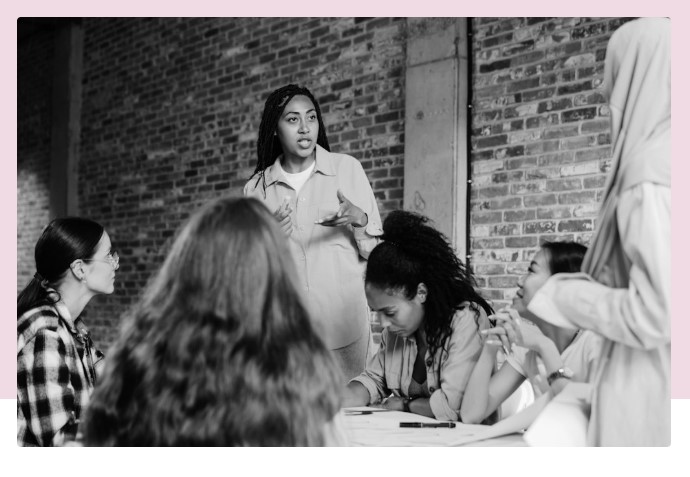
Fanny’s project starts from a simple but radical intuition: women’s stories are often told about them, rarely by them. In Nous qui parlons, there is no expert panel, no PowerPoint, no pressure to “have the right analysis”. Instead, there is a circle, two hours, and a theme that touches everyday life as much as feminist theory.
From month to month, participants explore topics like emotional and sexual education, division of household labour and mental load, power dynamics at work, sorority, the female body (menstruation, motherhood, menopause, social injunctions), egalitarian relationships, parenting, gender representations, and how women occupy and reclaim public space. Each session is an invitation to name what is usually minimised, to connect personal struggles with broader structures, and to recognise that what hurts one woman is rarely just an individual problem.
From talking circle to sound documentary
One of the most singular dimensions of Nous qui parlons is its desire to keep a trace of these conversations. With the informed consent of the participants, each meeting is audio recorded, with the aim of creating a sound documentary at the end of the season.
This gesture transforms the circle into a living archive. Rather than letting these words disappear at the end of the evening, Fanny treats them as a precious material: fragments of oral history, testimonies of how it feels to be a woman here and now, in all the diversity of age, origin, class, body and desire. The final documentary is not just a “product”; it is a way of honouring voices that are often marginalised, of transmitting them beyond the walls of the room, and of inscribing them in a collective memory.
A feminist act as much as a workshop
Nous qui parlons is not a support group in the apolitical sense, nor a purely theoretical seminar. It sits exactly at the intersection: an act of care that is also an act of resistance. Speaking in one’s own name, being listened to without being interrupted or judged, daring to say “I” in front of others – all this goes against the social training that teaches women to minimise themselves, to be accommodating, to remain silent.
By making room for this “I”, Fanny opens up a space where links can be woven between women, where sorority is not a slogan but a practice. Session after session, the circle becomes a place to think differently about our bonds, our struggles and our possibilities: how to share tasks without guilt, how to support each other at work, how to mother (or not) outside of norms, how to inhabit our bodies and the city without apologising.
Practical details
- Format: one meeting per month, 2 hours per session
- Group: up to 20 participants (people identifying as women)
- Place: La Tricoterie, mezzanine
- Dates & times (19h–21h): 02/03, 06/04, 11/05 and 01/06/2026
- Price: sliding-scale, “participation libre et consciente”
- Project: recording and post-production of a sound documentary to be shared at the end of the season
- Info & reservations: lavissefanny@gmail.com
In a world where women are constantly told to be quieter, Nous qui parlons is a simple, powerful promise: you come as you are, you speak in your own words, and together, you make sure those words don’t disappear.
You may also like
-

BRDCST 2026: Brussels’ most genre‑fluid festival turns listening into a political act
From 3 to 6 April, BRDCST 2026 takes over Ancienne Belgique and spills into Cinema
-
Ten Years After the Brussels Attacks, a City – and Its Queer Community – Still Carry the Shock
Ten years after the 22 March 2016 bombings at Brussels Airport and Maelbeek metro station,
-
Brussels Pride: from Gay Pride to Belgian Pride to a city that owns its colors
In 30 years, Brussels has gone from a small “Gay Pride” marched by a few
-

“Out of step, outlawed”: être homosexuel·le au Sénégal en 2026
While Brussels is gearing up for another Pride season, LGBTQI+ people in Senegal are facing
-

Every-Body-Knows: dancing with queer memory in Brussels
With Every-Body-Knows-What-Tomorrow-Brings-And-We-All-Know-What-Happened-Yesterday, choreographer Mohamed Toukabri offers an intimate and political solo where every movement asks what
