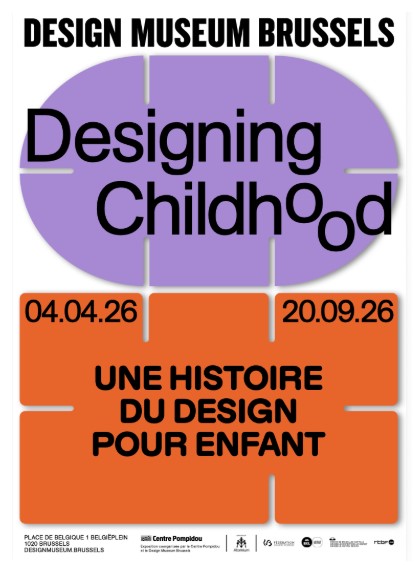
From 1 April to 20 September 2026, Design Museum Brussels presents Designing Childhood. A History of Design for Children, a co-curated exhibition with the Centre Pompidou that traces how 20th-century design imagined, shaped and reflected childhood. Through furniture, school equipment and contemporary pieces, the exhibition reveals how the child gradually became a distinct figure in the home, in society and in the design market.
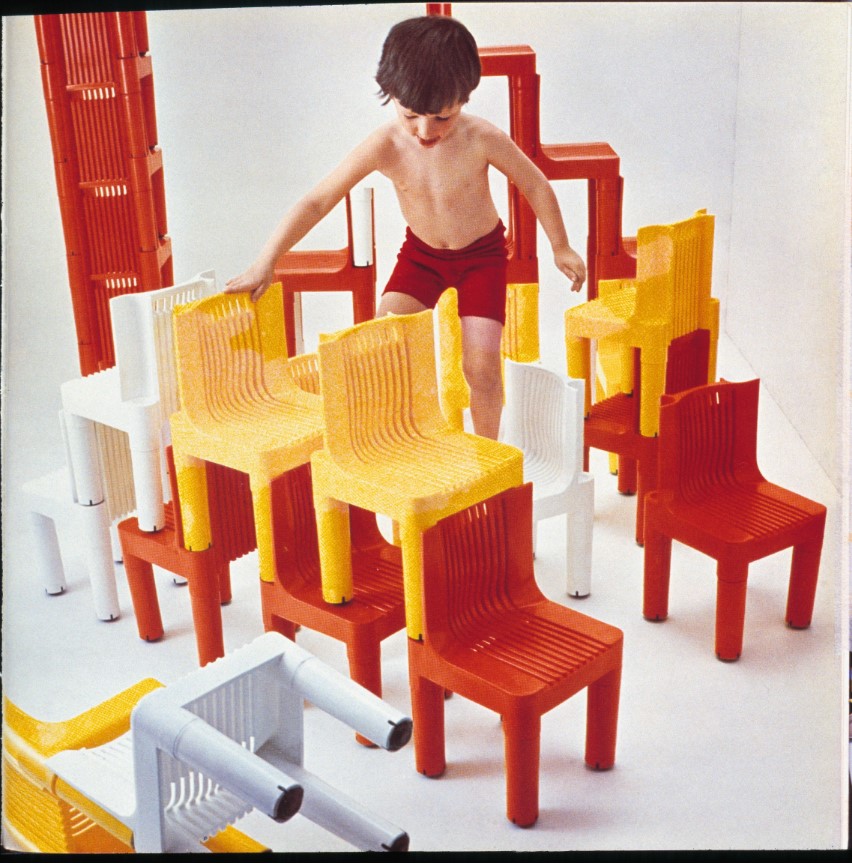
C- Courtesy Archivo Museo Kartell, ITA
The history of children’s furniture is also a history of social change. Far from being a marginal category, it became a space for experimentation, where designers tested new forms, new materials and new ways of thinking about everyday life. In the 20th century, children’s furniture combined playfulness and practicality, while also mirroring wider shifts in family structures, education and technology.
Read also : Christophe Gevers: The Architecture of Detail at Design Museum Brussels
By drawing on the collections of both Design Museum Brussels and the Centre Pompidou, the exhibition builds a dialogue that runs across the century. It begins with early examples such as Pierre Chareau’s children’s rooms in the 1920s and Sylvie Feron’s work in Belgium in the 1930s, then moves through school furniture by Jean Prouvé and Arne Jacobsen, and later the post-war “school-room” concept developed by Marcel Gascoin in France and Jules Wabbes in Belgium.
The exhibition also highlights Belgium’s role in this wider story. Through works from its own collection, Design Museum Brussels shows how Belgian design has long engaged with children’s needs in ways that were at once functional, educational and forward-looking. That attention is visible in the inclusion of ecological and pedagogical concerns from an early stage, and in more recent projects such as ecoBirdy’s Charlie chair, made from recycled plastic.
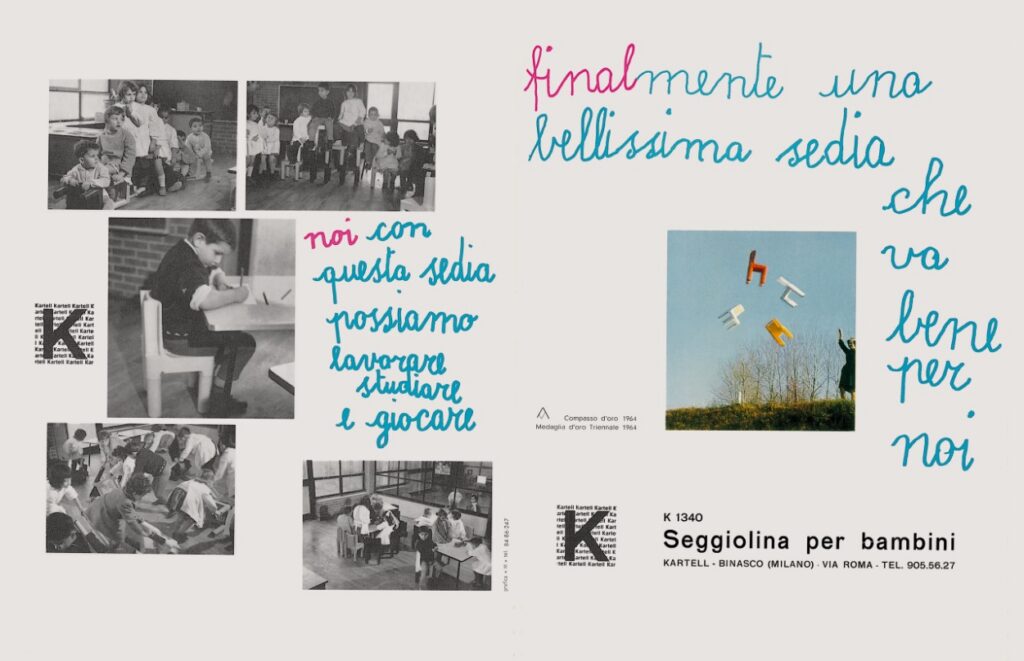
C- Courtesy Archivo Museo Kartell, ITA
If the 1960s marked a high point for children’s design, with pop aesthetics and the spread of plastic materials leading to lighter, more flexible furniture, today’s designers are once again returning to childhood as a key site of innovation. The current emphasis is different, however: inclusivity, learning and sustainability now sit at the centre of the conversation, and the exhibition shows how both historical and contemporary collections respond to these values.
Read also : Queer Footprints by Dan Glass presented at Design Museum Brussels
The project will also mark the launch of a new podcast series developed by Design Museum Brussels in collaboration with BNA-BBOT. Dedicated to major design figures in Brussels, the first episode focuses on the life and work of Marie Paquay Wabbes, adding an important local perspective to the exhibition’s broader European narrative.
To accompany the show, CFC Éditions will publish Designing Childhood. Le mobilier pour enfant – Kindermeubilair – Children’s furniture, edited by Marie-Ange Brayer and Arnaud Bozzini, with release scheduled for 12 May 2026. The trilingual book brings together emblematic pieces from the history of children’s furniture and offers an accessible introduction to the evolution of design for children.
The exhibition is co-organised by the Centre Pompidou and Design Museum Brussels.
Practical information
Designing Childhood. Une histoire du design pour enfant
1 April > 20 September 2026
Press visit: 31 March | 11:00
Design Museum Brussels, Place de Belgique, 1020 Brussels
Open Monday to Sunday | 11:00 > 19:00
Tickets: 10 € (+ reductions)
More info: designmuseum.brussels
KET Magazine is a community‑driven, non‑profit magazine run by volunteers based in Brussels. Get in touch to share your thoughts or tell us about your activities. You can also promote your events on our website or support our work with a donation. Contact us at Info@ket.brussels.
You may also like
-

Benefit Party at Les Halles de Schaerbeek puts trans solidarity center stage
On 17 and 18 April, Les Halles de Schaerbeek hosts Benefit Party, a two-day fundraising event
-

Mothers and Daughters: calling for memories, building a collective queer archive
Mothers and Daughters, Brussels’ beloved lesbian & trans bar and art space, is looking back on
-

Doel Festival: the ghost village that refused to die – and turned itself into a dancefloor
On 25 July, Doel Festival returns for its fifth edition and once again turns Belgium’s
-

Clément Legrand at the Maison Arc-en-Ciel Liège: celebrating the beauty of the male body
Next Friday, April 3, 2026, the Maison Arc-en-Ciel Liège welcomes French artist Clément Legrand for a
-
THE VOTOS — A NON-EXHAUSTIVE ATLAS OF IMAGINATION
By Jean-Paul Lespagnard at La Verrière, Brussels Between Marrakech and Brussels, between craft and ritual,
