
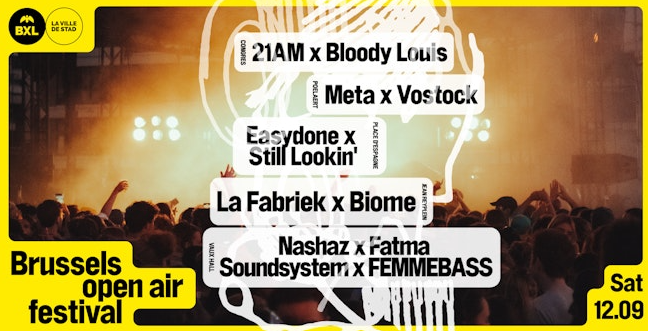
On Saturday 12 September, Brussels Open Air Festival turns five public spaces into open-air dancefloors for a full afternoon and evening of local club culture. From 2pm to 10pm, ten Brussels collectives will bring house, techno, hip-hop, dub, bass, amapiano, R&B and dancehall to the streets. More than a city-centre party crawl, BOAF is a chance to see the people, sounds and communities shaping Brussels nightlife take up public space — in daylight, together.
Club culture steps outside
Nightlife is often discussed as something that happens behind doors: in clubs, basements, converted warehouses or venues that only come alive after dark. Brussels Open Air Festival flips that logic.
For its third edition, BOAF brings five simultaneously running events to Dalle du Congrès, Place Poelaert, Place d’Espagne, Place Jean Rey and Vaux Hall, in Parc de Bruxelles. The festival is an initiative of the City of Brussels, coordinated by Brussels By Night, and designed to spotlight the diversity of the capital’s cultural and nightlife ecosystems.
Rather than asking audiences to commit to one stage or one musical world, the format encourages movement. The city itself becomes part of the experience: take a walk, follow a bassline, meet friends on another square, or let a new collective introduce you to a sound you might not otherwise seek out.
Ten collectives, many musical worlds
The line-up is built through collaborations between local promoters and collectives, each bringing its own community, aesthetic and musical language. Among the announced pairings are 21AM x Bloody Louis, Easydone x Still Lookin’, Vostock, and La Fabriek x Biome. A further collaboration brings together Nashaz, Fatma Soundsystem and FEMMEBASS.
That last collaboration, hosted at Vaux Hall, is particularly worth highlighting. Fatma Soundsystem, FEMMEBASS and Nashaz frame their open air around the sounds, cultures and histories of the Global Majority, combining dub, reggae, sound-system culture, house, percussion and diasporic sounds. Their event explicitly centres migrants, women, queer, trans and racialised communities, with live acts and performances alongside the music.
This is where BOAF’s collective model matters. It does not present Brussels nightlife as one uniform scene. It makes room for different musical traditions, different audiences and different ways of gathering — from club-focused electronic sets to bass-heavy sound-system culture, hip-hop, R&B and dancehall.
A public space for queer joy
For LGBTQIA+ people, especially those who experience nightlife as a place of freedom, recognition and chosen family, seeing queer and marginalised communities at the centre of a city-wide event is significant.
The Vaux Hall programme’s commitment to creating a safer space for underrepresented communities is not a decorative add-on. It points to a central question for cultural events: who feels able to arrive, stay, dance and take up space without being judged, harassed or treated as an exception?
Of course, a safer-space statement does not automatically guarantee everyone’s experience. But making those values visible — and placing queer, trans, migrant and racialised people among the event’s protagonists rather than at its margins — is an important starting point.
BOAF also shows that queer nightlife can be expansive. It is not limited to a particular genre, venue or audience. It lives in the overlap between music, self-expression, friendship, community care and the right to be visible in the city.
Brussels, beyond one dancefloor
Brussels has long been a meeting point for different languages, diasporas and creative scenes. Yet much of its nightlife remains fragile, subject to rising costs, licensing pressures, transport concerns and debates around public order.
An event like BOAF offers a different model: daytime, outdoors and spread across the city. It makes the work of independent collectives visible to audiences who may not regularly enter clubs, while allowing regular nightlife communities to meet beyond their usual walls.
The festival expects around 11,000 visitors across its five sites. Its 2026 edition runs from 2pm to 10pm, making it possible to explore several locations during the day.
Practical information
What? Brussels Open Air Festival 2026
When? Saturday 12 September 2026, from 2pm to 10pm
Where? Dalle du Congrès, Place Poelaert, Place d’Espagne, Place Jean Rey and Vaux Hall, Brussels
Featuring: Ten Brussels collectives across five open-air events, with music ranging from hip-hop, dub and bass music to house, techno, amapiano, R&B and dancehall
Festival pass: A pass provides access to all five events. Available waves are listed at €25 and €30; check the official ticketing information for current availability.brussels-by-night
Getting around: The sites are served by nearby public transport, including Louise for Place Poelaert, Central Station for Place d’Espagne and Park for Vaux Hall.stibstories
More information: City of Brussels’ BOAF page and Brussels By Night
Bring comfortable shoes, a curious ear and room in your day for a few unexpected detours: BOAF is made for discovering how many dancefloors Brussels can hold at once.
KET Magazine is a community‑driven, non‑profit magazine run by volunteers and based in Brussels. You can find our other music and nightlife stories on ket.brussels, and you can always write to us to share your projects or pitch a story: info@ket.brussels
You may also like
-

Tels Quels Talent Show: Brussels’ Queer Voices Take the Mic
On Friday 16 October, the Tels Quels Talent Show brings live queer creativity to Les
-

CLELIA Turns Solitude Into a Shared Pop Therapy
The Brussels-based musician opens up to KET about mental health, queer visibility and her new
-

Eli Is Bringing Her Colourful Pop Universe to Brussels
American singer-songwriter Eli is heading to Brussels this autumn for an intimate show at the
-
FrancoFaune 2026: Brussels, Turn Up the Volume
From 1 to 11 October, FrancoFaune returns for its 13th edition, spreading French-language music across
-
Bears Attack: Brussels’ Bear Folies Hit the Dancefloor
Belgium Bear Pride celebrates its 15th anniversary from 29 September to 4 October 2026, and