
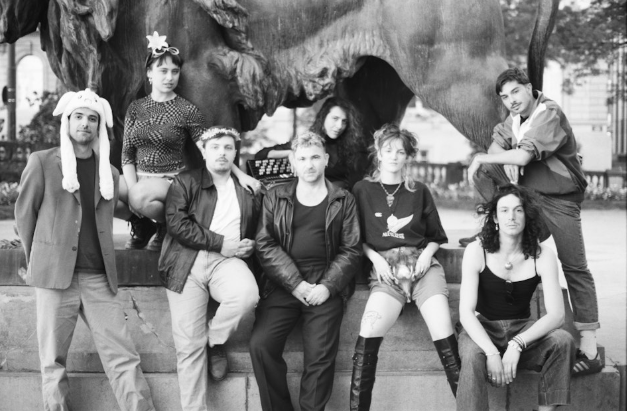
What if masculinity did not have to mean control, silence or violence? With Tendre feu – boys don’t cry, theatre-maker Romain David gathers a young ensemble for a live, musical and physical performance that takes on patriarchal power without losing its sense of play. From 15 to 19 September, Théâtre des Martyrs welcomes this cabaret-infused creation, where laughter, dance and vulnerability become tools for imagining other ways of being together.
A different score for masculinity
From childhood, boys are often handed a script: be strong, do not cry, do not show fear, dominate rather than doubt. For some, that script offers comfort or social protection. For many others — including queer, trans and gender-nonconforming people — it can be suffocating.
Tendre feu – boys don’t cry starts from this pressure. The new work by Belgian theatre-maker Romain David explores masculine domination and the violence it can generate, while asking what might happen if those inherited rules were challenged, dismantled or simply refused.visit+1
Rather than presenting masculinity as a fixed identity, the show treats it as something performed: a role learned through family, school, friendship, desire, media and social expectations. And, like any role, it can be rewritten.
Cabaret, music hall and fragile bodies
The performance combines music hall, cabaret and pared-back theatre. On stage, a group of young performers sing, dance and embody a shifting series of figures that expose the mechanics of patriarchal violence.wirikuta+1
The form matters. Cabaret has always offered a space for exaggeration, disguise, gender play and social critique. By drawing on its festive and theatrical energy, Tendre feu avoids delivering a lecture from the stage. Instead, it uses bodies, rhythm, humour and live music to make power visible — then unsettle it.
The production has been developed through collective writing. Its cast includes Auguste Bercker, Théo Bisinella, Envel-Oan Bodinier, Selma Goueygou Ganantchian, Valentin Martin, Ségolène Neyroud and Giulia Rzewski. Live music is performed by Neyroud on piano, Bisinella on accordion and Goueygou Ganantchian on flute.
The result is described as a sensual, lively and fragile ritual: a performance where music, movement and storytelling meet in a search for repair.
Beyond “boys don’t cry”
The title is a familiar command. “Boys don’t cry” is often used to discipline emotion, teaching boys and men that vulnerability makes them weak. But holding back emotion does not make pain disappear. It can turn into shame, isolation or anger — and can reproduce harm in relationships with others.
Tendre feu opens another possibility: tenderness as a form of strength, not a failure of masculinity. Its performers do not appear to be looking for a single “good” way to be a man. Instead, the show makes room for contradiction, softness, transformation and collective responsibility.
This is particularly relevant for LGBTQIA+ audiences. Queer communities have long questioned narrow gender roles, but they are not automatically free from sexism, misogyny, racism, transphobia or the pressure to conform to masculine ideals. A performance that looks directly at the structures behind these expectations can create space for more honest conversations — and for more caring forms of solidarity.
A political show that keeps moving
Theatre about domination can easily become heavy-handed. Tendre feu seems to choose another route: a political performance that remains alive, musical and slightly unruly.
The stage becomes a place where figures of authority can confront one another, slip away or become almost carnival-like masks. Exposing those masks is a way of taking away some of their power.
That approach feels timely in Brussels, where conversations about gender, consent, LGBTQIA+ rights and backlash against equality are never purely theoretical. They shape the way people move through public space, access culture and form relationships. A theatre piece that connects personal experience with wider social structures has the potential to land far beyond the auditorium.
Practical information
What? Tendre feu – boys don’t cry, a collective creation directed by Romain David
When? Tuesday 15 to Saturday 19 September 2026
Where? Théâtre des Martyrs, Brussels
Duration: Listed as 1 hour 45 minutes, without an interval
Recommended age: From 15 years old
On stage: Auguste Bercker, Théo Bisinella, Envel-Oan Bodinier, Selma Goueygou Ganantchian, Valentin Martin, Ségolène Neyroud and Giulia Rzewski
More information and tickets: Théâtre des Martyrs
Tenderness is not the opposite of resistance. Tendre feu offers a vivid, musical and collective reminder that the roles imposed on us can always be changed.
KET Magazine is a community‑driven, non‑profit magazine run by volunteers and based in Brussels. You can find our other music and nightlife stories on ket.brussels, and you can always write to us to share your projects or pitch a story: info@ket.brussels
You may also like
-
When Nuns Go Pirate: A Queer Sacred Thriller at Varia
What happens when lesbian love, religious memory and horror theatre enter a locked convent—and refuse
-

Tels Quels Talent Show: Brussels’ Queer Voices Take the Mic
On Friday 16 October, the Tels Quels Talent Show brings live queer creativity to Les
-
CLELIA Turns Solitude Into a Shared Pop Therapy
The Brussels-based musician opens up to KET about mental health, queer visibility and her new
-

Eli Is Bringing Her Colourful Pop Universe to Brussels
American singer-songwriter Eli is heading to Brussels this autumn for an intimate show at the
-
FrancoFaune 2026: Brussels, Turn Up the Volume
From 1 to 11 October, FrancoFaune returns for its 13th edition, spreading French-language music across