
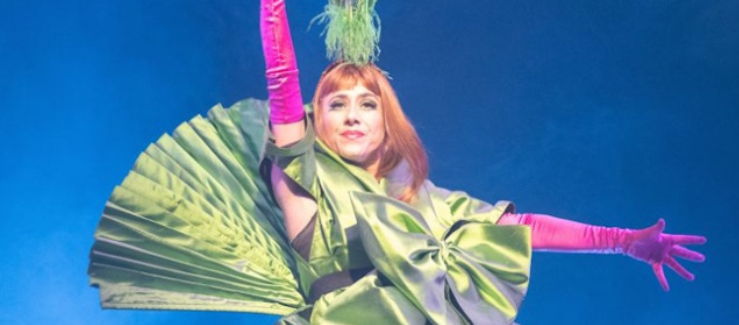
What if laughing could be a way of resisting? With RIRE (pour en finir avec soi-même), historic queer performer Sara Selma Dolorès brings a glittery, unruly and sharply political meta-cabaret to Brussels. Mixing theatre, clowning, songs and deliberate excess, the show asks where our laughter comes from — and what it reveals about gender, class, morality and the right to take up space.
A laugh with teeth
RIRE does not promise the soft, harmless kind of comedy designed to make everyone comfortable. Its point of departure is much more exciting: what happens when a queer artist uses humour to prod at social conventions, ideological certainties and the suffocating pressure to always be serious?
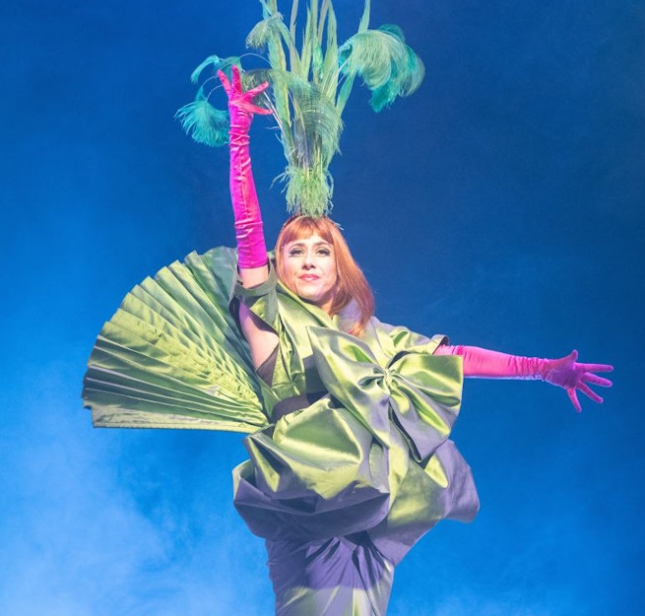
Sara Selma Dolorès enters this territory as an oversized, feathered and glitter-covered creature — part clown, part fool, part master of ceremonies. From there, the performance opens into a world where the ridiculous becomes political and self-mockery becomes contagious.
The title can be read as an invitation to laugh, but also as a small act of liberation. At a time of permanent crisis, reactionary discourse and online outrage, RIRE asks whether we can find a collective breath outside the damaging spiral of seriousness.
Cabaret at the edge of the rules
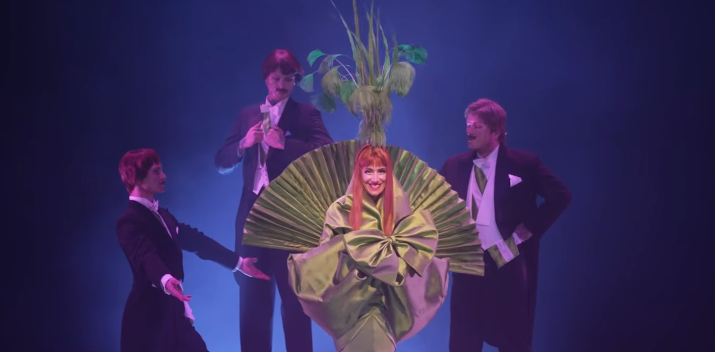
The show sits somewhere between theatre and cabaret, but it has no interest in staying obediently within either format. Sara Selma Dolorès is joined on stage by Jean-Biche, Olga Kalachnikova and Kimi Amen, creating a four-person performance that moves between reflection, music, embodied comedy and joyful disorder.
Their shared material travels through questions that can sound deceptively simple: what does laughter bring us back to? Our social class? Our gender? Childhood’s first act of disobedience? The feeling that we are or are not entitled to speak?
By embracing a form of “foolishness”, the performers make space for contradiction. The stage is not a place where audiences receive a perfect moral lesson. It is a place for testing boundaries, joking about the things that usually feel too big or too charged, and admitting that we are all implicated in the norms we criticise.
Queer laughter is never neutral
For LGBTQIA+ communities, humour has long been a survival tool. Queer camp, drag, cabaret and nightlife have made room for exaggeration, parody and play at moments when mainstream culture offered little space to exist openly.
But RIRE does not treat this legacy as a museum piece. It connects queer irreverence to present-day debates around feminism, competing moral positions and the now-familiar claim that “you can’t laugh about anything anymore”.
The show’s answer is not that anything goes. Instead, it appears to ask a more useful question: who gets to joke, who becomes the target, and what kinds of power are hidden behind the demand to be respectable?
This matters because queer and marginalised people are still often expected to explain themselves calmly, politely and in terms that make others comfortable. A loud, strange and self-aware cabaret can disrupt that expectation. It refuses respectability as the only route to legitimacy.
A figure of Brussels’ queer stage
Sara Selma Dolorès is described as an author, director and performer with a long history in Belgium’s queer cultural scene. Her work has moved through squats, bars, roundabouts, public spaces and other non-traditional venues, drawing on popular song, oral traditions, nightlife and the kind of encounters that rarely make it into official cultural canons.ancre+1
That trajectory gives RIRE a particular resonance in Brussels. The city’s queer culture does not only live in institutions: it has been made in bars, activist spaces, collectives, improvised stages and late-night conversations. Bringing this artistic language into a theatre setting is not about making it respectable. It is about recognising its cultural value without sanding away its rougher edges.
Practical information
What? RIRE (pour en finir avec soi-même) by Sara Selma Dolorès
Format: A French-language meta-cabaret between theatre and clowning
Duration: 1 hour 45 minutes
Recommended age: From 16 years old; some scenes include nudity
On stage: Sara Selma Dolorès, Jean-Biche, Olga Kalachnikova and Kimi Amen
Themes: Queer culture, gender, class, feminism, transgression, social norms and the politics of laughter
More information: Visit Brussels event listing
Accessibility and exact Brussels performance details: Check the venue and ticketing information before booking, as the available listings indicate different dates across the show’s touring schedule.visit+1
Come for the feathers, the clowning and the cabaret chaos; leave with a few more questions about who gets to laugh — and why.
KET Magazine is a community‑driven, non‑profit magazine run by volunteers and based in Brussels. You can find our other music and nightlife stories on ket.brussels, and you can always write to us to share your projects or pitch a story: info@ket.brussels
You may also like
-
When Nuns Go Pirate: A Queer Sacred Thriller at Varia
What happens when lesbian love, religious memory and horror theatre enter a locked convent—and refuse
-

Tels Quels Talent Show: Brussels’ Queer Voices Take the Mic
On Friday 16 October, the Tels Quels Talent Show brings live queer creativity to Les
-

CLELIA Turns Solitude Into a Shared Pop Therapy
The Brussels-based musician opens up to KET about mental health, queer visibility and her new
-

Eli Is Bringing Her Colourful Pop Universe to Brussels
American singer-songwriter Eli is heading to Brussels this autumn for an intimate show at the
-
FrancoFaune 2026: Brussels, Turn Up the Volume
From 1 to 11 October, FrancoFaune returns for its 13th edition, spreading French-language music across