
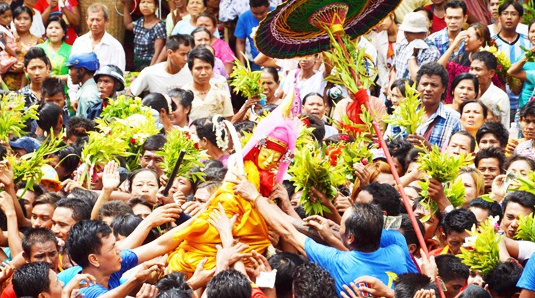
Near Mandalay, in a country torn apart by civil war, the annual Taungbyone festival has once again brought thousands of people together around the Nat spirits. At the heart of the celebrations are the nat-kadaw — “spirit wives”, many of them trans women or members of other marginalised LGBTQIA+ communities. In a country where same-sex relations remain criminalised, their visibility offers a rare and powerful public space for queer presence, faith and collective survival.
When spirits take the stage
The Taungbyone festival is not a Pride in the European sense. There are no rainbow floats, corporate sponsors or neatly branded slogans. Yet for many participants, it carries something recognisably queer: a moment when people who are often pushed to the margins become the centre of attention.
During the festival, held near Mandalay in central Myanmar, nat-kadaw act as mediums for the country’s ancestral Nat spirits. According to the tradition, these spirits can influence everyday life, from relationships and work to illness, protection and major national events. There are around 111 revered Nat figures in this animist belief system, which continues to exist alongside Myanmar’s majority Buddhist practice.
Dressed in gold jewellery, vivid make-up and elaborate clothing, the mediums dance, drink and enter trance states. Visitors throw roses, offer money and place cigarettes between the mediums’ lips as they become vessels for the spirits. It is ritual, spectacle, devotion and social gathering at once.
A place for trans women and queer people
The nat-kadaw are often called “spirit wives” because of their symbolic marriage to the Nats they embody. Many are transgender women or belong to other LGBTQIA+ minorities who face exclusion in wider Burmese society. At Taungbyone, however, they are not asked to disappear, soften themselves or become more acceptable. Their spiritual role gives them a highly visible place in the centre of the ritual.
That visibility matters. Myanmar still criminalises same-sex sexual activity between men under Section 377 of its Penal Code, a colonial-era provision that can carry a prison sentence of up to ten years. Trans people may also face criminalisation through policing laws targeting gender expression.
Legal repression is only one part of the picture. LGBTQIA+ people can also face stigma, discrimination and harassment in family, work and public life. In that context, Taungbyone offers a striking contrast: queer and trans people become respected spiritual intermediaries, called upon by thousands of devotees seeking help, reassurance or connection.
Celebration during a civil war
The festival has taken place under the long shadow of Myanmar’s civil war, which began after the military coup of 2021. In recent years, fighting has disrupted the celebrations. This year, with front lines further away from the area, the festival has been able to return with some breathing room.france24+1
That does not mean life is normal. One 35-year-old festival participant told AFP that he had lost friends, his home and his sense of future because of the conflict. He came to Taungbyone hoping to “find the way back”.
This is perhaps why the festival’s atmosphere can feel so intense. People do not come only to watch. They come carrying grief, fear, hopes and requests for a life that feels more bearable. The Nats are understood as spiritual forces able to respond to very concrete needs: protection, love, stability, luck, healing or simply the strength to continue.
Queer joy is not separate from grief
It would be easy to frame Taungbyone only through its spectacular images: glittering outfits, ecstatic dance, roses in the air, music and crowded devotion. Those images are real, but they exist alongside a devastating political reality.
For queer communities, joy has often been more than a party mood. It can be a way to stay visible when invisibility is safer, to create ritual when institutions fail, and to recognise one another in places where official recognition remains out of reach.
The Taungbyone festival makes that tension visible. Under the gaze of pro-government militia members, trans women and LGBTQIA+ mediums still dance in public, embodying figures of power rooted in a much older spiritual tradition.f
There is no simple message of liberation here. The nat-kadaw do not erase the discrimination queer people face in Myanmar, nor can a festival resolve the violence of war. But their presence refuses the idea that LGBTQIA+ people are foreign to tradition, faith or national culture. They are not outside Myanmar’s history. They are part of its living spiritual landscape.
A ritual of care
For the mediums, the relationship with the Nats can be experienced as a source of calm and purpose. One nat-kadaw, Shwe Moe Thae Kyaw Kyaw, told AFP that when the spirits come to her, she feels especially peaceful and serene.
Another medium described the spirits as “like remedies”, connecting people with particular Nats according to what they need. That idea of a remedy is powerful: not a promise that suffering disappears, but a form of care, recognition and support in the face of uncertainty.
For a world that often treats queer and trans lives as problems to be solved, Taungbyone offers another image. Here, queerness is connected to knowledge, ritual, service and a capacity to hold a community’s desires and sorrows.
Practical information
What? Taungbyone Nat Festival, an annual animist celebration centred on Myanmar’s revered Nat spirits
Where? Taungbyone, near Mandalay, central Myanmar
Who are the nat-kadaw? Spirit mediums, often known as “spirit wives”, who embody Nat spirits during ritual ceremonies
Why it matters: The festival is widely seen as an unofficial space of LGBTQIA+ visibility in Myanmar, where many trans women and other queer people remain marginalised and where same-sex relations are still criminalised.ohchr+1
Context: The 2026 celebrations took place amid Myanmar’s ongoing civil war, which followed the military coup of 2021
Taungbyone reminds us that queer survival can take many forms: a ritual, a crowd, a body in motion, and a moment of shared belief when the rest of the world feels impossible.
KET Magazine is a community‑driven, non‑profit magazine run by volunteers based in Brussels. Get in touch to share your thoughts or tell us about your activities. You can also promote your events on our website or support our work with a donation. Contact us at Info@ket.brussels.
You may also like
-

Türkiye’s LGBTQIA+ Community Faces a New Wave of Pressure
LGBTQIA+ people in Türkiye are living through a sharp escalation in state pressure: Pride events
-

Fiji Declares a National HIV Emergency — and the World Must Pay Attention
Fiji has declared a national HIV emergency after a dramatic rise in diagnoses: 2,016 people
-

Balkan Trafik! Turns Brussels’ Bourse into a Three-Day Balkan Universe
After a year away, Balkan Trafik! returns to Brussels from 19 to 21 November 2026
-

Five Equality Champions Remind WorldPride What Queer Progress Looks Like
On 5 August, during the WorldPride Human Rights Conference in Amsterdam, UNDP and ILGA World
-

Lenacapavir: Hope, Hype and a Price Tag That Hurts
Lenacapavir is the name on everyone’s lips at the World AIDS Conference in Rio de