
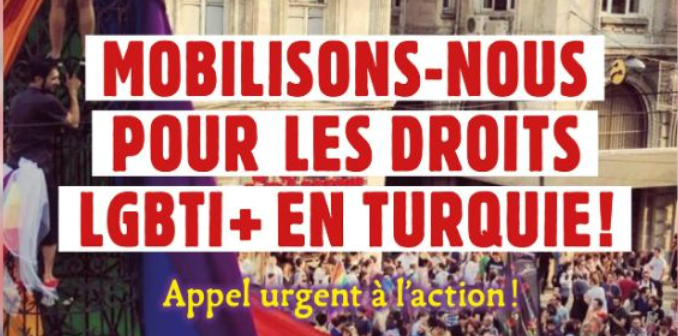
LGBTQIA+ people in Türkiye are living through a sharp escalation in state pressure: Pride events remain routinely banned, anti-LGBTQIA+ rhetoric has become embedded in official “family” politics, and recent police raids have targeted community groups, venues, activists and HIV-support organisations. Same-sex sexual activity is not illegal in Türkiye, but legal tolerance is not the same as safety, equality or freedom to organise. For queer people in Brussels and Belgium, the situation is a reminder that visibility, solidarity and community spaces can never be taken for granted.
Legal on paper, precarious in life
Türkiye does not criminalise consensual same-sex sexual activity. Yet the country offers no comprehensive legal protection against discrimination based on sexual orientation or gender identity, no recognition of same-sex partnerships or marriage, and no straightforward legal route for trans people to amend their gender markers without restrictive requirements.
That gap matters because rights are lived in everyday situations: at work, in housing, at school, in healthcare, at the police station, with family, or while simply trying to hold a partner’s hand in public. When discrimination is not clearly prohibited and institutions are hostile or indifferent, LGBTQIA+ people are often left to manage risk on their own.
Human Rights Watch notes that the government’s designation of 2025 as the “Year of the Family” was used to justify measures undermining the rights of women and LGBTQIA+ people. A May 2025 directive from the Ministry of Family and Social Services instructed provincial directorates to avoid terms including “gender”, “sexual orientation” and “gender identity”, presenting them as threats to family unity and society.
This language is not neutral. It turns the existence of queer and trans people into a political problem, rather than recognising them as members of society entitled to dignity, safety and equal access to public life.
Pride has become an act of resistance
Istanbul Pride was once among the most visible LGBTQIA+ gatherings in the region, drawing tens of thousands of people. Authorities banned it in 2015. Since then, attempted Pride marches and related queer gatherings have repeatedly been prohibited, contained or violently dispersed by police in Istanbul and other cities.france24+1
In 2025, Istanbul Pride was banned for the eleventh consecutive year, while similar restrictions were imposed in cities across the country. These bans do not only block a parade. They restrict freedom of assembly, artistic expression, political organising and the basic possibility for LGBTQIA+ people to appear together in public.
For those who still try to gather, the consequences can include police checks, detention, criminal proceedings and intense public exposure. A Pride march is supposed to be a celebration of identity and collective history; in Türkiye, it has increasingly become a test of whether queer people are permitted to exist visibly in public space.
Raids and censorship escalate
The pressure intensified again in September 2026, when authorities carried out coordinated raids targeting LGBTQIA+ associations, activists’ homes, gay bars, nightlife venues and HIV-support groups in several cities. The operations were framed by the authorities as efforts to protect children, public order and “the family.”
The reported numbers vary as the situation develops. Reuters reported that at least 47 people had been detained, while ILGA-Europe said at least 162 people were detained in the wider operation, including an estimated 50 to 60 LGBTQIA+ human-rights defenders and activists. The raids also involved investigations into nine associations and 13 businesses, according to reporting cited by ABC News.
Rights organisations say the operation has blurred and weaponised accusations such as “obscenity”, prostitution and drug use in order to criminalise LGBTQIA+ organising. Access to websites and social-media accounts associated with LGBTQIA+ groups, activists and rights advocates has reportedly also been blocked or restricted.
The scale of the crackdown is especially alarming because it targets more than individual people. It goes after the infrastructure of community life: offices where people seek advice, organisations that document rights violations, HIV-awareness services, nightlife venues, peer networks and the channels through which communities communicate.
“Family values” as a political weapon
Türkiye’s government presents its campaign as a defence of family values. But framing LGBTQIA+ people as a threat to children, morality or social order has concrete effects: it legitimises stigma, makes violence easier to excuse and gives institutions a language for excluding people from public life.
In late 2025, a leaked draft law proposed criminalising conduct deemed “contrary to biological sex”, as well as the alleged “promotion” of such conduct. The proposal also sought to impose stricter limits on gender-affirming healthcare. Although the draft was not adopted in that form, its emergence signalled the direction of travel and contributed to fear among LGBTQIA+ and especially trans communities.
This rhetoric also feeds a wider cultural climate in which queer people can be portrayed as foreign, dangerous or incompatible with society. It leaves little room for the ordinary truth of LGBTQIA+ life in Türkiye: people work, study, make art, care for friends, form relationships, build chosen families and contribute to their cities — often while facing hostility that others do not have to consider.
Queer life continues, with courage
The current picture should not erase the long history, creativity and resilience of Türkiye’s LGBTQIA+ communities. Istanbul, Ankara, İzmir, Diyarbakır and other cities have sustained activist networks, feminist movements, cultural scenes, student groups, artists, lawyers, health advocates and grassroots organisers for decades.
That work now happens under serious pressure. Organising an event, maintaining a community space or publishing information can carry heightened risk. Yet people continue to build forms of support, whether publicly, online, through cultural projects or within trusted networks.
For Brussels’ queer communities, solidarity should be practical rather than passive: follow reporting by Turkish LGBTQIA+ and human-rights organisations, amplify their work when they request it, support groups that assist activists at risk, and challenge the idea that anti-LGBTQIA+ repression is somehow a distant issue. Queer freedoms are interconnected — and so are the threats to them.
Türkiye’s LGBTQIA+ community is not asking to be treated as an exception. It is asking for the same things queer people demand everywhere: safety, equality, bodily autonomy, the freedom to organise, and the right to live openly without being made into a public enemy.
You may also like
-
Fiji Declares a National HIV Emergency — and the World Must Pay Attention
Fiji has declared a national HIV emergency after a dramatic rise in diagnoses: 2,016 people
-

Balkan Trafik! Turns Brussels’ Bourse into a Three-Day Balkan Universe
After a year away, Balkan Trafik! returns to Brussels from 19 to 21 November 2026
-
In Myanmar, the Spirit Wives Keep Dancing
Near Mandalay, in a country torn apart by civil war, the annual Taungbyone festival has
-

Five Equality Champions Remind WorldPride What Queer Progress Looks Like
On 5 August, during the WorldPride Human Rights Conference in Amsterdam, UNDP and ILGA World
-

Lenacapavir: Hope, Hype and a Price Tag That Hurts
Lenacapavir is the name on everyone’s lips at the World AIDS Conference in Rio de