
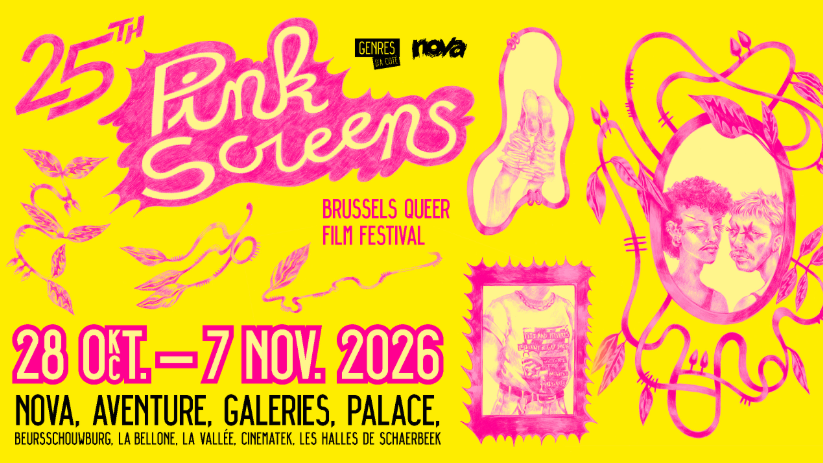
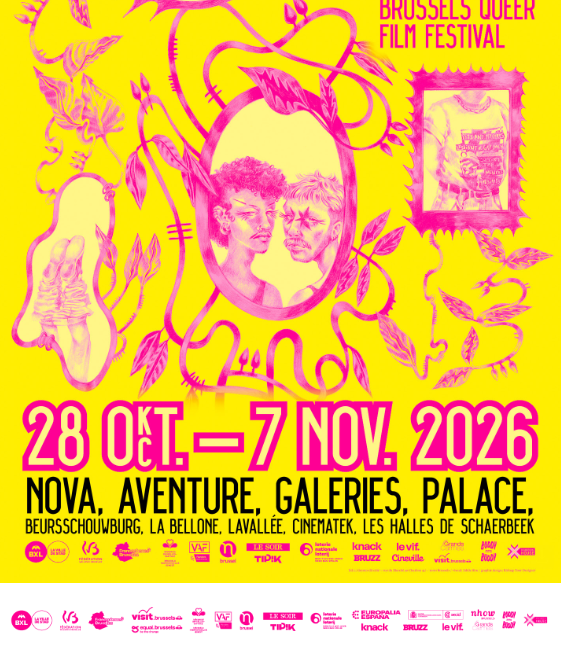
From 28 October to 7 November 2026, Pink Screens returns to Brussels for its 25th edition with more than 170 queer films, alongside exhibitions, talks, readings, performances, encounters and parties. Yellow and fuchsia will once again take over cinemas and cultural venues in the city centre — with an added November programme at CINEMATEK devoted to queer cinema of the 1970s. For LGBTQIA+ audiences, this anniversary is not simply a festival milestone: it celebrates 25 years of putting queer desire, rage, pleasure, bodies and political imagination on the big screen.
25 years of taking over the screen
Pink Screens has never been interested in being a polite little film festival. Created by the Brussels non-profit Genres d’à côté, it has spent a quarter-century bringing lesbian, gay, bisexual, trans, intersex and queer stories into cinemas — along with films engaging feminism, sexuality, bodies, identities and gender fluidity.
For its 25th edition, the festival is leaning into its age without becoming respectable. The invitation is clear: after thousands of films, parties, arguments, artistic encounters and very short nights, Pink Screens is still here because queer people keep making it, watching it, debating it and passing it on.
That collective history is central. Queer festivals are not only places where films are shown; they are places where audiences recognise themselves, discover unfamiliar experiences, make connections and see their lives treated as complex rather than secondary. A screening can be a first encounter with a trans story, an intersex perspective, a radical archive, a sexuality rarely depicted without shame, or a political reality that mainstream cinema keeps outside the frame.
More than 170 films, fewer certainties
This year’s programming team watched hundreds of submissions before selecting more than 170 films — a record for the festival. The result spans feature films, short films, documentaries, experimental cinema, animation and other unruly formats that refuse easy categorisation.
Pink Screens does not chase a safe consensus. Its films are chosen to shift perspectives, open arguments and sometimes make audiences uncomfortable in productive ways. Across the programme, queer lives appear in all their contradictions: love and sex, joy and grief, political struggle and private intimacy, chosen family and difficult family, tenderness and anger.
Short-film sessions remain a major part of the festival’s identity. They create space for emerging artists, bold forms and stories that might never find a conventional theatrical route. In a film landscape often shaped by funding hierarchies and market logic, that matters: short films can be a crucial space for queer filmmakers to take risks, experiment and speak in their own visual language.
The city, the self, the class struggle
Three programme strands bring particular focus to the 2026 edition.
“When We Arrive in Town” explores the city as a space of intimacy, discovery and collective gathering. For queer people, cities can mean freedom, anonymity, danger, nightlife, migration, loneliness, chosen family and the possibility of finding others. Brussels itself is part of that story: a city where different languages, nationalities, identities and subcultures cross paths — not always easily, but often creatively.
“I Is Another” turns towards personal experience and intimate relationships. The title suggests that identity is never entirely fixed or solitary: it is shaped through love, memory, friendship, conflict, desire and the ways other people see us. Expect films that make room for interior lives rather than reducing queer characters to coming-out plots or political symbols.
Then there is “Working Class Heroes”, a necessary focus on working-class realities and struggles too often missing from queer narratives. LGBTQIA+ representation can still lean towards a narrow image of urban, white, middle-class freedom. Bringing class into the frame means asking who can afford safety, who gets access to housing and healthcare, whose labour remains invisible, and how queer liberation is tied to economic justice.
Two exhibitions and plenty of glorious spillover
Pink Screens has always understood that cinema does not end when the credits roll. For its anniversary edition, the festival is expanding its visual-arts programme with two exhibitions rather than one.
One will take over the cellars of Cinéma Galeries; another will be hosted at LaVallée. Performances, readings and artistic proposals will further blur the borders between cinema, visual art, literature, nightlife and the kind of joyful queer chaos that has long been part of Pink Screens’ DNA.
This crossover matters because queer culture has never lived in one discipline. A film can lead to a conversation; a conversation can turn into a reading, a performance, a party or a new collective project. The festival’s many encounters with filmmakers, artists, activists, associations and other guests make room for that chain reaction.
Pink Screens’ closing Pink Night remains one of Brussels’ key queer party moments, while the wider festival programme keeps creating occasions to meet beyond the cinema seat.
A queer archive at CINEMATEK
The 25th edition will not end when the main festival closes. Throughout November, CINEMATEK will host a special programme dedicated to queer cinema of the 1970s.
That extension is more than an anniversary bonus. The 1970s were a decade of major liberation movements, feminist organising, experimental filmmaking and radical shifts in how sexuality and gender could be represented — even as censorship, homophobia and patriarchal norms remained deeply entrenched.
Returning to that cinema today offers an opportunity to see how queer images have changed, what struggles recur, and where today’s filmmakers are still breaking new ground. It can also complicate nostalgia: queer archives hold liberation, but they may also reveal exclusions around race, class, trans representation and whose stories were considered legible at the time.
A festival that looks forward needs an archive — not as a shrine, but as a living place for arguments, inspiration and unfinished conversations.
Practical information
Festival: Pink Screens — Brussels Queer Film Festival
Dates: Wednesday 28 October to Saturday 7 November 2026
Extended programme: Throughout November 2026 at CINEMATEK, dedicated to queer cinema from the 1970s
Festival locations: Venues in central Brussels, including Cinéma Nova, Cinéma Aventure, Cinéma Galeries, Beursschouwburg, Cinéma Palace, Les Halles de Schaerbeek and LaVallée.
Ticket prices:
- Cinéma Nova: €7 standard / €4 reduced for students and jobseekers
- Other partner cinemas: €10 standard / €8 reduced for students and jobseekers
- Online booking is available through most partner cinemas; Cinéma Nova operates separately.
Accessibility: People needing access support can contact the festival team at gdac_logistique@gdac.org ahead of their visit.
Programme and updates: Pink Screens 2026
pinkscreens.org
facebook: GDACpinkscreens
Instagram: pinkscreens_festival
Mail: info@gdac.org
At 25, Pink Screens still knows the essential rule of a good queer night out: open the doors wide, bring the difficult stories as well as the dazzling ones — and do not expect anyone to leave early.
KET Magazine is a community‑driven, non‑profit magazine run by volunteers and based in Brussels. You can find our other music and nightlife stories on ket.brussels, and you can always write to us to share your projects or pitch a story: info@ket.brussels
You may also like
-
FrancoFaune 2026: Brussels, Turn Up the Volume
From 1 to 11 October, FrancoFaune returns for its 13th edition, spreading French-language music across
-
Circle Park Prepares One Last Summer Dancefloor in Brussels
Circle Park is bringing its summer season to a close with a two-day Closing Weekend
-

Balkan Trafik! Turns Brussels’ Bourse into a Three-Day Balkan Universe
After a year away, Balkan Trafik! returns to Brussels from 19 to 21 November 2026
-
Listen Festival Turns Brussels Into a 24-Hour Dancefloor
Listen Festival is back on Saturday 21 November for its 10th anniversary — and this
-

Flesh and Fuel: A Queer Love Story on the Motorway
Two truck drivers, a motorway service area and a love story that refuses to stay