
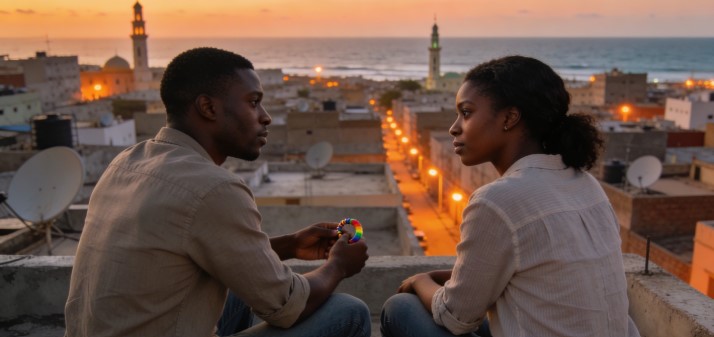
While Brussels is gearing up for another Pride season, LGBTQI+ people in Senegal are facing one of the harshest crackdowns on the continent, with longer prison sentences, mass arrests and an increasingly violent public climate. Between colonial‑era laws, moral panic and underground networks of care, queer life in Senegal is forced to exist in the shadows – but it has not disappeared.
For decades, homosexuality in Senegal has been criminalised under article 319 of the Penal Code, which punishes so‑called “acts against nature” between people of the same sex with heavy fines and up to five years in prison. In early 2026, lawmakers went a step further by voting an amendment that doubles the maximum prison term to ten years and broadens the scope of what can be prosecuted, from sexual acts to anything seen as “promoting” or financing LGBTQI+ lives. Behind the legal jargon, this means that queer people are not only punished for who they love, but that anyone trying to support them – from HIV prevention workers to community groups – can also be targeted.
This tightening of the law does not arrive in a vacuum. It comes after years of homophobic mobilisations, street protests “against homosexuality”, religious sermons turning queer people into scapegoats, and political campaigns where rejecting “Western LGBT values” is used as an identity marker. In a deeply paradoxical twist, the authorities are using legal tools inherited from French colonial rule to present themselves as defenders of “authentic” African values. For queer Senegalese people, this translates into a daily reality where the state, the media and sometimes families work together to make their existence unspeakable – and punishable.
On the ground, this climate has very concrete consequences. Over the past months, dozens of people suspected of being gay have been arrested following denunciations, police raids or simple phone checks, then publicly exposed in the press and on social media. Names, faces and neighbourhoods are sometimes revealed, turning judicial cases into open invitations for harassment and violence. For many, the first instinct is to disappear: changing jobs or homes, cutting ties with relatives, or trying to leave the country altogether. The fear is not only of prison, but of what might happen before and after: beatings, blackmail, being thrown out of school, losing custody of children, or being refused medical care.
Yet even under this pressure, queer Senegalese communities continue to exist and to resist. Activists and grassroots groups organise support networks, safe places to stay, legal aid and discreet health services for those who need to stay invisible to survive. Meetings are held behind closed doors, encrypted apps replace bars and clubs, and trusted circles become a matter of life or death. This work is increasingly risky: by targeting any “promotion” of homosexuality, the new law effectively criminalises not only public advocacy but also much of this quiet, everyday solidarity. Still, without it, many LGBTQI+ people would be left completely alone.
From Brussels, it is tempting to see this as a distant, purely “African” story, but that would be a mistake. The Senegalese diaspora – including queer and questioning people – is very present in Europe and in Belgium. Some have left precisely because living openly at home felt impossible. Others move back and forth between Dakar and European cities, constantly navigating different legal and social realities. For them, Pride marches and queer venues in Brussels are not just parties; they are spaces where they can breathe, build community and talk about what is happening back home without fear of being arrested the next day.
For a platform like ket.brussels, talking about Senegal is also about recognising these transnational ties: the Senegalese queer people who live here, those who are still there and follow what happens in Europe online, and the organisations that try to build bridges between both. It raises difficult questions: how can we show solidarity without putting people at risk? How do we amplify local voices instead of speaking over them? And what does it mean, as a queer person in a relatively safer context, to watch another community being pushed further into illegality?
If you want to go further, there are a few concrete things you can do from Brussels: support human rights organisations working with LGBTQI+ people in West Africa, follow and share the work of Senegalese activists in the diaspora, and stay informed about how EU migration and asylum policies affect queer people fleeing criminalisation. Above all, keep in mind that the freedoms we celebrate during Pride are not evenly shared – and that visibility, which we often claim as a goal here, can be a direct threat elsewhere.
KET Magazine is a community‑driven, non‑profit magazine run by volunteers based in Brussels. Get in touch to share your thoughts or tell us about your activities. You can also promote your events on our website or support our work with a donation. Contact us at Info@ket.brussels.
You may also like
-

At Liège’s Queer Families Festival, Every Family Has a Story
The third edition of the Queer Families Festival takes place on 11 October at the
-
Türkiye’s LGBTQIA+ Community Faces a New Wave of Pressure
LGBTQIA+ people in Türkiye are living through a sharp escalation in state pressure: Pride events
-
Fiji Declares a National HIV Emergency — and the World Must Pay Attention
Fiji has declared a national HIV emergency after a dramatic rise in diagnoses: 2,016 people
-

“After”: Listening to LGBTQIA+ Survivors Speak About Intimate Partner Violence
On 8 October, Tels Quels invites people to Les Grands Carmes in central Brussels for
-

Balkan Trafik! Turns Brussels’ Bourse into a Three-Day Balkan Universe
After a year away, Balkan Trafik! returns to Brussels from 19 to 21 November 2026