
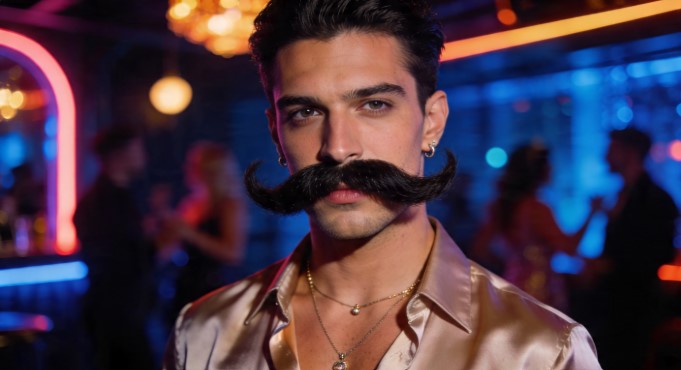
The moustache has always been more than facial hair. Across history, it has marked status, masculinity, rebellion, eroticism and style, moving from ancient power symbol to a modern shorthand for identity and performance. In queer culture especially, the moustache has often carried an extra charge, becoming a visual code that could signal community, desire or deliberate provocation.
Its queer history is especially rich. In the 1970s and 1980s, the moustache became closely associated with gay subcultures such as the Castro clone look in San Francisco, where it was paired with leather, denim and exaggerated masculinity. That image also fed into the legacy of icons like Freddie Mercury, whose moustache became one of the most recognisable queer-adjacent style statements in pop history.
A hairy history
Before it became a fashion choice, the moustache was a symbol of rank and power in many societies. Over time it shifted from warrior marker to bourgeois ornament, then to a more ambiguous style sign that could be respected, mocked or reclaimed depending on the era.
That ambiguity is part of what keeps it interesting today. The moustache can read as retro, camp, hyper-masculine, ironic or sexy depending on who wears it and how it is styled, which is exactly why it continues to reappear in fashion cycles.
Freddie Mercury remains the clearest example of how a moustache can operate as both image and message. According to accounts of the early 1980s, Mercury adopted his now-famous moustache after being inspired by the gay club scene in San Francisco, and he wore it as part of a look that was both flamboyant and coded.
The 2026 moustache crowd
In 2026, the moustache is once again everywhere, especially among male celebrities who use it to project cool, edge or a softer form of masculinity. The names most often linked to the trend include Timothée Chalamet, Jacob Elordi, Pedro Pascal, Paul Mescal, Jonathan Bailey, Kit Connor, Matt Bomer, Brad Pitt, Jean Dujardin, Joe Jonas, Zac Efron, Colin Farrell, Johnny Depp and Viggo Mortensen.
The most frequently cited 2026 faces of the trend are Timothée Chalamet, Jacob Elordi and Pedro Pascal, whose baby moustaches have already become a recurring subject of fashion commentary and online debate.
Chalamet’s version is the most delicate, almost teasing in its refusal to fully commit, while Pascal’s is more established and part of a signature look. Elordi, meanwhile, pushes the moustache into a broader 1970s- and 1980s-coded aesthetic that feels both nostalgic and newly slick.
Why queer readers should care
For queer audiences, the moustache is never just a grooming detail. It is a symbol that has been used to stage masculinity, flirt with codes of belonging and resist the idea that gender presentation has to be clean or natural.
That is why the current revival feels culturally interesting rather than merely cosmetic. In a moment when male beauty standards are becoming more plural, the moustache offers a way to signal control, irony, camp and desire all at once, which is exactly the kind of ambiguity queer culture tends to understand very well.
What the revival says now
The moustache’s comeback also reflects a broader shift in how masculinity is being packaged and consumed. The clean-shaven look is no longer the only default, and the rise of the moustache suggests a return to visible styling choices that carry personality, reference and attitude.
In that sense, the moustache is less a throwback than a tool of self-fashioning. It can be playful or precise, classic or subversive, and it still has the rare ability to say something about its wearer before they even speak.
KET Magazine is a community‑driven, non‑profit magazine run by volunteers based in Brussels. Get in touch to share your thoughts or tell us about your activities. You can also promote your events on our website or support our work with a donation. Contact us at Info@ket.brussels.
You may also like
-

Canal, Sun and Queer Chill: Quai d’Été Turns Brussels into a Summer Waterfront
From 2 to 19 July 2026, Quai d’Été / Zomerkaai drops anchor at the Quai
-

Love, Law and Queer Futures: Why LGBTQ+ Couples Should Still Visit Their Notary
In Belgium, same-sex marriage has been legal for over 20 years, and yet many LGBTQ+
-

Sky High, Queer Wide: Brussels Rooftops for Your Summer Nights
When the sun finally shows up in Brussels, the city opens up from above: cocktails,
-

“Lick the Balls: Brussels’ Hottest Ice Cream Spots for Queer Summer Nights”
As summer edges closer, Brussels is once again queuing for ice cream, and independent food
-

Soft Mornings, Bold Design: A Queer-Friendly Brunch at Design Museum Brussels
On Sunday June 7, Design Museum Brussels hosts a Design Brunch that blends food, creativity,