
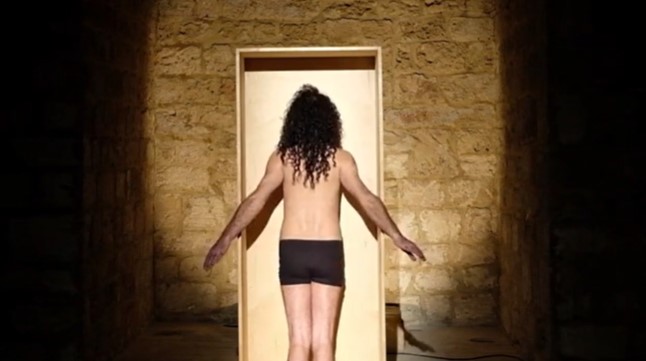
In Lebanon, even the act of dancing can become a political gesture. In a recent RTBF piece, Alexandre, a Lebanese dancer resisting war through movement, says: “Le pire, ce ne sont pas les bombes, c’est l’indifférence,” a sentence that cuts straight through the numbness surrounding a country still absorbing violence, displacement and the slow erosion of daily life.
Read the original RTBF article here: Le pire, ce ne sont pas les bombes, c’est l’indifférence : Alexandre résiste avec sa danse à l’invasion du Liban.
Alexandre’s story matters because it places art exactly where it often becomes most urgent: inside a country being pushed to its limits. Lebanon is not only living through war and instability, but also through a deep social and economic collapse that has left artists trying to continue creating in a landscape of ruins, uncertainty and exhaustion.
View de video here : https://www.rtbf.be/auvio/embed/media?id=3465476
Art as survival
What makes Alexandre’s dance powerful is not only its beauty, but its refusal to disappear. In the RTBF report, he presents movement as resistance — a way to stay visible, to stay alive, and to answer destruction with presence rather than silence.
That is the condition many Lebanese artists are working under now. Whether through dance, visual art, music or performance, they are trying to build meaning in a country where infrastructure has been damaged, institutions weakened, and the emotional cost of survival is carried in every gesture.
A country in ruins
To speak about Lebanese artists today is also to speak about a country that has been repeatedly broken open by war, political paralysis and economic collapse. Beirut in particular remains marked by the 2020 port explosion and by the layers of damage that have accumulated since then, both material and psychological.
In that context, art is not a luxury. It becomes a form of witness, a way to preserve memory, and sometimes the only remaining space where grief, rage and dignity can still coexist. Alexandre’s dance belongs to that lineage: not escapism, but survival through expression.
Why this story resonates
Ket follows stories like Alexandre’s because they show what art can still do when politics fails and institutions collapse. His movement becomes a reminder that visibility itself can be a resistance strategy, especially in a region where indifference can be as destructive as violence.
And Lebanon’s artists keep proving that even from within collapse, culture does not stop. It mutates, persists and keeps naming what power would rather leave unspoken.
Useful link
KET Magazine is a community‑driven, non‑profit magazine run by volunteers based in Brussels. Get in touch to share your thoughts or tell us about your activities. You can also promote your events on our website or support our work with a donation. Contact us at Info@ket.brussels.
You may also like
-

Endless Summer Camp: Scout Rules Meet Queer Desire at Balsamine
Summer might be over, but Sophie Guisset has other plans. From 19 to 28 November
-

Escher in Brussels: Who Said Reality Had to Behave?
Staircases refuse to play by the rules, birds become fish, and two hands draw each
-
When Nuns Go Pirate: A Queer Sacred Thriller at Varia
What happens when lesbian love, religious memory and horror theatre enter a locked convent—and refuse
-

Tels Quels Talent Show: Brussels’ Queer Voices Take the Mic
On Friday 16 October, the Tels Quels Talent Show brings live queer creativity to Les
-

CLELIA Turns Solitude Into a Shared Pop Therapy
The Brussels-based musician opens up to KET about mental health, queer visibility and her new