
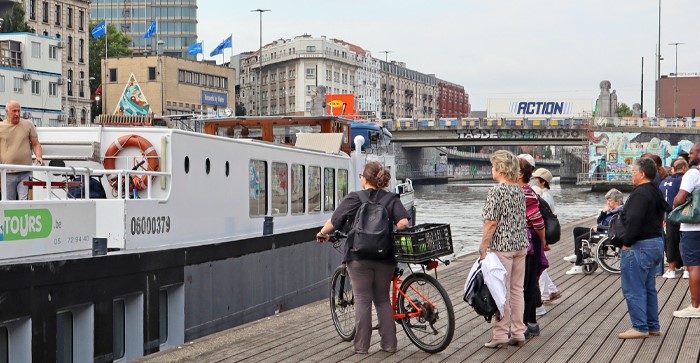
From Vilvoorde to the heart of Brussels, there is another “transport line” besides the tram and metro: the Waterbus, a canal shuttle that travels roughly ten kilometres along the Brussels–Scheldt canal. It runs from spring to autumn and lets you skip traffic jams while rediscovering the canal area from the water, between industrial docks, new neighbourhoods, street art and urban nature.
The concept is straightforward: a metropolitan boat-bus with fixed stops, regular timetables and space for bikes on board, all for just a few euros per ride. It is both genuine public transport and a laid‑back mini‑cruise, designed for locals and visitors who want to see the city from a different angle.
A mobility project that doubles as a day out
Launched in 2013, the Brussels–Vilvoorde Waterbus was created as a sustainable mobility project for a canal zone in full transition. The route links stops such as Sainctelette/Yser, the surroundings of KANAL – Centre Pompidou, Tour & Taxis, the shopping district around Docks Bruxsel, Laeken and the centre of Vilvoorde, in a journey of about one hour end to end.
Along the way, the stops connect with the regular public transport network and shared bike stations, turning the Waterbus into a real part of Brussels’ mobility puzzle. For commuters with a little time, it is a calmer alternative to clogged tunnels; for everyone else, it is a ready‑made canal tour, sliding between industrial heritage, new housing projects and slices of greenery.
Why it feels very “Brussels”
The Waterbus brings together several very Belgian obsessions: DIY solutions, soft mobility, love of old infrastructure and a quiet pride in the canal. It is a slow but efficient way to move around, one where you actually see the city change in front of you, and where the valley of the Senne suddenly makes sense as a single landscape.
For a queer crowd (and allies) who like to explore beyond the inner ring, it is also a playful way to draw new maps of the city: hopping off for an exhibition in Laeken, an event at Tour & Taxis or a terrace in Vilvoorde, all without leaving the water. Think of it as Brussels’ answer to the coastal tram – a bit rougher around the edges, but with that very local charm.
Useful links
- Waterbus – official presentation
- Brussels by Water – visit and cruise info
- Practical article – Boat transport in Brussels (FR)
- Practical article – Boat transport in Brussels (EN)
KET Magazine is a community‑driven, non‑profit magazine run by volunteers based in Brussels. Get in touch to share your thoughts or tell us about your activities. You can also promote your events on our website or support our work with a donation. Contact us at Info@ket.brussels.
You may also like
-
KET in Paris — Le Hasard Ludique, Where the Tracks Lead to Music
For this stop in our KET in Paris series, we visited Le Hasard Ludique, a
-
KET in Paris — At Paradis Latin, Even the Waiters Take the Stage
For this stop in our KET in Paris series, we spent an evening at Paradis
-

Cósmica Galería: The Madrid Gallery Making Space for Queer Desire and Tenderness Cósmica Galería is
-
Leuven Pride returns with a stronger focus on safety and access
Leuven Pride is back on Saturday 26 September 2026 for its third edition, turning the
-
Acte de Présence: a Queer-leaning Château Festival Turning Mayenne into a Shared Dream
Some festivals sell escape. Acte de Présence seems more interested in belonging: four days, one