
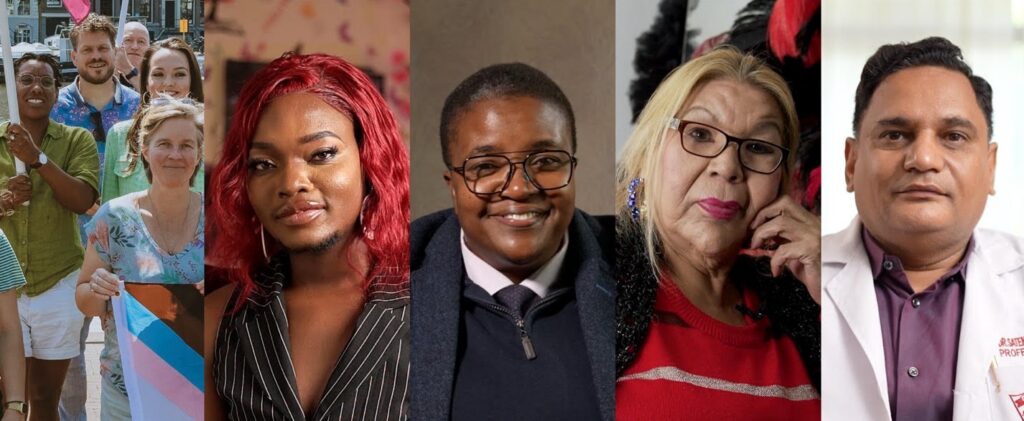
On 5 August, during the WorldPride Human Rights Conference in Amsterdam, UNDP and ILGA World honoured five International Pride Awards recipients whose work is changing LGBTIQ+ lives across continents. From trans-led care in Uganda to intersex-inclusive healthcare in India, their stories place grassroots organising — not celebrity — at the centre of queer progress. Two days later, their message feels particularly urgent: equality is built through care, memory, political action and collective resilience.
A Global Stage for Ground-Level Work
The 2026 International Pride Awards celebrate people and organisations advancing equality for lesbian, gay, bisexual, trans, intersex and queer people in very different contexts. The recipients were selected by an awards committee after global nominations, and eligible winners from low- and middle-income countries receive a US$10,000 grant to continue their work.
The ceremony took place during Amsterdam WorldPride’s Human Rights Conference — a fitting setting for awards that look beyond rainbow branding. These are not prizes for visibility alone. They recognise people building support networks, pushing institutions to change and holding space for communities facing violence, exclusion and shrinking civic freedoms.
Five Ways to Build Equality
The five awardees show that queer liberation has many forms — and no single geography.
- COC Nederland, founded in 1946 and described as the world’s oldest existing LGBTIQ+ rights organisation, received the award for movement building in the face of hostility. Working with more than 200 organisations across over 35 countries, it supports grassroots groups dealing with criminalisation, discrimination and violence.
- Aggie Dennett Harmon, a trans pastor, community leader and advocate from Uganda, was honoured for celebrating diverse lives. Through trans women-led initiatives, she supports people facing displacement and exclusion with trauma-informed care, peer networks and safer, affirming spaces — while also challenging the false idea that faith and queerness cannot coexist.
- Mmapaseka Steve Letsike, South Africa’s Deputy Minister of Women, Youth and Persons with Disabilities, received the Emerging Leader award. After years in LGBTIQ+ and social-justice activism, she is bringing movement experience into government to address discrimination, violence, healthcare inequalities and political underrepresentation.
- Marcela Dimonty, a Chilean trans activist, received recognition for her lifelong pursuit of equality. Her work connects the repression suffered by LGBTIQ+ people during Chile’s military dictatorship with the continuing marginalisation of older trans people — turning personal survival, testimony and artistic expression into a demand for truth and reparation.
- Dr Satendra Singh, an Indian disability-rights advocate and medical educator, was named an Extraordinary Ally. He has challenged the pathologisation of intersex and LGBTQ+ people in healthcare, supported trans-affirmative medical training and advocated against medically unnecessary surgeries on intersex children.
Beyond the “Inspiring” Headline
These stories deserve celebration — but not in a way that turns activists into feel-good symbols while ignoring the conditions they work against. Trans people in Uganda, older trans people in Chile, intersex people navigating medical institutions, and grassroots organisers under political pressure do not need applause alone. They need resources, protection, political allies and long-term attention.
That is why the award’s focus on leadership across care, healthcare, political representation and community history feels important. It recognises that queer rights are not won in one arena: progress depends on people organising locally, documenting what happened, supporting one another and pushing systems to stop causing harm.
For LGBTQIA+ people today, these five awardees matter because they show that equality is intersectional by nature. It includes race, disability, age, migration, faith, healthcare, gender identity and access to public life — not just the right to be visible.
Why It Resonates in Brussels
For Brussels’ queer communities, Amsterdam may be close, but the themes are familiar. Our city’s LGBTQIA+ culture is made not only by parties, Pride stages and institutions, but by the people who build safer spaces, care networks and political pressure when official inclusion falls short.
COC Nederland’s cross-border movement work also offers a useful reminder for Belgium: queer solidarity cannot stop at national borders. When LGBTIQ+ rights are under attack elsewhere in Europe and around the world, local communities, media and organisations have a role in amplifying voices without speaking over them.
Practical Info
The 2026 International Pride Awards ceremony took place on 5 August 2026 at the WorldPride Human Rights Conference in Amsterdam. It was organised by the United Nations Development Programme (UNDP) and ILGA World.
The full ceremony is available to watch on YouTube. More information on the recipients is available through International Pride Awards and ILGA World.
Five awards cannot capture every person doing this work. But they make one thing clear: queer futures are being built every day, often far from the spotlight — and always through community.
KET Magazine is a community‑driven, non‑profit magazine run by volunteers and based in Brussels. You can find our other music and nightlife stories on ket.brussels, and you can always write to us to share your projects or pitch a story: info@ket.brussels
You may also like
-
At Liège’s Queer Families Festival, Every Family Has a Story
The third edition of the Queer Families Festival takes place on 11 October at the
-
Türkiye’s LGBTQIA+ Community Faces a New Wave of Pressure
LGBTQIA+ people in Türkiye are living through a sharp escalation in state pressure: Pride events
-
Fiji Declares a National HIV Emergency — and the World Must Pay Attention
Fiji has declared a national HIV emergency after a dramatic rise in diagnoses: 2,016 people
-

“After”: Listening to LGBTQIA+ Survivors Speak About Intimate Partner Violence
On 8 October, Tels Quels invites people to Les Grands Carmes in central Brussels for
-

Balkan Trafik! Turns Brussels’ Bourse into a Three-Day Balkan Universe
After a year away, Balkan Trafik! returns to Brussels from 19 to 21 November 2026