
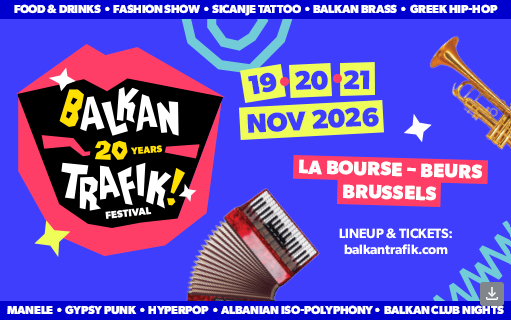
After a year away, Balkan Trafik! returns to Brussels from 19 to 21 November 2026 with a special 20th-anniversary edition at the Bourse–Beurs. For the first time, the festival will take over the entire landmark building, mixing concerts, clubbing, food, fashion, talks and cultural encounters across several spaces. For queer audiences, its interest lies in this invitation to cross borders — between genres, generations, diasporas and identities — while making room for conversations about gender equality, solidarity and living together.
A comeback with a new home
Balkan Trafik! is back after a one-year pause — and it is changing scale as much as location. Rather than returning to its familiar outdoor format, the Brussels festival will transform the Bourse–Beurs into an indoor cultural playground for its 20th anniversary.
Two main stages, more intimate semi-acoustic music lounges, a Balkan Village and meeting spaces will spread throughout the building. The Bourse itself is entering new territory too: this will be the first time it hosts a festival across all of its spaces.
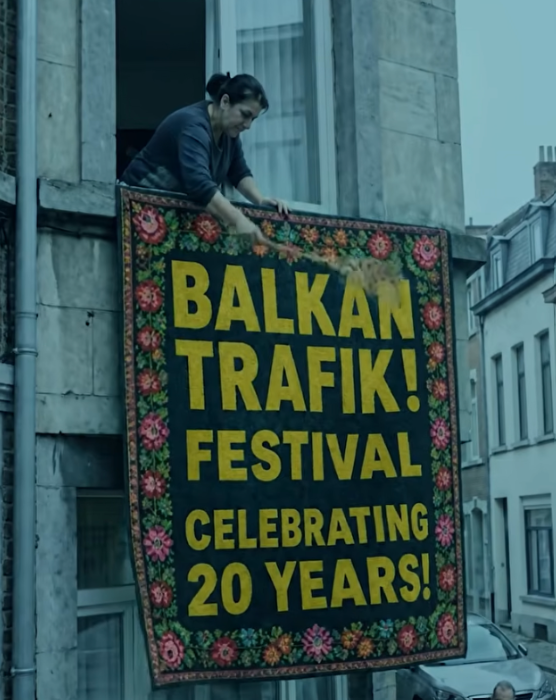
That shift feels meaningful. Instead of a festival experienced from one stage or one crowd, Balkan Trafik! promises a more roaming format: moving through rooms, stumbling across sounds, taking breaks in lounges, sharing food and potentially finding a corner that fits your own rhythm.
From ancient harmonies to bass-heavy nights
Balkan Trafik!’s line-up remains committed to the many musical languages of South-East Europe and its diasporas. It is not about presenting “the Balkans” as one fixed sound or aesthetic; instead, the programme moves between living traditions, contemporary pop, electronic music, folk, punk, jazz and brass.
Among the announced artists are Slovenian singer ZEVIN and Croatian musician Stela Rade, both part of a new generation of women artists reshaping regional pop and alternative scenes. Albanian ensemble Krojet e Velçës will bring labë iso-polyphony, a vocal tradition recognised by UNESCO as intangible cultural heritage, while Serbia’s Bojan Krstić Brass Band will deliver the full physical force of Balkan brass.
Saturday night closes with DJ Shahash Akrimski, whose set connects breakbeat, jungle, drum’n’bass and electro with Ukrainian and Moldovan sounds. Elsewhere, the festival’s late-night club programme will keep the Bourse moving after the concerts, with DJs including Gaetano Fabri, SKANDAL and Shahash Akrimski.
Collaborations, roots and new energy
Original creations are central to this anniversary edition. Balkaniada by Clejani gathers more than 15 Romanian artists, including Marga, Viorica & Ioniță de la Clejani, Taraful din Clejani and manele star Florin Salam. It is a rare chance to encounter a large-scale meeting of Romanian popular music, virtuoso traditions and contemporary fame on a Brussels stage.
Greek rapper Eisvoleas will meet Brussels-based Greek musicians and rebetiko dancers, while Hungarian groups Bohemian Betyars and Besh o droM bring together folk, punk and Eastern European musical traditions. Czech band Terne Čhave, rooted in Romani traditions and blending funk, rock, soul, ska and jazz, expands the programme beyond a narrow or folklorised vision of heritage.
Moldova’s Lupii lui Calancea will bring another intense crossover: ancestral musical references collide with tribal rhythms, rock energy and contemporary production under the direction of composer and producer Alex Calancea. Belgian artists are part of the picture too, including Muriel D’Ailleurs & Jama Orchestra, Belgian-Greek trumpeter Dominic Ntoumos, and a new collaboration between Brussels DJs Gaetano Fabri and SKANDAL with a live brass band.
A festival where culture circulates
The festival is designed to happen beyond the stages. Throughout the three days, roaming brass bands, musicians and artistic interventions will accompany people through the Bourse. Balkan food, South-East European wines and Belgian beers will add to the social side of the experience.
Croatian artist Eva Balažin will offer temporary tattoos inspired by sicanje, a traditional tattoo practice, with booking required. These small-format encounters matter: they turn the festival from a succession of concerts into a shared environment where heritage can be heard, tasted, discussed and reinterpreted.dhnet+1
For LGBTQIA+ visitors, that broader approach can be especially welcome. Queer cultural life often thrives in places where people can move between the dancefloor, the conversation, the artwork and the quieter moment — without having to choose one single way of taking part. A festival that values diasporic stories, minority cultures and multiple forms of expression can create more room for complex identities, as long as that openness is actively lived in the space.
Balkan Agora: fashion, debate and shared futures
On Saturday afternoon, Balkan Agora opens the Bourse free of charge until 18:00. The programme broadens Balkan Trafik! beyond music with workshops, dance and language introductions, cultural activities, and discussions involving activists and civil-society voices.
A first-ever catwalk will bring together designers from the Balkans, creators from the Belgian diaspora and traditional costumes. Talks will address environmental issues, gender equality and living together — subjects that are not side notes, but deeply linked to who gets visibility, safety and agency in cultural spaces.
The free afternoon is also a welcome access point. It offers a way into the festival for people who may not be able, or may not want, to buy a full evening ticket. It is a reminder that inclusion is not only about who appears on stage, but also about who can enter the room, join the conversation and feel that the festival belongs to them too.
Practical information
Festival: Balkan Trafik!
Dates: Thursday 19 to Saturday 21 November 2026
Venue: Bourse–Beurs de Bruxelles, Boulevard Anspach 80, 1000 Brussels
Opening hours:
- Thursday 19 November: 18:30–01:30
- Friday 20 November: 18:30–01:30
- Saturday 21 November: free Balkan Agora from 14:30 to 18:00; ticketed festival from 18:30 to 01:30
Tickets: €35 per day; Saturday afternoon’s Balkan Agora is free. Capacity is limited because of the new Bourse format, and the festival operates cashlessly, with card payments only.balkantrafik+1
More information and tickets: Balkan Trafik!
A dancefloor, a brass band, a fashion catwalk, a conversation about gender equality and a plate of Balkan food in the same building: Balkan Trafik! is returning with a format made for wandering, listening and connecting.
KET Magazine is a community‑driven, non‑profit magazine run by volunteers and based in Brussels. You can find our other music and nightlife stories on ket.brussels, and you can always write to us to share your projects or pitch a story: info@ket.brussels
You may also like
-
Listen Festival Turns Brussels Into a 24-Hour Dancefloor
Listen Festival is back on Saturday 21 November for its 10th anniversary — and this
-
In Myanmar, the Spirit Wives Keep Dancing
Near Mandalay, in a country torn apart by civil war, the annual Taungbyone festival has
-
Brussels Design Week: Who Gets to Shape the City?
Brussels Design September is becoming Brussels Design Week for its 20th edition, running from 24
-
Brussels Open Air Festival: Five Dancefloors, One City in Motion
On Saturday 12 September, Brussels Open Air Festival turns five public spaces into open-air dancefloors
-

John & Jen: A Small Musical With a Devastating Emotional Punch
At Festival Bruxellons!, John & Jen turns a two-person cast and an intimate barn stage