
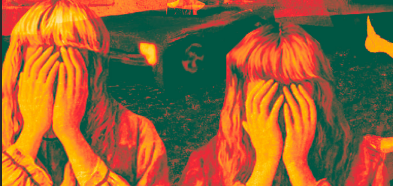
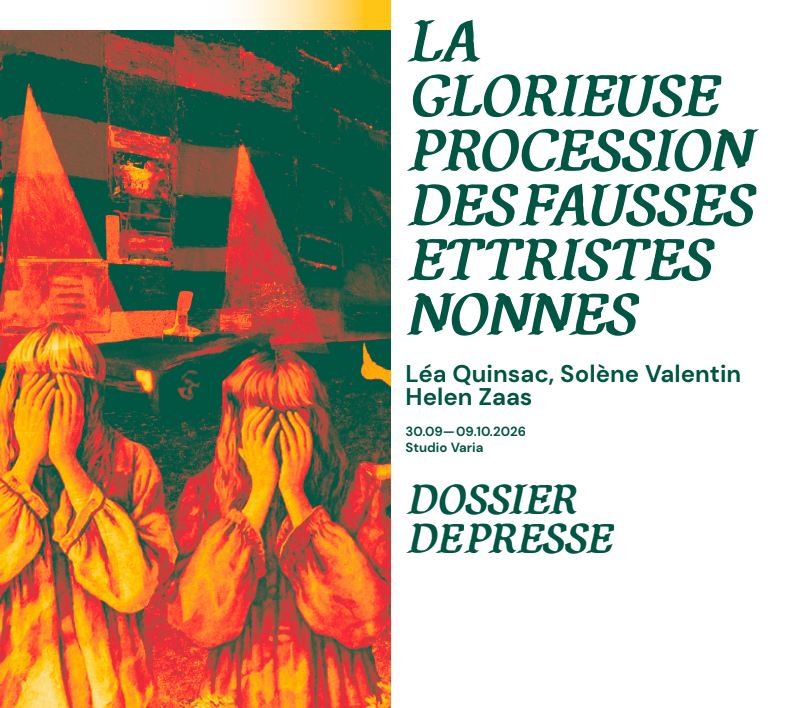
What happens when lesbian love, religious memory and horror theatre enter a locked convent—and refuse to behave? From 30 September to 9 October, La glorieuse procession des fausses et tristes nonnes turns Studio Varia into a pirate radio station haunted by untold histories. Created by Léa Quinsac and Solène Valentin with the Helen Zaas company, this fierce, strange and tender new work asks a question many queer people know intimately: can faith and a life deemed “deviant” ever be reconciled?
A convent broadcasting on the margins
The set-up of La glorieuse procession des fausses et tristes nonnes is deliciously gothic: a clandestine radio studio hidden inside a convent. One nun sends an appeal out across the airwaves, searching for answers about a disturbing incident that took place there years ago. Then one woman arrives. Then another. Then another.
What follows is described as a horror thriller with a Grand Guignol edge: fragmented memories, ghost stories, false leads and an investigation that shifts between despair and unsettling fantasy. The nuns’ voices travel through the radio frequency, trying to piece together what has been buried by the institution around them.
The premise is theatrical in the richest sense: mystery, blood, comedy, liturgy and the possibility that something very old is still speaking back.
Faith without the gatekeepers
At the centre of the work is a radical proposition: spirituality and lesbian love do not have to be enemies.
Quinsac and Valentin do not approach Christianity as a list of beliefs to endorse or reject. Instead, they engage with its cultural and emotional inheritance—rituals, mystical traditions, archetypes, music, death and the invisible. The point is not to hand religion back to conservative institutions. It is to reclaim it from them.
As the artists put it, the piece seeks to tell stories in which spirituality and lesbian love no longer oppose one another, refusing to leave the monopoly on religion to conservatives. This is what gives the production its queer urgency. It does not flatten the harm religion has done to LGBTQIA+ people. It asks how people can live with inherited wounds while still finding space for intimacy, wonder, devotion and collective freedom.
Saints, dissidents and unruly histories
The fiction draws on women whose histories have been erased, distorted or punished. Among its inspirations is Hildegard von Bingen, the medieval composer, healer and abbess who defied restrictions on women singing in church; in the play, she echoes through Hilde, a nun who creates pirate radio so her sisters can be heard.
The research also reaches toward the Belgian beguine Marguerite Porete, burned at the stake in Paris in 1310 after writing of divine love in ways deemed dangerous; Julie d’Aubigny, the 17th-century duellist and singer who dressed in men’s clothing and loved women; and the histories of women confined in “corrective” religious institutions. The convent is partly informed by the Good Shepherd congregations in France and Ireland’s Magdalene Laundries—sites where women judged immoral were controlled, exploited and silenced.
These are not historical footnotes. They become material for a contemporary queer imagination: a way to recognise that dissidence has always existed, even when institutions worked hard to make it disappear.
A beautiful nightmare in colour
Helen Zaas works in a deliberately excessive visual language: baroque, feminist, grotesque and full of theatrical transformation. The show’s visual research includes paintings by Elen Bezhen and Julius Hofmann, as well as Christoph Schlingensief’s The 120 Days of Bottrop and Alexandra Karelina’s Last Words. Its wider visual constellation ranges from vampire imagery and medieval folklore to the work of Apolonia Sokol, Miriam Cahn, Tahnee Lonsdale and Ulrike Ottinger.varia+1
Costumes by Solène Valentin explore confinement, uniformity and the spread of evil. Nuns may share faces, silhouettes distort, bodies acquire animal heads, and red appears in the clothing and scenography like a stain that will not disappear. The stage design, by Marie Szersnovicz, is inspired in part by Le Corbusier’s brutalist convent of Sainte Marie de La Tourette: a rational, controlling architecture made porous by hidden passages, glitches and spectral arrivals.
Live music by Léonie Floret—also known as Tratenwald—and sound creation by Laure Lapel deepen the unstable atmosphere. Songs and radio interference become both a way to anchor the audience and a way to unsettle it: liturgy meets crime drama, ghost story meets sonic disturbance.
Why queer audiences should care
This is not theatre that treats queer faith as a contradiction to solve politely. It lets contradiction become an aesthetic engine: sacred and profane, tender and grotesque, historical and invented, terrified and triumphant.
For LGBTQIA+ audiences, especially those whose lives have been shaped by religious exclusion, that can be a meaningful shift. The show makes room for a spirituality that does not require self-erasure. Its women are vulnerable, unruly, strange and grandiose; they get to tell their own versions of events, and to imagine a world beyond the cultural ban on loving one another.
In this convent, a nun with a microphone is not a symbol of silence. She is a broadcaster.
Practical information
- What: La glorieuse procession des fausses et tristes nonnes, a new theatre creation by Léa Quinsac and Solène Valentin with Helen Zaas.
- When: 30 September–9 October 2026. Performances are scheduled on 3 October at 6 pm; 6 and 7 October at 7:30 pm; and 8 and 9 October at 8:30 pm.
- Where: Studio Varia, Rue Gray 154, 1050 Ixelles.
- Language and duration: French; approximately 1 hour 30 minutes.
- Tickets: Varia’s “Pay What You Can” scale is €10, €13, €17, €22 or €27. Article 27 access is available.visit+1
- Content note: Recommended from age 14. The show includes references to gender-based and sexual violence, as well as stage blood and vomiting.
- Bookings: Reserve via the Varia event page.
A prayer, a scream, a love song and a radio signal: La glorieuse procession des fausses et tristes nonnes promises all four—and refuses to choose only one.
KET Magazine is a community‑driven, non‑profit magazine run by volunteers and based in Brussels. You can find our other music and nightlife stories on ket.brussels, and you can always write to us to share your projects or pitch a story: info@ket.brussels
You may also like
-
KET in Paris — Le Hasard Ludique, Where the Tracks Lead to Music
For this stop in our KET in Paris series, we visited Le Hasard Ludique, a
-

At Liège’s Queer Families Festival, Every Family Has a Story
The third edition of the Queer Families Festival takes place on 11 October at the
-
In Concrete Purgatory, Desire Finds a Way Through
La Boue (Remix) is a short, intimate film by Belgian director Noah Dechamps, made in
-
Inuit Art Takes Centre Stage at Brussels’ Art & History Museum
From 16 October 2026 to 18 April 2027, the Art & History Museum in Brussels
-
What Happens When We Move Together? The Mechanics of Crowds Comes to Liège
From 20 November 2026 to 4 April 2027, La Cité Miroir in Liège hosts The