
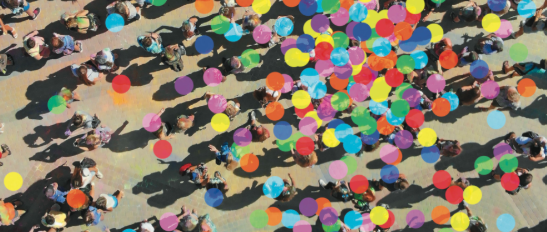
From 20 November 2026 to 4 April 2027, La Cité Miroir in Liège hosts The Mechanics of Crowds, an immersive exhibition about the hidden forces that shape collective behaviour. Designed by Paris’s Cité des sciences et de l’industrie, the interactive show explores everything from pedestrian flows and packed gatherings to viral posts and online misinformation. For queer visitors, it offers a timely way to think about how communities assemble, how visibility spreads, and how collective care can turn a crowd into something more than a mass of strangers.
More than a collection of people
A crowd can feel exhilarating, uncomfortable, protective or overwhelming — sometimes all at once. At a concert, a Pride march, a demonstration, a busy station or a packed dancefloor, our movements are constantly influenced by the people around us. We adjust our pace, follow an opening in the flow, make space, cluster with friends or react to a sudden shift in atmosphere.
The Mechanics of Crowds asks visitors to look more closely at those everyday instincts. Rather than treating crowds as irrational, dangerous or anonymous by default, the exhibition investigates the often invisible rules that organise collective movement and shared behaviour.
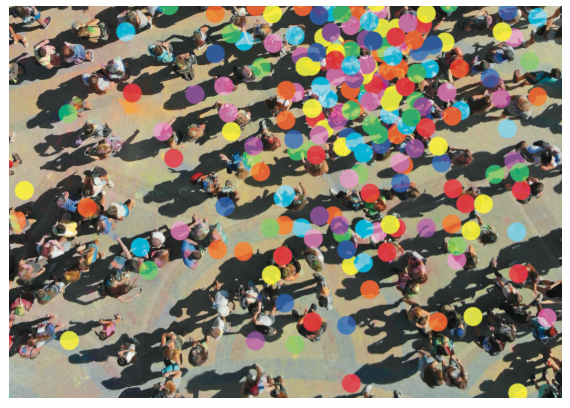
Presented in Belgium for the first time after stops in Paris, Montréal, Toulouse and Bern, the exhibition brings scientific research into an accessible, playful and participatory format. It invites audiences to experience crowd dynamics from the inside — and to question the assumptions we bring to large gatherings.
Feeling the flow
The exhibition begins with the physical reality of being among other people. Through immersive installations, interactive devices and staged situations, visitors can explore how density, movement and human interaction shape shared spaces.
How do people behave in a compact crowd? Why do pedestrian flows often become surprisingly organised even when nobody appears to be coordinating them? How can organisers anticipate bottlenecks, create safer circulation routes and reduce risks at large public events?
These are not abstract questions. They affect the practical experience of festivals, protests, sporting events, nightlife, public transport and city centres. By making collective movement visible, the exhibition offers tools for understanding both the pleasures and pressures of sharing space.
For LGBTQIA+ people, that question of space is especially familiar. Queer communities know that gathering can be joyful and political at the same time: a Pride crowd can make people feel visible and less alone, while a badly managed or hostile public setting can quickly feel unsafe. Thinking about circulation, density, access and care is part of thinking about who gets to participate.
The invisible choreography of everyday life
Most of the time, we do not consciously plan how to walk through a crowd. Yet people continually read small signals from others: speed, direction, posture, available gaps and moments of hesitation. From these tiny individual decisions, larger patterns emerge.
The exhibition uses interactive experiences to make that informal choreography easier to see. It shows how shared movement can be structured without a central leader, and how collective patterns can arise from simple reactions between people.
This perspective challenges the old image of the crowd as automatically chaotic. Crowds can indeed become dangerous in certain conditions, particularly where density is high and movement is constrained. But they can also demonstrate cooperation, mutual adjustment and what researchers describe as collective intelligence.
That more nuanced view matters. It recognises that people in groups are not simply swept along by emotion: they can observe, adapt, care for one another and act together.
From the street to the social feed
The Mechanics of Crowds also moves into digital territory, examining how collective behaviour unfolds on social networks. Online, a crowd does not need to share the same physical space to produce real effects. A post can travel at speed, an opinion can gain momentum, and misinformation can be amplified long before it is checked.
The exhibition looks at virality, influence and the large-scale circulation of content. It offers visitors ways to better understand how information spreads — and why certain narratives become visible, dominant or difficult to challenge.
For queer communities, digital circulation can be a double-edged reality. Social media can connect isolated people with affirming resources, mutual-aid networks, cultural events and chosen family. It can also accelerate harassment, disinformation and moral panic, particularly around trans rights, sex education, drag performance or LGBTQIA+ visibility in public life.
The question is not whether online crowds are good or bad. It is how we recognise the systems shaping what we see, share and believe — and how we build more thoughtful forms of digital solidarity.
Collective power, collective responsibility
One of the exhibition’s strongest ideas is that crowds have two faces. They can be sites of fear, pressure and exclusion, but they can also produce cooperation, support and shared intelligence.
That tension is central to queer history. LGBTQIA+ people have repeatedly created collective spaces in response to isolation and discrimination: marches, mutual-aid groups, community centres, nightlife, activist networks, art scenes and online communities. These spaces can offer belonging and political power, but they also require attention to access, racism, ableism, gendered violence, consent and whose voices are being heard.
By combining science, play and lived experience, The Mechanics of Crowds creates an opening to discuss these issues without becoming overly theoretical. It asks a simple but powerful question: when we come together, what do we make possible?
Practical information
Exhibition: The Mechanics of Crowds / La mécanique des FOULES
Dates: 20 November 2026 to 4 April 2027
Venue: La Cité Miroir, Place Xavier Neujean 22, 4000 Liège
Recommended age: From 10 years old
Languages: French, English, Spanish, German and Dutch
Opening hours:
- Monday to Friday: last entry at 16:00
- Saturday: last entry at 16:00
- Sunday: last entry at 16:00
- Closed on 24, 25 and 31 December, 1 January, and public holidays
Tickets:
- Standard: €12
- Groups of 10 or more: €8.50 per person
- Reduced: €6.50 for under-26s, seniors, Fed+ card holders, Cité Miroir citizens, Article 27 beneficiaries, jobseekers and disabled people
- Free admission for one accompanying person per group of 10, teacher-card holders and Lerarenkaart holders
Information and bookings: La Cité Miroir — reservation@citemiroir.be — +32 (0)4 230 70 50
The press links supplied for the exhibition could not be accessed independently, so visitors with specific access needs are encouraged to contact La Cité Miroir directly before their visit. The listed reduced rate for disabled visitors is welcome, but it does not on its own confirm the building’s full physical, sensory or communication accessibility.
Whether you arrive with friends, family, a school group or your own questions about public life, The Mechanics of Crowds offers a smart, hands-on invitation to notice what changes when we move together.
KET Magazine is a community‑driven, non‑profit magazine run by volunteers and based in Brussels. You can find our other music and nightlife stories on ket.brussels, and you can always write to us to share your projects or pitch a story: info@ket.brussels
You may also like
-

Endless Summer Camp: Scout Rules Meet Queer Desire at Balsamine
Summer might be over, but Sophie Guisset has other plans. From 19 to 28 November
-

Escher in Brussels: Who Said Reality Had to Behave?
Staircases refuse to play by the rules, birds become fish, and two hands draw each
-
When Nuns Go Pirate: A Queer Sacred Thriller at Varia
What happens when lesbian love, religious memory and horror theatre enter a locked convent—and refuse
-
KET in Paris — Le Hasard Ludique, Where the Tracks Lead to Music
For this stop in our KET in Paris series, we visited Le Hasard Ludique, a
-

At Liège’s Queer Families Festival, Every Family Has a Story
The third edition of the Queer Families Festival takes place on 11 October at the