
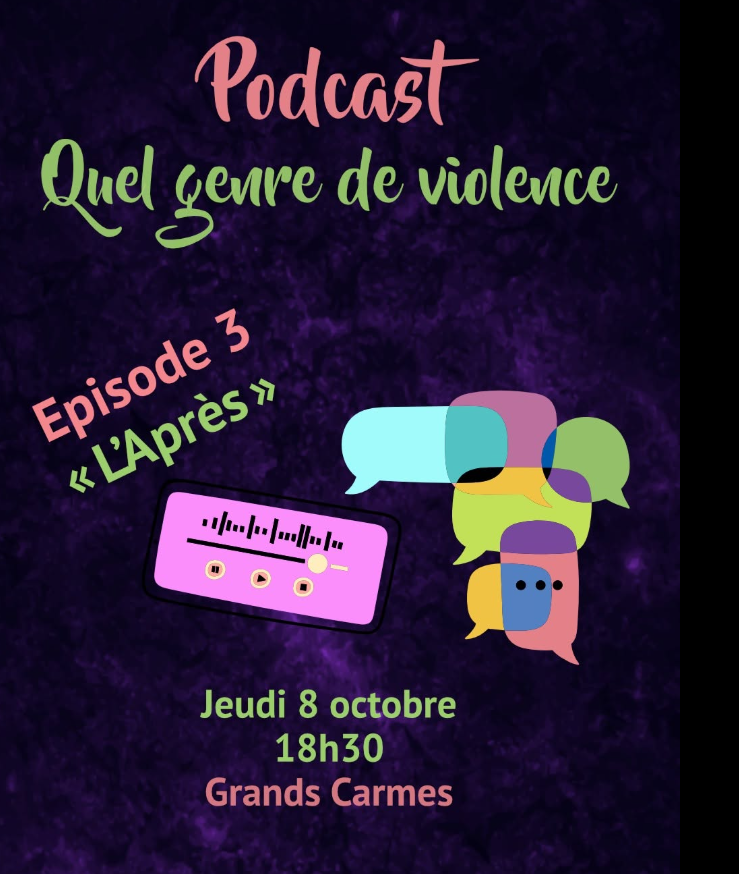
On 8 October, Tels Quels invites people to Les Grands Carmes in central Brussels for a free collective listening session of “Quel genre de violence”, its podcast on intimate partner violence in LGBTQIA+ relationships. The event presents the third and final episode, “After”, in the presence of volunteer contributors and the production team. It is an important space for queer communities because intimate partner violence is too often overlooked when public conversations still assume that abuse only happens in straight, cisgender couples.
Making visible what is often silenced
Violence within LGBTQIA+ relationships remains difficult to name — not because it is rare, but because it is still too often hidden by stereotypes. The idea that queer relationships are automatically more equal, more enlightened or free from power dynamics can make it harder for survivors to recognise abuse, speak about it, or find support that understands their realities.
For several years, Brussels-based LGBTQIA+ organisation Tels Quels has been working specifically on intimate partner violence among lesbian, gay, bisexual, trans, non-binary, intersex and queer people. Its podcast, Quel genre de violence, creates room for voices that are frequently absent from mainstream prevention campaigns, support services and media coverage.
The project is built with volunteers who are survivors or former victims of violence. Over several months, they came together to shape a series of testimonies based on lived experience — not as spectacle, but as a way to break isolation and make recognition possible.
A final episode about what comes next
The listening session focuses on the third and final episode, titled “After”. It looks beyond the moment of violence itself: what happens once someone begins to leave, rebuild, ask for help or make sense of an experience that may have been minimised by others?
That “after” can be complex. Survivors may have to navigate emotional recovery, shared social circles, financial dependence, housing issues, fear of being outed, or uncertainty about whether services will understand the specific realities of LGBTQIA+ relationships. For trans and non-binary people, violence may also be tied to gender identity, transition, discrimination or the threat of having personal information used against them.
By centring testimonies rather than speaking about survivors from a distance, the podcast gives them agency over the words, experiences and questions that need to be heard.
Listening together, with care
The event will take place in the presence of the volunteers involved in the project and the production team. That makes it more than a standard podcast presentation: it is an opportunity to listen collectively, acknowledge a shared issue and meet some of the people behind the work.
A collective listening space can matter for people who have lived through violence, but also for friends, partners, community organisers and professionals. It can help challenge harmful assumptions, make supportive language more available, and remind people that accountability and care should be part of queer community life too.
There is no simple or universal experience of violence. But creating spaces where people can speak, be believed and be met without judgement is one necessary step towards safer relationships and stronger community support.
A necessary queer conversation
For LGBTQIA+ communities, conversations about intimate partner violence can sometimes feel uncomfortable because they complicate the image of queer spaces as solely liberating or celebratory. But refusing the subject does not protect anyone. It can leave survivors alone and allow harmful behaviour to remain invisible.
Tels Quels’ initiative makes a different choice: it treats queer people as deserving of nuanced, non-stigmatising support. It also recognises that building safer communities means taking violence seriously while avoiding narratives that pathologise LGBTQIA+ relationships.
The project is organised as part of Tels Quels’ continuing-education work, supported by the Fédération Wallonie-Bruxelles.
Practical information
Event: Listening session — Quel genre de violence, episode 3: “After”
Date: Thursday 8 October 2026
Time: 18:30–20:30
Venue: Les Grands Carmes, Rue des Grands Carmes 22, 1000 Brussels
Admission: Free, with registration required; places are limited
Registration and details: Tels Quels event page
Accessibility: Tels Quels notes that Les Grands Carmes is not yet fully accessible for people with reduced mobility. The organisation invites anyone with access questions to contact it directly ahead of the event.
KET Magazine is a community‑driven, non‑profit magazine run by volunteers and based in Brussels. You can find our other music and nightlife stories on ket.brussels, and you can always write to us to share your projects or pitch a story: info@ket.brussels
You may also like
-
Brussels Rainbow Village: More Than a Night Out
Just steps from Brussels’ Grand Place, the Saint Jacques neighbourhood is a place to meet,
-
Pleasure, care and no lectures: a pocket guide to gay sexual health
Sexual health is about more than a test result. In Le Petit Guide de la
-

Mideterms Elections in US – The Closetocracy: when the closet becomes a question of power
The Closetocracy, now available on YouTube through The Young Turks, puts secrecy, sexuality and political
-

Beyond the rent rant: Bruscope puts Brussels life under the lens
Why does finding a home in Brussels feel so complicated? Who does the work that
-

At Liège’s Queer Families Festival, Every Family Has a Story
The third edition of the Queer Families Festival takes place on 11 October at the