
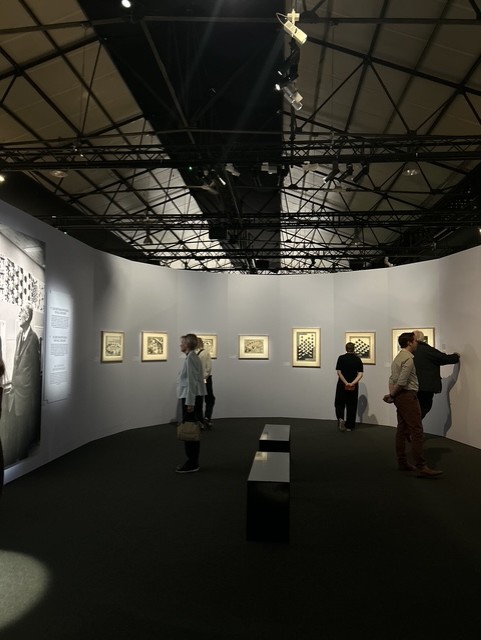
Staircases refuse to play by the rules, birds become fish, and two hands draw each other into existence. At Tour & Taxis, M.C. Escher — Beyond Infinity brings together more than 150 original works by the Dutch printmaker, alongside interactive installations. Open until 7 March 2027, the exhibition invites art lovers, families and curious minds to look twice—and offers queer audiences a playful way to question what we take for granted.
More than impossible staircases
Maurits Cornelis Escher, born in Leeuwarden in 1898 and who died in 1972, made images that remain instantly recognisable: precise, often monochrome worlds in which the details seem perfectly reasonable until you try to understand the whole picture. His woodcuts and lithographs turned perspective, repetition and reflection into tools for exploring the limits of perception.
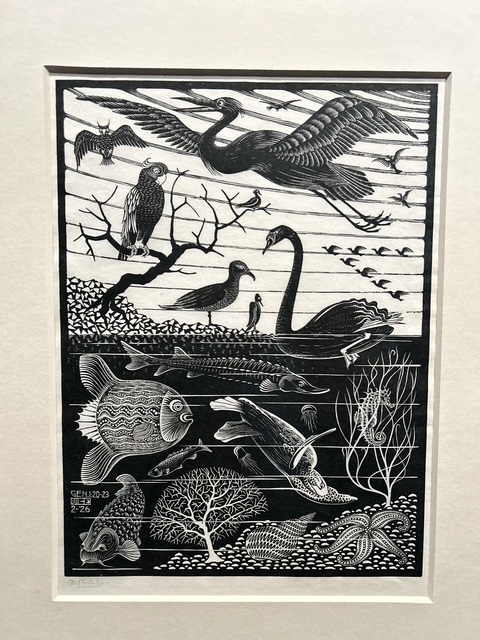
But Beyond Infinity does not begin and end with those famous visual puzzles. Its career-spanning selection follows Escher from his Italian landscapes towards the transformations and impossible architecture that made his name. His studies of the geometric mosaics at the Alhambra in Granada were particularly important to his development of tessellations: repeating shapes that fit together without gaps or overlaps.
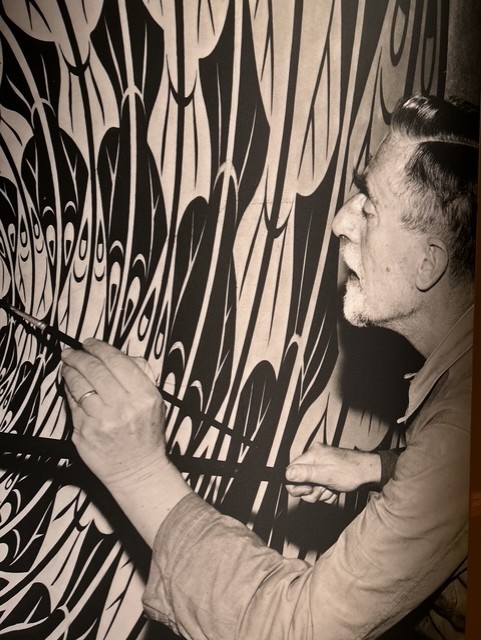
That journey matters. Behind the apparent magic lies a patient craftsperson, testing how a line, a pattern or a shift in viewpoint can change everything.
Images worth looking at twice
Among the works highlighted in coverage of the Brussels exhibition are Hand with Reflecting Sphere (1935), Drawing Hands (1948) and Relativity (1953). Each offers a different kind of visual double take: a room compressed into a handheld mirror, a drawing apparently creating itself, or stairways shared by people obeying different directions of gravity.
Day and Night (1938) brings another pleasure. Birds move through contrasting landscapes, while light and darkness become part of the same carefully interlocking composition. In Bond of Union (1956), two faces emerge from a ribbon-like structure, turning a portrait into something suspended between presence and absence.
These are images to linger over, not simply recognise from a poster. The longer you look, the harder it becomes to settle on one stable reading.
Step inside the puzzle
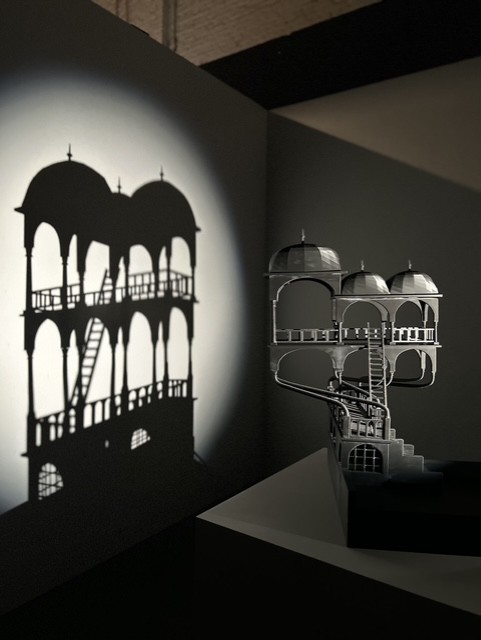
The exhibition supplements its original prints with a recreation of Escher’s workspace and interactive modules. Visitors can participate in creating a metamorphosis, enter an installation based on an impossible form and explore an infinitely reflecting projection. The displays aim to make his creative process tangible rather than leave it as an unexplained trick.
An optional virtual-reality experience takes that idea further, translating Escher-inspired imagery into three-dimensional environments. It lasts around 20 minutes and costs extra. Crucially, it is an addition to the exhibition—not the only way to experience its immersive elements or appreciate the original works.
There is a Brussels connection beyond the venue, too: Escher lived in Uccle from 1937 to 1941. For local audiences, that gives this encounter with his imagined worlds a small, unexpectedly familiar foothold.
A queer way of looking
This is not an exhibition about LGBTQIA+ history, and there is no need to reinvent Escher as a queer icon to find something compelling here. A queer reading can begin with the images themselves: forms change, perspectives coexist, and supposedly obvious distinctions become less certain.
For LGBTQIA+ audiences today, that invitation to question a single, unquestionable version of reality can resonate—without turning an optical illusion into a political manifesto. There is also room for a simpler pleasure: spending an afternoon with art that makes you curious, amused and a little less sure of your own eyes.
Practical information
- Dates: 17 September 2026–7 March 2027.
- Venue: Tour & Taxis, Shed 4bis, Brussels. The entrance is opposite the Food Market and the Produits Dangereux building, at the same entrance as WOM.
- Hours: Tuesday–Sunday, 10 am–6 pm. Also open on Mondays during Belgian school holidays and public holidays; closed on 25 December and 1 January. Last admission is at 4:30 pm.
- Tickets: Adults €17.90; ages 6–18 €13.90; under-6s free. Students, teachers, seniors and disabled visitors €15.90. Article 27 admission is €1.25 with a valid voucher, available at reception.
- Accessibility: An external lift provides access to Shed 4bis, and the exhibition occupies one accessible level. Wheelchairs are available at reception, without advance reservation. Disabled visitors can collect a free companion ticket at reception.
- Languages and duration: French, Dutch and English; allow 90 minutes to two hours. A free activity booklet is available for younger visitors.
- Optional VR: €5 when booked online or €8 on site. Available from age eight, with adult accompaniment required for ages 8–13. It requires standing and walking throughout; the organisers list additional health restrictions on the practical information page.expo-mcescher
- Booking: Find tickets through the official exhibition website.expo-mcescher
Bring someone who sees things differently from you. In Escher’s world, that might be the best place to start.
KET Magazine is a community‑driven, non‑profit magazine run by volunteers and based in Brussels. You can find our other music and nightlife stories on ket.brussels, and you can always write to us to share your projects or pitch a story: info@ket.brussels
You may also like
-
When Nuns Go Pirate: A Queer Sacred Thriller at Varia
What happens when lesbian love, religious memory and horror theatre enter a locked convent—and refuse
-
KET in Paris — Le Hasard Ludique, Where the Tracks Lead to Music
For this stop in our KET in Paris series, we visited Le Hasard Ludique, a
-
At Liège’s Queer Families Festival, Every Family Has a Story
The third edition of the Queer Families Festival takes place on 11 October at the
-
In Concrete Purgatory, Desire Finds a Way Through
La Boue (Remix) is a short, intimate film by Belgian director Noah Dechamps, made in
-
Inuit Art Takes Centre Stage at Brussels’ Art & History Museum
From 16 October 2026 to 18 April 2027, the Art & History Museum in Brussels