
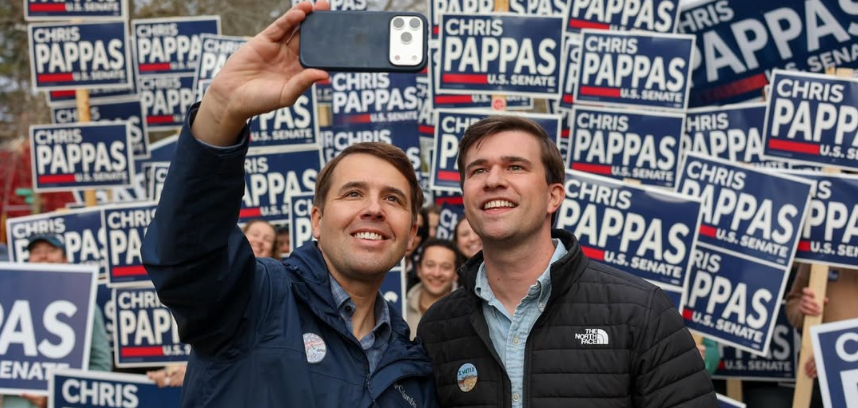
Democrats have won back control of the US House and Senate in the 3 November midterms, with a series of victories changing who gets to hold power. In New Hampshire, Chris Pappas has become the first openly gay man elected to the US Senate. Alongside historic wins for Black, Indigenous and Muslim candidates, his election offers a different picture of American leadership — one where people long treated as political talking points get to make decisions themselves.
Chris Pappas makes history — with his husband beside him
The milestone deserves a moment: an openly gay man has won a seat in the United States Senate.
Democrat Chris Pappas defeated Republican former senator John E. Sununu in New Hampshire, holding a seat being vacated by retiring Democrat Jeanne Shaheen. He will enter the Senate in January, taking an established political career into a chamber where no openly gay man has previously served.apnews+1
On election night, the institutional breakthrough came with a personal image. Pappas celebrated alongside his husband, Vann Bentley, and spoke about their relationship in his acceptance speech: “I’m the luckiest guy because I’m married to a man that I love.”
A husband on a victory stage should not be revolutionary. That it accompanies a first in 2026 says something about how slowly the doors of political power can open.
One important distinction: Pappas is the first openly gay man elected to the Senate, not its first openly LGBTQIA+ member. Wisconsin Democrat Tammy Baldwin became the first openly gay person elected to the chamber in 2012. Queer women got there first.
More than a rainbow milestone
Pappas, 46, comes from a Greek-American family known in New Hampshire for its restaurant business. He has served in the House of Representatives since January 2019, meaning this is not an outsider arriving in Washington without a record.
That record includes support for the Equality Act, the proposed federal legislation intended to strengthen protections against discrimination based on sexual orientation and gender identity. It is a useful connection between the symbolism of his election and the policy questions awaiting him.
For LGBTQIA+ people today, his victory matters because being visible in public life is not the same as having a vote in the institutions that shape our rights.
The Senate has a role in federal legislation, judicial confirmations and senior government appointments. Pappas is moving into a room where representation can become institutional influence — although one senator cannot deliver equality alone.
New faces does not mean political beginners
Pappas is part of a wider set of Democratic breakthroughs. But “new generation” needs a little unpacking: many of these winners already have substantial experience. What is new is the office they are entering — and whose presence is no longer being treated as unimaginable.
In Georgia, Keisha Lance Bottoms has become the first Black woman elected governor of a US state. The former Atlanta mayor, who led the city from 2018 to 2022, has spoken about her descent from an enslaved family on a Georgia plantation. Her election places that family history alongside a new chapter in the leadership of a state deeply marked by slavery and segregation.
In New Mexico, Deb Haaland, a member of the Pueblo of Laguna, has become the country’s first Native American woman elected governor. She previously broke another barrier as the first Native American Cabinet secretary, serving as interior secretary under Joe Biden.
Minnesota’s Peggy Flanagan, previously the state’s lieutenant governor, has become the first Native American woman elected to the US Senate. These are separate offices and separate achievements — not interchangeable entries in a diversity scoreboard.
Abdul El-Sayed: a different route into the Senate
In Michigan, Abdul El-Sayed has claimed victory and is set to become the first Muslim US senator. A physician and son of Egyptian immigrants, he comes from the Democratic Party’s left wing.
His campaign also shows why these milestones cannot be separated from the hostility candidates encounter. RTBF reports that Donald Trump targeted El-Sayed with accusations linking him and his family to terrorism, including calling him a “terrorist sympathiser”. Those were campaign attacks, not established facts about the candidate.
Putting El-Sayed alongside Pappas, Haaland, Flanagan and Bottoms does not mean they share one political outlook. It means the incoming cohort brings different histories, professions and experiences into institutions that have not traditionally reflected the full population.
A changed Congress — not a finished fight
The Democratic victory changes the balance of power for the remainder of Donald Trump’s term. With the party taking both congressional chambers, the result gives Democrats greater capacity to challenge his administration.
It could also produce another historic first. Democratic House leader Hakeem Jeffries is expected to seek the speakership following his party’s victory. If elected by the House, he would become its first Black speaker. That remains a next step, not an office already secured.
Still, a more representative Congress is not automatically a more equal country. The test comes after the victory speeches: what gets defended, what gets funded, which protections advance and who benefits.
That is where representation has to become more than a photograph. These elections change who is in the room. What they do with that access is the next story.
The essentials
- Election: US midterms, held on Tuesday 3 November 2026.
- Overall result: Democrats have regained control of the House of Representatives and Senate, according to reporting published on 4 November.
- Chris Pappas: Senator-elect for New Hampshire; the first openly gay man elected to the US Senate. He will succeed Jeanne Shaheen in January.
- Other historic winners: Keisha Lance Bottoms in Georgia, Deb Haaland in New Mexico, Peggy Flanagan in Minnesota and Abdul El-Sayed in Michigan.
- Further reading: RTBF’s overview of the new faces of American politics and The Washington Blade’s reporting on Pappas’s victory.
For now, there is a moment worth holding onto: a senator-elect thanking the man he loves, with no need to edit him out of the picture.
KET Magazine is a community‑driven, non‑profit magazine run by volunteers and based in Brussels. You can find our other music and nightlife stories on ket.brussels, and you can always write to us to share your projects or pitch a story: info@ket.brussels
You may also like
-

Brussels Rainbow Village: More Than a Night Out
Just steps from Brussels’ Grand Place, the Saint Jacques neighbourhood is a place to meet,
-

Thirty-seven and still dancing: La Demence opens its birthday weekend at Fuse
La Demence turns 37 with three nights in Brussels, beginning at Fuse on Friday 30
-

Pleasure, care and no lectures: a pocket guide to gay sexual health
Sexual health is about more than a test result. In Le Petit Guide de la
-

Mideterms Elections in US – The Closetocracy: when the closet becomes a question of power
The Closetocracy, now available on YouTube through The Young Turks, puts secrecy, sexuality and political
-

Beyond the rent rant: Bruscope puts Brussels life under the lens
Why does finding a home in Brussels feel so complicated? Who does the work that