

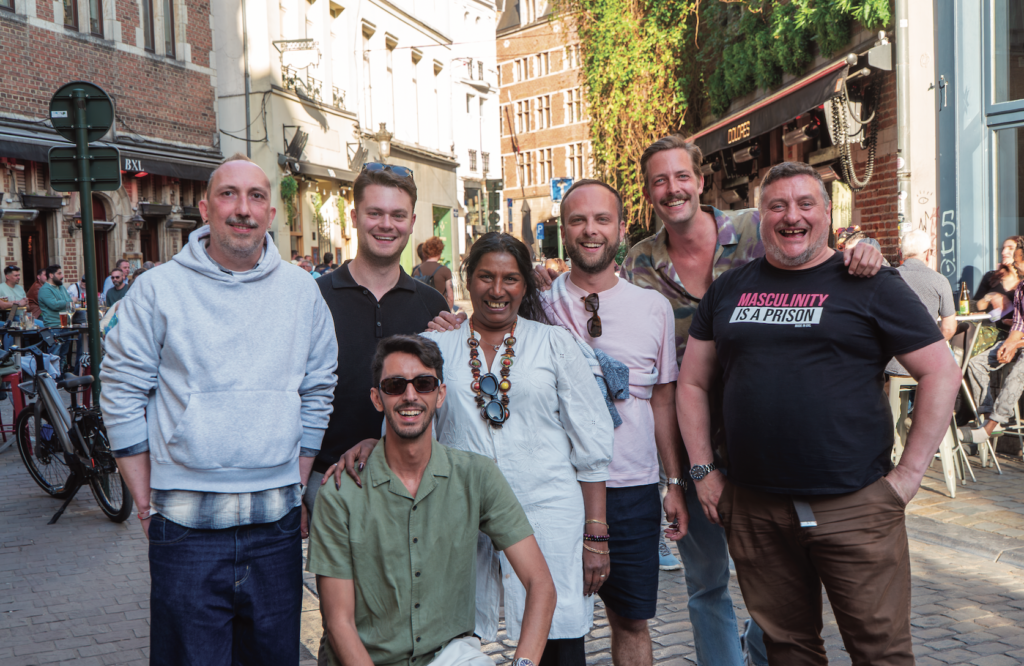
Just steps from Brussels’ Grand Place, the Saint Jacques neighbourhood is a place to meet, go out and find familiar faces. Behind its bars and nightlife venues, Brussels Rainbow Village brings establishments together around shared concerns: welcoming LGBTQIA+ audiences, maintaining spaces where people can be themselves, and making their needs heard.
“Today, the Brussels Rainbow Village is above all a structure of the field. It is not an abstract idea of community, nor a showcase.”
Speaking to KET for its May print edition, venue manager and Brussels Rainbow Village vice president Fred Da Soghe described an organisation rooted in everyday experience. “It is a network of establishments that live daily the realities of LGBTQIA+ audiences: welcoming, safety, celebration, but also tensions, evolutions and fragilities.”
Its origins lie in a practical need. “At one point, people felt the need to no longer function alone.” What began as Syndigay developed into a more structured network, while the challenges facing its members also changed.
“The challenges have shifted… They concern more our place in a wider environment: the city, the region, and how our realities are understood and integrated within these structures.”
The reason for working collectively remains straightforward: “The necessity of being together.”

Each venue has its own identity, atmosphere and audience. What connects them, Fred explains, is “a common experience: welcoming audiences who do not always find their place elsewhere.” Their shared responsibility is to “create a space where people can be themselves without having to justify it.”
The neighbourhood’s audiences have also broadened. “It is no longer a ‘closed’ community space… It is crossed by wider, more mixed audiences.” That openness raises questions about how a recognisably queer neighbourhood maintains its identity as more people move through it.
“The question today is not to preserve an in group, but to maintain an identifiable, living space, without losing its meaning.”
The work behind Pride illustrates these responsibilities particularly clearly. When the streets fill with celebration, venue teams also have to manage the practical demands that come with it.
“We are not only in visible programming. We are in implementation: welcoming, supervising, securing, cleaning, coordinating.”
For Fred, the scale of that work needs greater recognition. “It is no longer only about ‘having a party’. It is about maintaining a complex system, with high expectations and resources that are often disconnected from the reality on the ground.”
Inclusivity requires the same practical attention. “It does not decree itself. It is built daily, through concrete choices and real-life situations.” Fred is equally clear about its limits: “No place is perfectly inclusive. Thinking otherwise would be a mistake.”
The work involves recognising where people may feel excluded and being willing to respond: “Being able to see unintentional exclusions, to adjust constantly.”
Physical meeting places also retain a particular importance as more social interaction moves online. “There is a tension between very digital practices and a still present, even reinforced, need for real contact.” A bar, a conversation or a familiar face can offer a form of connection that a screen cannot always provide.
These venues exist alongside organisations such as RainbowHouse Brussels, with different but complementary roles. As Fred puts it: “It is not about opposing the two, but recognising that these are distinct functions, which must dialogue.”
Looking ahead, his ambition is to “make visible the dynamics that are already there.” It begins with recognising what these establishments mean to the people who use them.
“These places are not only commercial spaces, but spaces of life.”
Photography by @elena
Originally published in the May 2026 print edition of KET.brussels.
You may also like
-

Thirty-seven and still dancing: La Demence opens its birthday weekend at Fuse
La Demence turns 37 with three nights in Brussels, beginning at Fuse on Friday 30
-
Pleasure, care and no lectures: a pocket guide to gay sexual health
Sexual health is about more than a test result. In Le Petit Guide de la
-

Mideterms Elections in US – The Closetocracy: when the closet becomes a question of power
The Closetocracy, now available on YouTube through The Young Turks, puts secrecy, sexuality and political
-

Beyond the rent rant: Bruscope puts Brussels life under the lens
Why does finding a home in Brussels feel so complicated? Who does the work that
-
Bears Attack: Brussels’ Bear Folies Hit the Dancefloor
Belgium Bear Pride celebrates its 15th anniversary from 29 September to 4 October 2026, and