
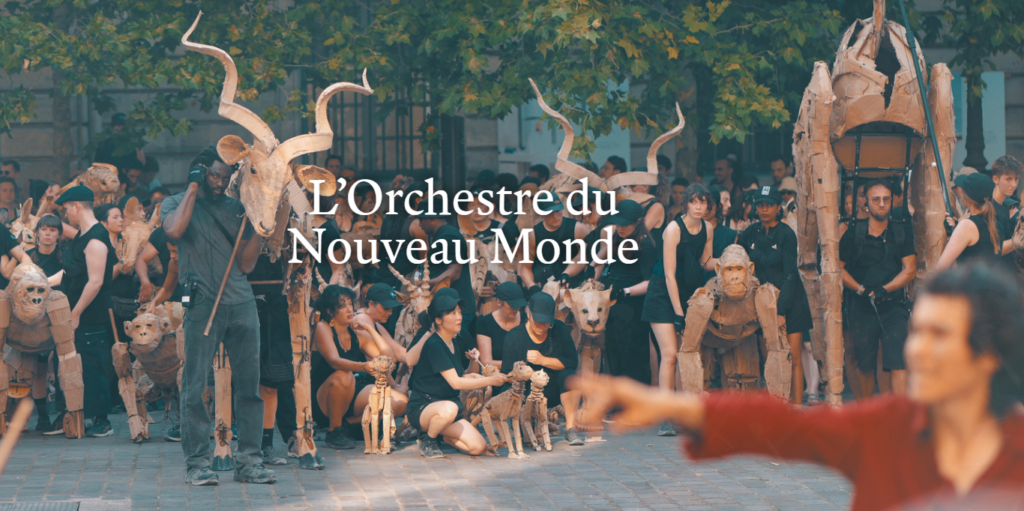
What if an orchestra belonged as much in a public square as in a concert hall? France’s Orchestre du Nouveau Monde is making that argument with instruments, collective action and a manifesto for social and climate justice. Now, Brussels collective Be Free BE Academy is preparing an artistic gathering on 22 November, calling on participants to come together in defence of art and freedom of expression. Registration is encouraged so the organisers can estimate numbers and prepare the event.
Classical music, out of its comfort zone
The Orchestre du Nouveau Monde does not present music as an escape from the world. It wants music to engage with it.
Founded in 2020 by conductor Étienne Jarrier, the French ensemble connects musical practice with social and climate activism. Its musicians take their instruments beyond conventional concert settings, bringing orchestral sound into demonstrations and public spaces.
The ambition is not simply to make classical music look less formal. In its manifesto, the collective explicitly challenges structures of domination and discrimination, whether gendered, cultural, political or economic. It describes art as a common good, with the power to bring people together and expand what they can imagine.
That is a bigger proposition than swapping evening wear for street clothes: it asks whom music serves, where it happens and who gets to feel that it belongs to them.
A soundtrack for people who want to be heard
In October, the orchestra joined mobilisations in Paris, bringing together professional and amateur musicians to perform repertoire that included music from Star Wars, Hunger Games and Avengers, alongside songs familiar from demonstrations. The meeting of symphonic sound and popular references made the performance recognisable beyond a specialist classical audience.
On 17 October, a gathering of instrumentalists and singers at Place de la République was interrupted by police tear gas. RTBF reported that the musicians eventually left to protect both participants and instruments.
The ensemble has since called for other activist orchestras to form and join mobilisations. In a statement published by Libération on 3 November, it invited conservatoire students, professional musicians, teachers, singers, technicians and amateur ensembles to make music an act of resistance and solidarity.
The message is clear: an orchestra can be more than a performance people watch. It can become a way for people to organise.
Brussels is preparing its own artistic gathering
In their announcement, organisers Laurence, Emilie, Morgan and Manon put the principle plainly: defending art also means defending freedom of expression. They encourage people intending to join to register, helping the collective assess attendance and organise the gathering.
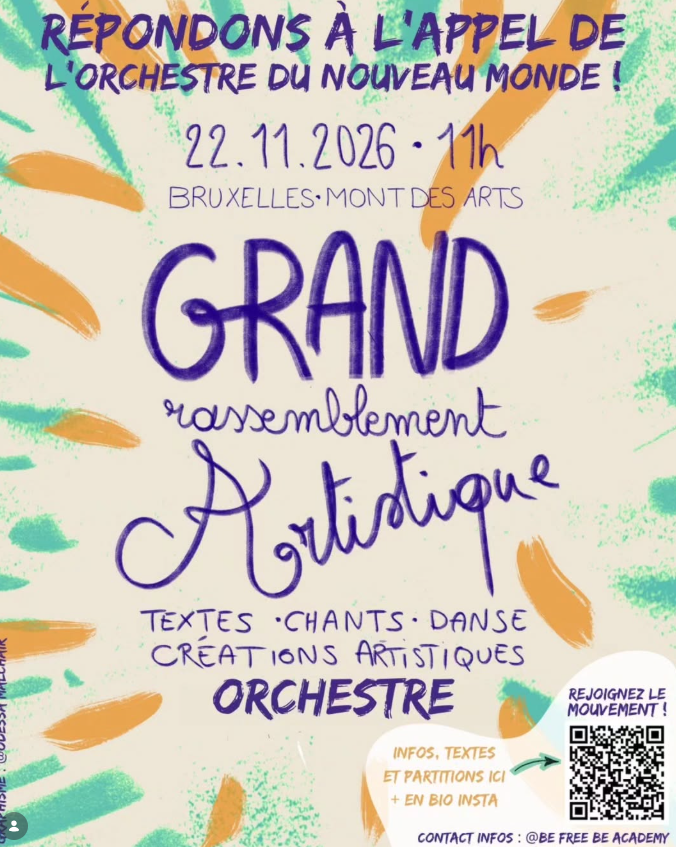
A shared folder brings together practical information, scores and texts. Participants are also invited to exchange questions, ideas and comments in the associated groups, while an announcements space will carry the most important updates.
For now, this should be understood as a developing participatory project, rather than a fully detailed concert listing. The supplied announcement does not establish that the French orchestra itself will travel to Brussels, nor does it confirm a final programme, venue or timetable.
Why this belongs in a queer conversation
The Orchestre du Nouveau Monde is not an LGBTQIA+-specific ensemble. Its manifesto does, however, place opposition to discrimination, gendered domination and conservatism within its wider commitments to human rights and collective emancipation.
For queer communities, the connection is solidarity. Freedom of expression is not an abstract cultural principle when being visible, telling a story or presenting a body onstage can become a matter of public controversy.
Defending artistic freedom matters to LGBTQIA+ people today because it helps protect the space to represent ourselves, challenge expectations and imagine lives beyond the roles assigned to us.
That does not mean every participant must share an identity, an artistic discipline or an identical political position. The interest of a collective gathering is precisely the possibility of finding a shared purpose without erasing those differences.
Participation starts before the first note
There is something significant about the organisers’ emphasis on registering and exchanging ideas. A gathering does not become collective simply because a crowd turns up: someone needs to coordinate people, distribute material and work out what is possible.
The practical invitation is therefore part of the project, not an administrative footnote. If you intend to participate, signalling that intention helps the organisers plan.
At the same time, the announcement leaves questions open. Required musical experience, opportunities for non-musicians, rehearsal arrangements and access provisions should be confirmed through the organisers’ channels rather than assumed. A shared score is a starting point; making participation genuinely possible takes further work.
Practical information
- Project: Brussels artistic gathering shared by Be Free BE Academy, in defence of art and freedom of expression.
- Announced date: 22 November. The message supplied does not state the year explicitly; confirm the current arrangements with the organisers.
- Location: Brussels; the exact meeting point is not specified in the supplied announcement.
- Time and programme: To be confirmed through the organisers’ updates.
- Registration: Encouraged to help estimate attendance and organise the event. No standalone registration link was included in the supplied message; consult the shared resources or the collective’s groups for instructions.
- Scores, texts and practical material: Access the organisers’ shared folder. Its contents could not be independently checked for this article.
- Participation and accessibility: Required experience, costs, step-free access and other support arrangements are not confirmed in the supplied announcement.
- About the French initiative: Explore the Orchestre du Nouveau Monde website and its manifesto.
A score can be a set of instructions. Played together, it can also become a statement: art belongs in our shared life, and its freedom is worth defending.
KET Magazine is a community‑driven, non‑profit magazine run by volunteers and based in Brussels. You can find our other music and nightlife stories on ket.brussels, and you can always write to us to share your projects or pitch a story: info@ket.brussels
You may also like
-
No name tag needed: 330 Brussels artists take over Vanderborght
From 13 to 15 November 2026, Carte de Visite | ARTopenKUNST brings 330 Brussels artists
-

No need to rush: KosmoSuna turn “Pas Besoin” into a ten-minute escape
Lille-based electronica pop duo KosmoSuna introduce their forthcoming EP, Muted Skin, with “Pas Besoin” —
-
Cross the border, change the picture: NEXT Festival returns with queer stories and bodies in motion
From 13 November to 4 December 2026, NEXT Festival turns the Franco-Belgian border region into
-
Lou Trotignon brings transition, testosterone and a little fish energy to Brussels
What if the person everyone expected you to be simply wasn’t you? In Mérou, comedian
-

Love behind the lines: Lukas Dhont’s Coward comes to Flagey
In Coward, a young soldier looking to prove himself finds something he did not expect