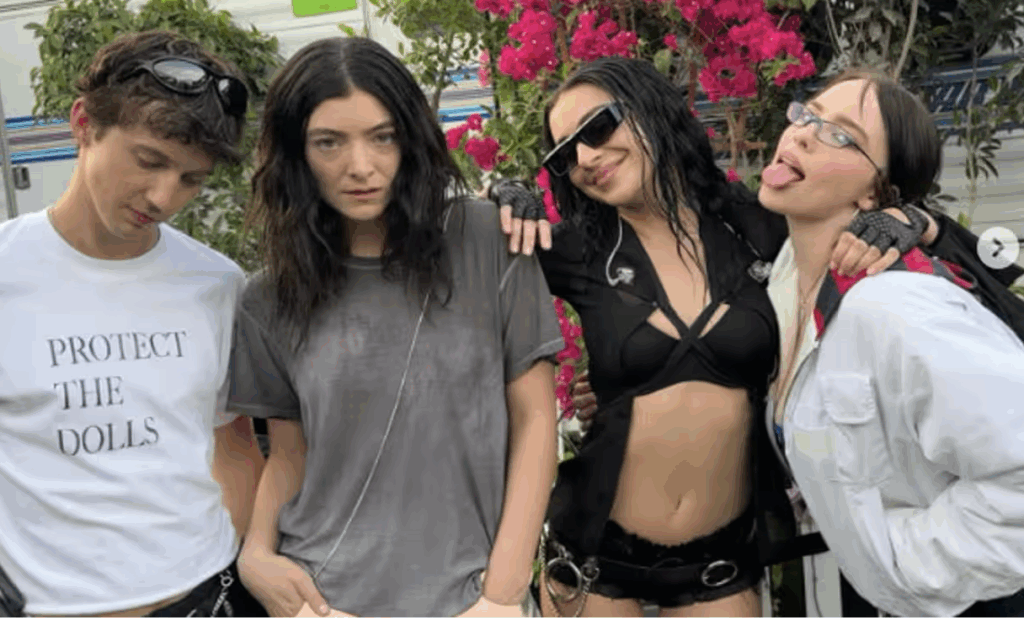
When American designer Conner Ives sent the “Protect The Dolls” T-shirt down the runway at London Fashion Week in February 2025, he likely knew he was doing more than launching a trend. He was making a statement — one that quickly traveled far beyond the fashion world.
With its bold serif letters and striking message, “Protect The Dolls” has become an emblem of solidarity with trans women, rooted in the language of LGBTQIA+ and ballroom culture. In this context, “dolls” is an affectionate, affirming term for trans women — a celebration of their beauty, strength, and survival.

The message gained international visibility when actors Pedro Pascal, his sister Lux Pascal, Tilda Swinton, Troye Sivan, and Addison Rae wore the shirt in public appearances. For Pedro, the gesture was especially personal. His sister Lux, a trans actress and activist, has often spoken about the power of family support. In a world where trans rights are increasingly under attack, such public affirmations matter.
The T-shirt also arrived at a critical political moment: shortly after a controversial UK Supreme Court ruling defined “woman” based solely on biological sex, stripping trans women of key legal protections. Wearing “Protect The Dolls” is a direct response — a soft fabric banner against hardening legal restrictions.
More than symbolic, the initiative has real-world impact: sales of the shirt have already raised over $300,000 for Trans Lifeline, a nonprofit that supports trans people in crisis.
In Brussels, as across Europe, trans communities — especially migrants and people of color — still face structural violence and barriers. Visibility campaigns like “Protect The Dolls” remind us of the urgent need for both cultural recognition and concrete action.
Solidarity doesn’t always start with protest. Sometimes, it begins with the simple, radical act of wearing your heart — and your politics — proudly on your sleeve.
You may also like
-

Portugal set to roll back trans self-determination law: what’s at stake?
Portugal, long seen as a frontrunner on trans rights in Europe, is on the verge
-

Sing It Queer: open your home (and your city) to 4,000 LGBTQI+ voices
From 24 to 28 June 2026, Various Voices Brussels 2026 will turn the capital into
-

Poland’s Supreme Administrative Court Recognises Same-Sex Marriages from Other EU Countries
A major step for LGBTQ+ rights in Eastern Europe: on Friday, Poland’s Supreme Administrative Court (NSA)
-

The Cruise 2027: Ready to Sail into Queer Paradise?
From July 15th to 24th, 2027, The Cruise is back on board the spectacular Celebrity Equinox for
-

Brussels Pride: from Gay Pride to Belgian Pride to a city that owns its colors
In 30 years, Brussels has gone from a small “Gay Pride” marched by a few
