
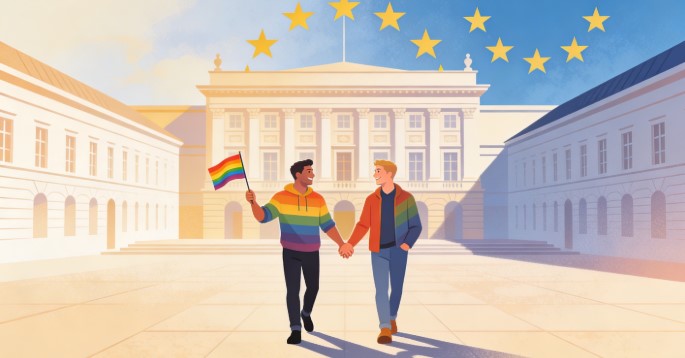
A major step for LGBTQ+ rights in Eastern Europe: on Friday, Poland’s Supreme Administrative Court (NSA) ruled that same-sex marriages legally performed in other EU member states must be recognised by the Polish state — a landmark decision in a country still shaped by strong Catholic traditions.
A long-awaited victory for equality
The case was brought forward by Jakub Cupriak-Trojan and Mateusz Trojan, a Polish couple married in Berlin in 2018. When they tried to register their marriage in Warsaw, the city’s civil registry refused, citing the Polish Constitution, which defines marriage strictly as a union between a man and a woman.
Their legal battle began years ago, but a turning point came last November when the Court of Justice of the European Union (CJEU) ruled that same-sex marriages recognised in one EU country must be acknowledged across all member states. Friday’s Polish verdict finally aligns national practice with that European ruling.
“A celebration of human rights”
“This is a human rights celebration — an incredible and long-needed decision,” said lawyer Pawel Knut, who represented the couple alongside legal advocacy groups such as Love Does Not Exclude (Miłość Nie Wyklucza). The courtroom reportedly erupted in applause as the ruling was announced.
Judge Leszek Kirnaszek emphasised that the Polish Constitution does not explicitly forbid the recognition of marriages performed abroad. He also reminded the court that EU rules guarantee free movement and prohibit discrimination based on sex or sexual orientation — fundamental rights enshrined in Article 21 of the EU Charter of Fundamental Rights.
A shift in a resistant country
According to activists, between 30,000 and 40,000 Polish citizens have married same-sex partners abroad, unable to do so at home. Poland remains one of the last EU countries — alongside Bulgaria, Romania, and Slovakia — to prohibit both same-sex marriage and civil unions.
Friday’s decision is seen as a symbolic breakthrough in a country long criticised by the European Commission for its anti-LGBTQ+ policies and “LGBT-free zone” declarations adopted by several municipalities in recent years.
While the ruling doesn’t legalise same-sex marriage domestically, it opens the door to recognition, and potentially to greater protection for same-sex couples living in Poland.
KET Magazine is a community‑driven, non‑profit magazine run by volunteers based in Brussels. Get in touch to share your thoughts or tell us about your activities. You can also promote your events on our website or support our work with a donation. Contact us at Info@ket.brussels.
You may also like
-
Türkiye’s LGBTQIA+ Community Faces a New Wave of Pressure
LGBTQIA+ people in Türkiye are living through a sharp escalation in state pressure: Pride events
-

Fiji Declares a National HIV Emergency — and the World Must Pay Attention
Fiji has declared a national HIV emergency after a dramatic rise in diagnoses: 2,016 people
-

Balkan Trafik! Turns Brussels’ Bourse into a Three-Day Balkan Universe
After a year away, Balkan Trafik! returns to Brussels from 19 to 21 November 2026
-

In Myanmar, the Spirit Wives Keep Dancing
Near Mandalay, in a country torn apart by civil war, the annual Taungbyone festival has
-

Five Equality Champions Remind WorldPride What Queer Progress Looks Like
On 5 August, during the WorldPride Human Rights Conference in Amsterdam, UNDP and ILGA World