
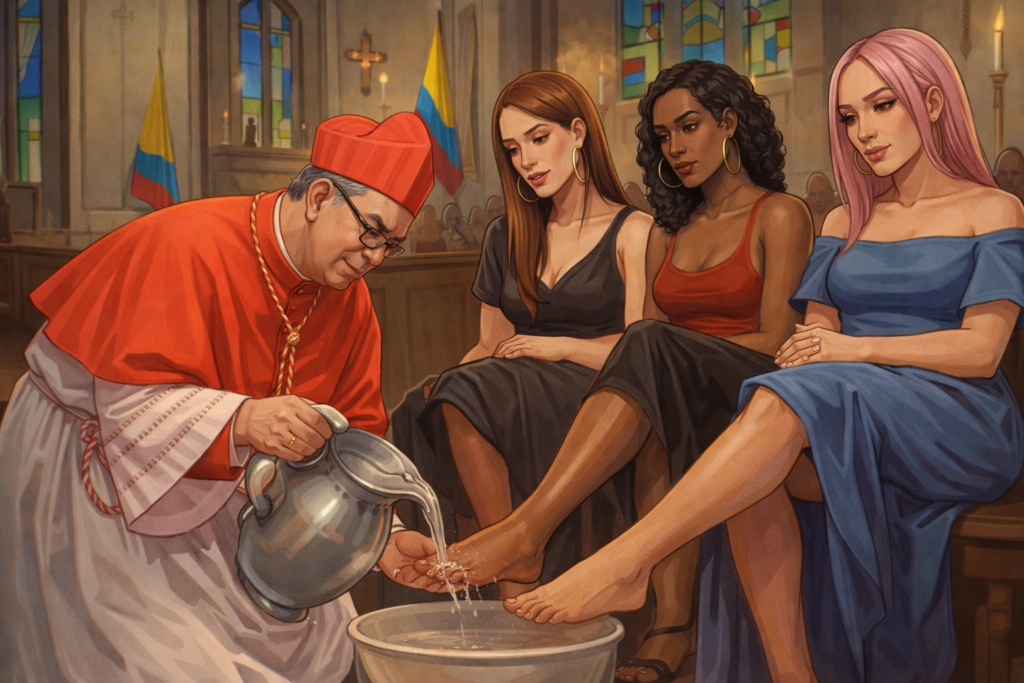
In Colombia, a powerful moment unfolded that reached far beyond church walls. The country’s highest ranking Catholic official knelt before a group of trans sex workers and washed their feet. A gesture rooted in religious tradition became something more, a rare and visible act of recognition.
For many in the LGBTQIA+ community, especially trans people, religion has often been a space marked by distance rather than belonging. Words like compassion and acceptance have not always translated into lived experience. That is why this moment matters, not as a sweeping change in doctrine, but as a human gesture that carries weight.
The act itself was simple. Water, hands, presence. But for those involved, it signaled something deeper, dignity. Trans sex workers are among the most marginalized communities globally, facing stigma both for their gender identity and their work. Being acknowledged in such a public and symbolic way challenges the invisibility many are forced into.
From Brussels, where queer life is vibrant yet layered with its own complexities, this story resonates. Our city celebrates diversity, but it also reminds us that inclusion is not a finished project. Even here, trans people, especially those navigating precarious work, often remain at the edges of visibility and safety.
What happened in Colombia does not erase systemic challenges. But it opens a door, however slightly, within an institution that has historically struggled with LGBTQIA+ inclusion. It shows that gestures, even small ones, can disrupt expectations and invite conversation.
Moments like this do not fix everything, but they shift something. They remind us that recognition, even when symbolic, can carry real meaning for those who rarely receive it.
KET Magazine is a community‑driven, non‑profit magazine run by volunteers based in Brussels. Get in touch to share your thoughts or tell us about your activities. You can also promote your events on our website or support our work with a donation. Contact us at Info@ket.brussels.
You may also like
-
Türkiye’s LGBTQIA+ Community Faces a New Wave of Pressure
LGBTQIA+ people in Türkiye are living through a sharp escalation in state pressure: Pride events
-
Fiji Declares a National HIV Emergency — and the World Must Pay Attention
Fiji has declared a national HIV emergency after a dramatic rise in diagnoses: 2,016 people
-

Balkan Trafik! Turns Brussels’ Bourse into a Three-Day Balkan Universe
After a year away, Balkan Trafik! returns to Brussels from 19 to 21 November 2026
-
In Myanmar, the Spirit Wives Keep Dancing
Near Mandalay, in a country torn apart by civil war, the annual Taungbyone festival has
-

Five Equality Champions Remind WorldPride What Queer Progress Looks Like
On 5 August, during the WorldPride Human Rights Conference in Amsterdam, UNDP and ILGA World

