
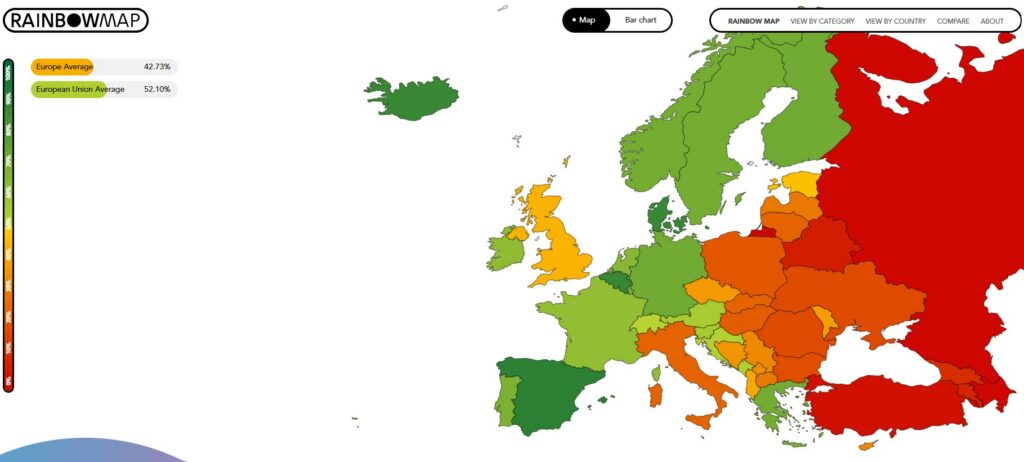
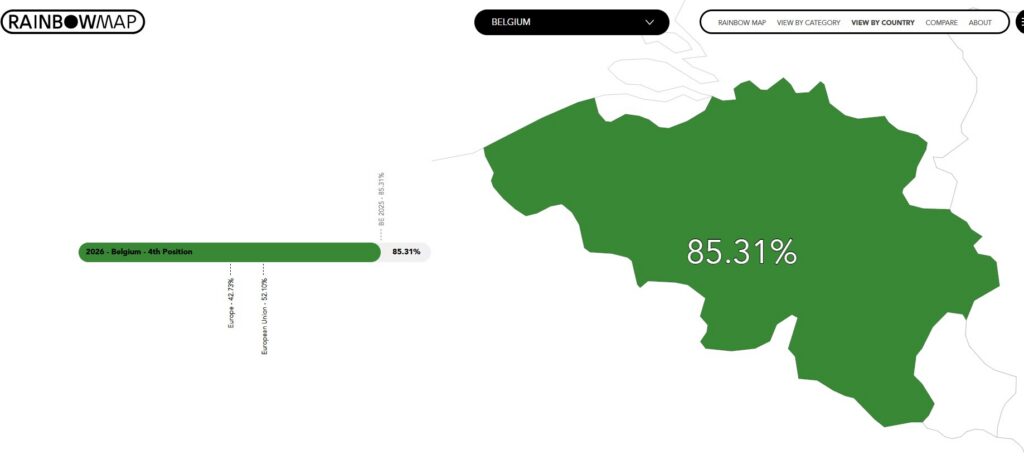
Belgium loves to see itself as a queer‑friendly haven. On paper, that image still holds: in the latest Rainbow Map published by ILGA‑Europe, the country scores a solid 85% on LGBTI+ rights. But there is a catch. While the score remains the same as last year, Belgium drops from second to fourth place in the European ranking, overtaken by countries that are moving faster and further.
In a year where Brussels Pride celebrates 30 years under the theme “When Times Get Darker, We Shine Brighter”, that slide is a warning. Standing still, even with a good score, now means losing ground.
What the Rainbow Map actually measures
The Rainbow Map is ILGA‑Europe’s annual x‑ray of LGBTI+ rights in 49 European countries. Each state is scored between 0% and 100% based on 75+ criteria spread across seven categories:
- equality and non‑discrimination
- family
- hate crime and hate speech
- legal gender recognition
- intersex bodily integrity
- civil society space
- asylum.
A high score does not mean “everything is perfect”; it means that laws and policies are in place to protect LGBTI+ people’s human rights. A lower score doesn’t necessarily reflect social attitudes, but points to legal gaps that can leave people unprotected.
Belgium’s 85% places it among the continent’s best performers. But in 2026, that is no longer enough to stay on the podium.
Spain sprints ahead, Belgium stays put
So what happened? The short version: other countries moved, Belgium did not.
- Spain jumps to first place with 89%, thanks to a wave of reforms on legal gender recognition, self‑determination and family rights.
- Malta, longtemps numéro un, now sits in second place with 88%.
- Iceland climbs to third with 86%.
- Belgium and Denmark follow with 85%, but Belgium is now ranked fourth.
ILGA‑Europe’s reading is clear: Belgium is not being punished for rolling back rights, but for not doing enough to move forward. The country has promised reforms in several areas – and then left them sitting in drawers.
Where Belgium is still lagging behind
On the Rainbow Map, Belgium scores highly in several categories: hate crime and hate speech laws are in place, civil society operates freely, and family rights have progressed over the years. But three areas stand out as stagnant or weak:
1. Intersex bodily integrity
The biggest red flag is the absence of a ban on non‑consensual medical interventions on intersex children. ILGA‑Europe has, for years, urged Belgium to:
- prohibit medically unnecessary surgeries and treatments on intersex minors without their informed consent
- create reparation mechanisms for those already harmed.
For intersex activists, this is not a technical detail; it is about ending what many describe as intersex genital mutilation in Belgian hospitals.
2. Legal gender recognition
Belgium has reasonably advanced trans legislation, but the Rainbow Map underlines that full self‑determination is not yet a reality for everyone. ILGA‑Europe points to:
- the need for better recognition beyond a strict male/female binary
- more accessible and depathologised procedures for changing legal gender markers.
Non‑binary people in particular remain in a grey zone, with no explicit legal recognition.
3. Asylum, equality and everyday discrimination
On asylum, Belgium is asked to better protect LGBTI+ applicants and ensure procedures reflect the specific risks they face in their countries of origin.
In terms of equality and non‑discrimination, the index also points to areas where discrimination still hides in plain sight, such as remaining restrictions on blood donation for certain groups. These might look “technical”, but they send a clear message about whose bodies are still seen as risky.
When hate goes unpunished: çavaria raises the alarm
The Flemish federation çavaria adds another layer to the diagnosis: online hate. In its reaction to the new Rainbow Map, the organisation talks about a feeling of “total impunity” for those who spread anti‑LGBTI+ hatred on social media.
Why? Because in Belgium, a lot of online hate is treated as a “délit de presse” (press offence), which in theory falls under the jurisdiction of the Cour d’assises – a very heavy, rarely used procedure. In practice, cases almost never make it to that level, and hate speech targeting queers and trans people goes unsanctioned.
The result is a gap between progressive laws on paper and what people experience in their feeds and comment sections – a gap campaigns like Flood The Feed (also launched by çavaria) try to address from the ground up.
“Standing still is moving backwards”
Federal minister for Equal Opportunities Rob Beenders has reacted by acknowledging that “immobilism sometimes means going backwards”. He insists that acquired rights are never guaranteed forever, and has promised to work on:
- more effective tools against online hate
- better information about LGBTI+ rights
- broader awareness‑raising on diversity and respect.
For many activists, the message is welcome – but they will be watching for laws, not just words. ILGA‑Europe’s recommendations are very concrete; they can be turned into draft bills.
What this means for queer people in Belgium
For a lot of queers in Belgium, the Rainbow Map ranking is both reassuring and frustrating. Reassuring, because Belgium remains in the European top tier, far from countries where LGBTI+ people are criminalised or violently repressed. Frustrating, because daily realities – trans healthcare, intersex rights, online hate, racism within and outside the community – are still far from the scorecard’s green zones.
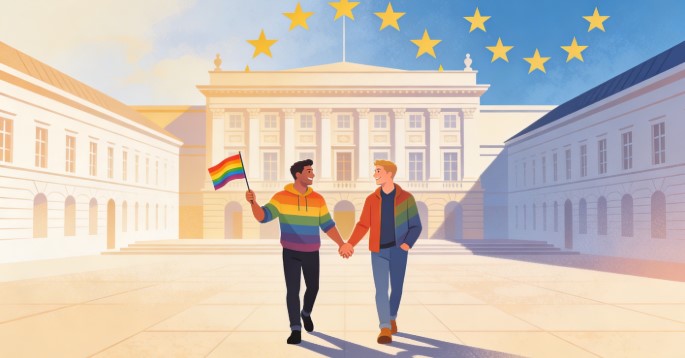
In Pride season, this tension is particularly visible: rainbow flags fly from official buildings, but intersex children are still operated on without consent; ministries celebrate diversity, but queer content creators drown in unpunished hate comments. The Rainbow Map doesn’t tell the whole story, but it gives a useful snapshot of where the law is falling behind people’s lives.
Where to go from here
If Belgium wants to climb back up on the Rainbow Map, the path is not mysterious. ILGA‑Europe explicitly calls on the country to:
- ban non‑consensual medical interventions on intersex children and offer reparations
- strengthen and depathologise legal gender recognition, including for non‑binary people
- improve protection and procedures for LGBTI+ asylum seekers
- remove remaining discriminatory practices (such as restrictions on blood donation)
- tackle online hate with mechanisms that actually lead to prosecutions.
For ket’s readers, the message is simple: Pride is not just a party; it is also a to‑do list. Belgium is still a relatively safe place to be queer – but the Rainbow Map reminds us that safety is something that must be built, extended and defended, not taken for granted.
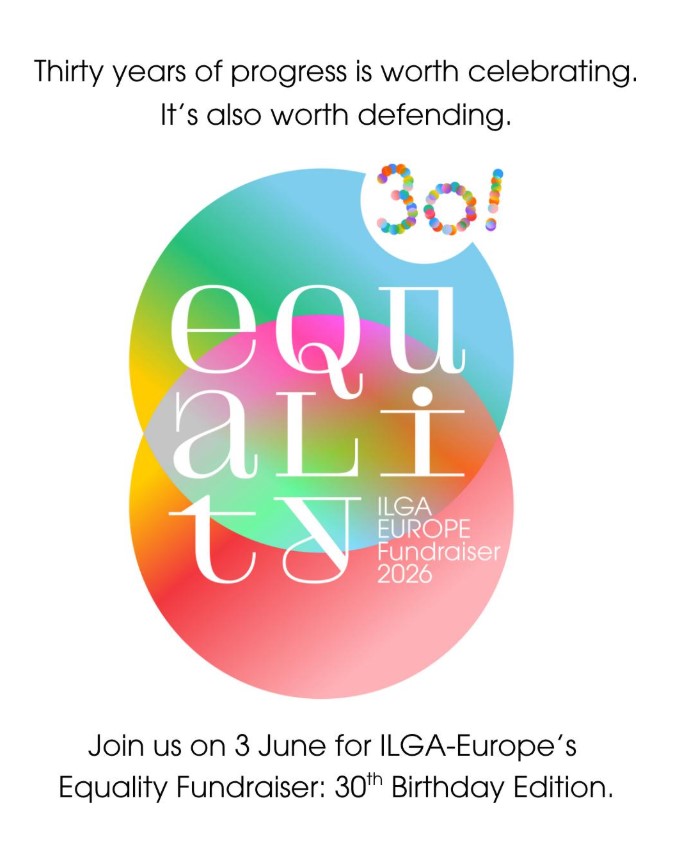
📅 Wednesday, 3 June 2026, from 6:30 PM to 11:00 PM📍 La Bellone, Brussels.
KET Magazine is a community‑driven, non‑profit magazine run by volunteers based in Brussels. Get in touch to share your thoughts or tell us about your activities. You can also promote your events on our website or support our work with a donation. Contact us at Info@ket.brussels.
You may also like
-
Brussels Rainbow Village: More Than a Night Out
Just steps from Brussels’ Grand Place, the Saint Jacques neighbourhood is a place to meet,
-

Thirty-seven and still dancing: La Demence opens its birthday weekend at Fuse
La Demence turns 37 with three nights in Brussels, beginning at Fuse on Friday 30
-
Pleasure, care and no lectures: a pocket guide to gay sexual health
Sexual health is about more than a test result. In Le Petit Guide de la
-
Mideterms Elections in US – The Closetocracy: when the closet becomes a question of power
The Closetocracy, now available on YouTube through The Young Turks, puts secrecy, sexuality and political
-

Beyond the rent rant: Bruscope puts Brussels life under the lens
Why does finding a home in Brussels feel so complicated? Who does the work that