

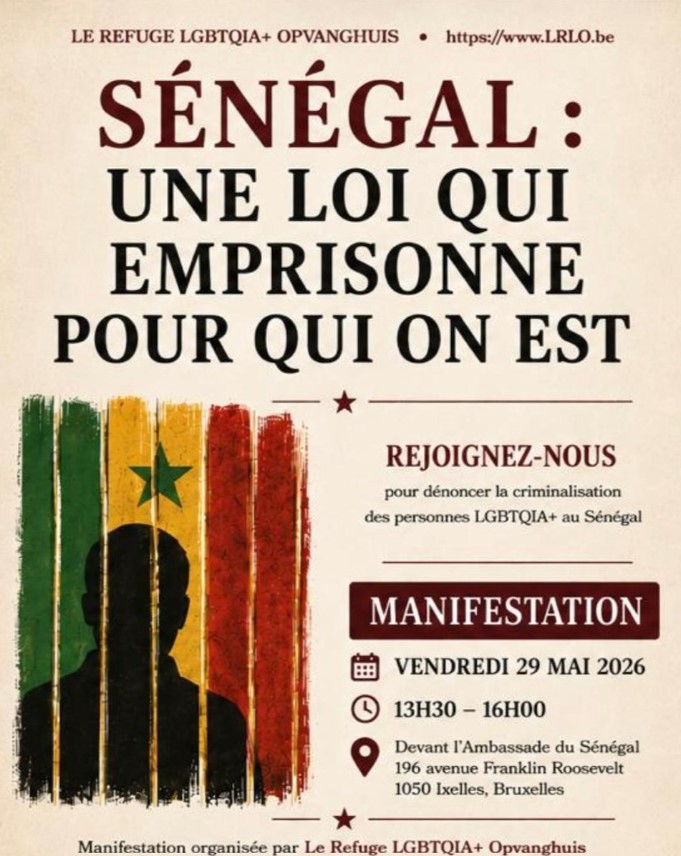
Senegal has sharply intensified its anti-LGBTQIA+ repression in 2026, with a new law that increases prison terms for same-sex relations and criminalises public support for queer lives. In response, a demonstration will take place in Brussels on Friday 29 May from 13:30 to 16:00 in front of the Senegalese Embassy, organised by Le Refuge LGBTQIA+ de Bruxelles. For queer people in Belgium, this is not a distant issue: it is about international solidarity, freedom of expression, and refusing the normalisation of state-backed homophobia.
A New Escalation in Senegal
Senegal already criminalised same-sex relations under Article 319 of its penal code, but the situation worsened dramatically this spring. In March 2026, parliament approved a new law, and President Bassirou Diomaye Faye signed it on 27 March, doubling the maximum prison sentence for consensual same-sex intimacy from five to ten years.
The law also goes further than punishing private relationships. It introduces penalties for the “promotion”, “glorification” or support of homosexuality and related identities, exposing activists, organisations, journalists and even support networks to prosecution. That matters far beyond Senegal’s borders, because it turns basic solidarity into a legal risk and tries to erase queer life from public space altogether.
Fear, Arrests and Public Hostility
This legal hardening did not happen in a vacuum. Human rights groups have described a broader climate of stigma, panic and arrests targeting people accused of same-sex relations, with at least 27 men reportedly detained in February 2026 on charges including “unnatural acts”.
Critics including the UN human rights office warned before the law was signed that it would violate rights to dignity, privacy, equality and freedom of expression. Organisations such as FIDH and Outright International have also said the new provisions could criminalise advocacy, care work and documentation of abuse, making life even more dangerous for LGBTQIA+ people and those who stand beside them.
For queer communities today, this matters because anti-LGBTQIA+ laws never stay symbolic: they feed violence, justify exclusion and make everyday survival harder.
Why Brussels Should Pay Attention
Brussels is home to many African, diasporic and activist communities, and solidarity actions here can amplify what is happening elsewhere without speaking over those directly affected. A protest in Brussels also places pressure in a diplomatic space, reminding institutions that queer rights are human rights and that silence is a political choice.
This is also a local issue for LGBTQIA+ people in Belgium because many queers, refugees and exiles carry these political realities across borders. When laws criminalise identity, love or public support, the consequences are not abstract: they shape asylum stories, mental health, family rupture and community safety.
A Protest Organised by Le Refuge
The Brussels demonstration is organised by Le Refuge LGBTQIA+ de Bruxelles, a local organisation that provides safe accommodation and support for LGBTQIA+ young people facing exclusion. Their call to gather on Friday 29 May is a direct response to the criminalisation of LGBTQIA+ people in Senegal and to the wider climate of hostility surrounding the new law.
There is something powerful about this link between local shelter work and international solidarity. It connects the fight for safer lives in Brussels to the fight against state repression abroad, and reminds us that queer community care is never only local.
Practical Info
- What: Demonstration against the criminalisation of LGBTQIA+ people in Senegal.
- When: Friday 29 May 2026, from 13:30 to 16:00.
- Where: In front of the Embassy of Senegal, Avenue Franklin Roosevelt 196, 1050 Brussels.
- Organised by: Le Refuge LGBTQIA+ de Bruxelles.
- Context: Senegal’s new law, signed in March 2026, increases prison terms for same-sex relations to up to ten years and criminalises forms of public support or “promotion” linked to LGBTQIA+ identities.
For details about Le Refuge’s work, visit www.lrlo.be.
Showing up matters here because solidarity is not abstract: sometimes it starts on a Brussels pavement, in front of an embassy, refusing to let repression pass in silence.
KET Magazine is a community‑driven, non‑profit magazine run by volunteers based in Brussels. Get in touch to share your thoughts or tell us about your activities. You can also promote your events on our website or support our work with a donation. Contact us at Info@ket.brussels.
You may also like
-

At Liège’s Queer Families Festival, Every Family Has a Story
The third edition of the Queer Families Festival takes place on 11 October at the
-
Türkiye’s LGBTQIA+ Community Faces a New Wave of Pressure
LGBTQIA+ people in Türkiye are living through a sharp escalation in state pressure: Pride events
-

Fiji Declares a National HIV Emergency — and the World Must Pay Attention
Fiji has declared a national HIV emergency after a dramatic rise in diagnoses: 2,016 people
-

“After”: Listening to LGBTQIA+ Survivors Speak About Intimate Partner Violence
On 8 October, Tels Quels invites people to Les Grands Carmes in central Brussels for
-

Balkan Trafik! Turns Brussels’ Bourse into a Three-Day Balkan Universe
After a year away, Balkan Trafik! returns to Brussels from 19 to 21 November 2026